

Missouri’s departure won’t change KU fight song
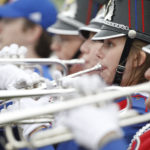
The Kansas marching band performs before kickoff against Texas A&M in this Oct. 23, 2010, file photo. Kansas fans are now wondering what will come of the fight song following the departure of Missouri from the Big 12.
Although Kansas University’s athletic teams won’t be twisting the Missouri Tigers’ tail as part of Big 12 Conference play starting next year, the lyric in the fight song won’t be going anywhere any time soon, KU Alumni Association officials said.
“I think we made it pretty clear,” last year, said Kevin Corbett, KU Alumni Association president and CEO, when the association led the first revision for the song’s lyrics in more than 50 years. “We weren’t going to change it again, no matter what happened with conference realignment.”
Last year, KU removed references to the University of Nebraska and the University of Colorado, and added in references to the four Big 12 schools from Texas. Since then, both Texas A&M and Missouri have announced their intention to leave the conference.
And even though the Tigers play a larger part in the song than most other conference foes (“Got a bill that’s big enough / To twist a Tiger’s tail,” reads one part of the song), they’ll be sticking around in the song for a while longer at least.
“With the way the conference realignment is going, it would be kind of like roping the wind,” Corbett said.
Matt Schoenfeld, a Countryside resident and Baylor University alumnus, has been a KU fan since the days when Ted Owens coached basketball. Schoenfeld wrote the winning entry in a contest to change the fight song’s lyrics.
“My version didn’t last very long, did it?” Schoenfeld said on Monday.
He said he was obviously disappointed that the conference didn’t hold up longer, and wasn’t too pleased that Missouri messed up the lyrics by leaving the conference. He said if the Alumni Association ever decided to change the song again, he’d be willing to work with it.
In a moment that turned out to be rather prescient, Schoenfeld said the initial version he turned in to the Alumni Association didn’t include the Aggies, as a sort of nod to his undergraduate institution’s rivalry with them.
“As a slight to them, they were the one team I didn’t include,” he said, even though the person who edited the song added them in to be able to include all the teams.
“I sent an email to the guy who ran the initial contest,” Schoenfeld said. “And I told him, ‘Now you see why I left the Aggies out.'”
KU

Regents approve new policy for what constitutes DEI-related content in KU, other university classes

Regents approve 5% tuition and fee increase for KU for upcoming school year

Girod said latest controversy with Texas Tech is stark reminder of why college athletics needs federal help

KU professor hopes ‘average places’ postcard project helps people connect to Langston Hughes’ Lawrence upbringing

KU professors would be limited in how they could present the idea of systemic racism in future classes
