Zookeepers must develop ways to communicate with wildlife
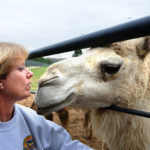
Vickie Musselman bonds with a camel named Cleo while caring for her at the Rolling Hills Wildlife Adventure, six miles west of Salina. Zookeepers develop a variety of ways to communicate with the animals they care for.
Salina ? Baby-Baby the potbellied pig loves to have her tummy rubbed. She’s never said as much in words, but Debbie Zerbe, a volunteer keeper at Rolling Hills Wildlife Adventure, a zoo near Salina, doesn’t need words to know. And Baby-Baby knows by the tone in Debbie’s voice when Debbie greets her that she is willing to rub.
Pokemon, one of three sugar gliders at the Salina-area zoo, was sick not long ago. He couldn’t tell Debbie he was sick, but she knew.
“We knew by the way he was acting,” said Zerbe, who has been a volunteer keeper at the zoo for about 2 1/2 years. “They can’t tell you when something isn’t going well. They have to show it by their behavior, what they are or aren’t eating and by what comes out the other end.”
Tohlo, one of the zoo’s four chimpanzees, missed Nicole Covington when she left for nine days to go to Mexico. He didn’t say so, but he sulked while she was gone. And he celebrated when Covington returned.
“We, as keepers, do find ways to communicate with the animals we care for,” said Vickie Musselman, head keeper at Rolling Hills Wildlife Adventure.
That communication helps to ensure the animals are cared for not only physically, with food and safe enclosures, but also stimulated intellectually. It also builds strong relationships between the animals and the keepers. Covington said she and partner Christine Ashcroft talk to all the primates they care for.
“They understand about three-fourths of what we say, so I’ll talk to them just like you would a person,” Covington said. When it’s time for them to eat, she’ll holler at the chimpanzees, “Hey boys, it’s supper time.” The animals come running most of the time.
Sometimes, Shudak, the smart but introverted chimpanzee the keepers sometimes call “the Einstein of the group,” will play games and take his time coming in.
Sometimes, none of the animals want to do something they are asked. And make no mistake, the keepers say, everything the keepers ask of the animals are requests, because they can’t be made to do anything.
“Just like you talk to them like you would a person, you also give them space just like you would a person,” Covington said. “Usually, if they don’t come in, they have a good reason.”
Trust
Megan Vohs said trust is an important part of the relationship she has with the carnivores, including the cats and bears. Soon, though, Vohs and her partner, Kelsey Nogel, will have to break a bit of that trust. The keepers have been training some of the cats to press a hip against the cage at the keepers’ requests.
The training will allow the keepers to give the animals an injection without having to involve the veterinarian, which can be more stressful to the animals. The training, which has been successful with the carnivores and other animals at the zoo, has been done with a stick.
“We’ll be breaking some of that trust when we give (Charlie, a cougar) an injection,” Vohs said. “The hope is that we have built up enough trust in the trust bank that it won’t take long to get back to where we were.”
As the keepers work to get the animals to trust them, they in return extend the same trust to the animals.
“It is definitely a relationship just like you would have with a person, one that’s built on honesty, trust and love,” Covington said. “You have to listen to them. Everything depends on if we can understand their communication, more so, I think, than if they can understand ours.”
Very vocal
Some of that communication is vocal. The chimpanzees, for example, have lots of vocalizations. Their keepers can recognize and even understand what some of them mean. They will do a Bronx cheer, also called a raspberry, as an attention-getter or a prelude to a display.
Often, a Bronx cheer from Tohlo is followed by him “tearing across the room and throwing a barrel,” Covington said.
“Chimpanzees have 32 different vocalizations just pertaining to food,” Covington said. “So not only are they saying ‘We are having fruit,’ but they are saying ‘We are having grapes.”‘
Behaviors
The animals at the zoo, though, also communicate in ways that are less vocal and require more attention for the keepers to pick up on.
“Our jobs are to do things like make sure they have fresh food, fresh water and to clean their enclosures, whether that be sweeping or cleaning a lot of poop a lot,” Zerbe said. “It also means getting to know your animals and their behaviors so you can recognize when something is a little off.”
Zerbe said some of the things she watches for from the animals she tends to, which include everything from goats to reptiles to insects, is an animal that is spending time in places it doesn’t normally do, wanting to spend more time indoors than normal and not wanting to get up at all. You can’t get to know those things without becoming attached, she said.
“They do kind of become like your kids in a way,” Zerbe said. “It’s amazing how even a 450-pound Aldabra (a giant tortoise) can become your best friend and wants a massage when you come in,” she said.
But she and the rest of the keepers have lots of best friends. Most won’t profess a favorite animal, for fear that the others would hear. But, Covington said, just like you would with humans, there are certain animals you relate to more.
“Tohlo (the chimp) and I always say our eyes met across a crowded enclosure,” she said. “We have a very close relationship. He’s my guy.”
State Government

KU professors would be limited in how they could present the idea of systemic racism in future classes
State legislators push back against federal energy regulators ending competitive bids
TOPEKA — Two Kansas legislators asked federal energy regulators to ensure competitive bidding occurs on ...
Senate confirms 1st of 3 Kansas nominees to U.S. District Court
Corporate income tax collections falling sharply in Kansas; Republican, Democratic leaders disagree on what it means
TOPEKA — Corporate income tax collections in Kansas have almost halved since last year, while other sources trend ...
Candidate’s campaign manager created website with documents used to attack rival
TOPEKA — Kansas U.S. Senate candidate Patrick Schmidt’s campaign manager left his digital footprint on ...