Archive for Monday, March 24, 2008
Judge imposes three-month jail term in hit-and-run fatality
Driver was drunk
March 24, 2008
Advertisement
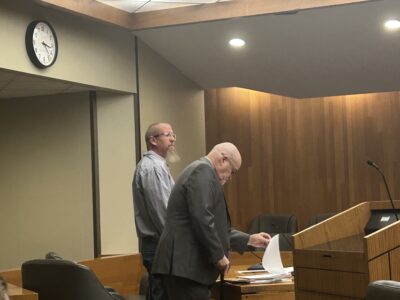
A judge this morning sentenced Joshua Walton, 25, to serve 90 days in jail, followed by two years of supervised probation, for a 2006 drunken driving accident that killed 22-year-old Kansas University student Ryan Kanost.
“This is a tragedy that everybody is going to have to live with the rest of their lives,” said Douglas County District Judge Robert Fairchild. “All the court can do is do what I'm allowed to by law and what I feel is the best way to try to achieve the result of preserving safety and making sure to the best of my ability this doesn’t happen again,”
Fairchild said that placing Walton on two years probation will allow him to supervise Walton on his progress. If Walton violates his probation, he will serve what is left of the two-year jail sentence.
Douglas County District Attorney Charles Branson had asked Fairchild to impose the maximum penalty of two years in jail on Walton, who fled the scene of the accident.
A jury in February convicted Walton of two misdemeanors: vehicular homicide and leaving the scene of an injury accident. At trial, prosecutors had sought more severe felony charges.
Kanost’s father, Michael Kanost, of Manhattan, in court asked that Walton be given jail time to keep him from driving drunk and to reflect on his actions. He also said Walton should be restricted from driving.
“This pain and sorrow that I know the rest of my family feels was caused by the actions of Joshua Walton,” he said.
Two of Kanost’s sisters also spoke during the hearing about the family’s difficulties since Kanost was struck Sept. 23, 2006, while he crossed Kentucky Street at 13th Street.
“You killed his kid, my brother, her brother and an uncle of five months at the time, a grandson, a friend, and not only did you kill someone's kid, but you destroyed a family,” Leah Kanost said.
Walton told Fairchild he thinks about the tragedy every day, and he wishes he could go back and erase what happened or change it. He also said he had taken full responsibility.
“The only thing that I can possibly do would be to try to give back as much positive in other areas that I can with the rest of the time that I have here,” he said.
Walton and his attorney mentioned talking to groups about the dangerous consequences of drunken driving. His attorney, Tom Bath, said Walton, who is also a KU student and works in Lawrence, likely would serve his three months in jail this summer.
Fairchild gave Walton the option to do that and to be released for work while he’s serving his jail time. Fairchild also assessed Walton with court costs.
Top ads RSS
Marketplace
Arts & Entertainment · Bars · Theatres · Restaurants · Coffeehouses · Libraries · Antiques · Services
- Accountability October 11, 2008 · 2 comments
- Alaska inquiry finds Palin abused power October 10, 2008 · 26 comments
- On the street: Do you think the presidential debates should be open to third-party candidates? October 10, 2008 · 64 comments
- Weblog: Muslim Religious Leader Declares Obama "The Messiah" October 10, 2008 · 69 comments
- Fans flock to Nader rally October 9, 2008 · 104 comments
- Maher finds ‘religulon’ in scathing documentary October 10, 2008 · 61 comments
- Saturday's KU game will test effort to ban obscene chant October 10, 2008 · 34 comments
- Civic duty October 10, 2008 · 52 comments
- Economy swamps GOP October 10, 2008 · 46 comments
- Palin tactic October 9, 2008 · 106 comments
- Chairwoman-elect for Lawrence Chamber of Commerce no longer works for bank October 2, 2008
- Alaska inquiry finds Palin abused power October 10, 2008
- Woman testifies she had illicit sex with church youth director October 2, 2008
- Feds agree with Sebelius, reject Texas' offer to boost incentives for National Bio and Agro-Defense Facility October 10, 2008
- KU hoops adds Hinson to staff October 9, 2008


24 March 2008 at 2:05 p.m.
Suggest removal
Permalink
ksdivakat (Anonymous) says…
Vehicular homicide is a misdemeanor????
24 March 2008 at 2:31 p.m.
Suggest removal
Permalink
Marion Lynn (Marion Lynn) says…
Well, ya got two things going on here…..a prosecutor who can't find the courtroom without a map and a bleeding-heart judge.
24 March 2008 at 2:35 p.m.
Suggest removal
Permalink
ebyrdstarr (Anonymous) says…
yes. 21-3405 is vehicular homicide. It is the unintentional killing of a person while driving in a manner that creates an unreasonable risk of injury and which constitutes a material deviation from the standard of care.
That is a separate charge from Involuntary manslaughter under the influence, 21-3442, which is a level 4 person felony.
24 March 2008 at 2:40 p.m.
Suggest removal
Permalink
Ragingbear (Anonymous) says…
Wow. So if I ever get it into my mind to run over somebody, it's only 2 years at maximum?
24 March 2008 at 2:49 p.m.
Suggest removal
Permalink
ebyrdstarr (Anonymous) says…
well, no, bear, if you decide to run somebody over, the state is free to charge you with intentional murder. Or if your driving is really, really reckless, but you lack the intent to kill or even hurt someone, the state can pursue a charge of involuntary manslaughter, which is a level 5 felony.
24 March 2008 at 3 p.m.
Suggest removal
Permalink
Hopbe (Anonymous) says…
i'm kinda shocked that killing someone and leaving the scene is only worth 3-months in jail.
i'd be irate if i were the victim's family.
24 March 2008 at 3:28 p.m.
Suggest removal
Permalink
Marion Lynn (Marion Lynn) says…
Well, how many of you people have written your legislators about this issue?
24 March 2008 at 3:38 p.m.
Suggest removal
Permalink
newsreader (Anonymous) says…
While this is a horrible thing all the way around, the LJWorld fails to say if the victims family is accepting of the sentence. The victims father said he wanted Mr. Walton to be in jail to 'reflect on his actions.' For all we know, the victims father took pity on Mr. Walton and asked for a light sentence.
Just a thought, no inside information.
24 March 2008 at 4:23 p.m.
Suggest removal
Permalink
OnlyTheOne (Anonymous) says…
What's wrong with the judges in Lawrence?
This is asinine!
Oh my, I'm in contempt of court - I'll probably get 4 years for that.
24 March 2008 at 5:07 p.m.
Suggest removal
Permalink
monkeyhawk (Anonymous) says…
Lawrence is a really good place to be a criminal.
Bad place to be a taxpayer.
24 March 2008 at 6:43 p.m.
Suggest removal
Permalink
Sigmund (Anonymous) says…
Could be worse, Fairchild was a possible Kansas Supreme Court Justice not to long ago. Just consider that keeping him here as our sacrifice for the greater good of the State of Kansas.
Leaving the scene of a fatal accident so he could cleanse his car and blood of incriminating evidence should have cost this moron two years in prison at the very least. Basically he got the benefit of leaving the kid to die in the street. Great message they are sending.
Hopefully, the DA appeals this like they did Judge Martin's three month gang rape of a minor sentence. Judges decry limiting their discretion, and generally I agree, but it is jurist like these that should cause citizens and legislators to limit them further.
24 March 2008 at 7:07 p.m.
Suggest removal
Permalink
WHY (Anonymous) says…
He will live with the guilt of his unintentional crime. He will have a criminal record, and will spend 3 mo in jail and not have another mistake for 2 years. After that he will go to work help others and benefit society. There is no reason for tax payers to have to pay for a long incarceration with little added benefit. And I believe if memory serves me that the victim was intoxicated at the time he walked out into the street. It is a sad situation that cannot be fixed so we must move on.
24 March 2008 at 7:26 p.m.
Suggest removal
Permalink
Sigmund (Anonymous) says…
WHY (Anonymous) says… “He will live with the guilt of his unintentional crime. He will have a criminal record, and will spend 3 mo in jail and not have another mistake for 2 years.”
There are no unintentional crimes, least that I know of. He was convicted of “vehicular homicide and leaving the scene of an accident” all require proving intentional acts beyond a reasonable doubt. Further, his defense “he thought he might have picked up someone else's drink at a bar by mistake “because he blacked out, went into a delusional rage” was rejected by the jury.
http://www2.ljworld.com/news/2008/feb/11…
Two years in prison does benefit society, it makes an example by punishing those that leave the scene of an fatal accident so that they have the opportunity to clear their blood and vehicle of more incriminating evidence. It sends a horrible message that leaving a kid to die in the streets so you can hide evidence of your guilt is the “smart” thing to do. Judge Fairchild's sentence, although legal, needs to be appealed and hopefully overturned.
Sorry, I being “mean” again.
http://www2.ljworld.com/news/2008/mar/22…
24 March 2008 at 7:31 p.m.
Suggest removal
Permalink
Sigmund (Anonymous) says…
Had this kid stopped, rendered assistance, at the cost of his defense, I would have more sympathy and would argue for mitigation, including two years supervised probation after three months in jail. As it is I have none, throw the book at him.
24 March 2008 at 7:57 p.m.
Suggest removal
Permalink
OldEnuf2BYurDad (Anonymous) says…
Oh Mah Gah! This is hard to believe.
Oh, wait… this is the guy who sobered up, then turned himself in. THAT's why he got off.
24 March 2008 at 8:09 p.m.
Suggest removal
Permalink
Sigmund (Anonymous) says…
Perhaps I should attempt to clarify the Kansas Vehicular Homicide statute, for non-lawyers. That statute contemplates a killing using a vehicle where the killing was not intended, but the driver intentionally operated “an automobile, … in a manner which creates an unreasonable risk of injury to the person or property of another and which constitutes a material deviation from the standard of care which a reasonable person would observe under the same circumstances.”
http://www.kslegislature.org/legsrv-stat…
The jury found, beyond a reasonable doubt, Joshua Walton guilty. Had they believed his defense that “he thought he might have picked up someone else's drink at a bar by mistake 'because he blacked out, went into a delusional rage'” they would have found him not guilty.
By leaving the scene Joshua Walton had an opportunity to cleanse his blood and vehicle of incriminating evidence of other crimes. He turned himself in when he realized the police had a description of his car, that he would have a hard time explaining to family and friends the damage to his car, and the police would notify every body shop in the area to be on the look out for a car like his needing repair.
Judge Fairchild's sentence will encourage others to flee the scene in order to hide evidence. After all, it worked for Joshua Walton.
24 March 2008 at 8:39 p.m.
Suggest removal
Permalink
silentbranden (Anonymous) says…
It's obvious that none of you have been to law school. The question the jury had to decide was whether the defendant was voluntarily intoxicated or involuntarily intoxicated. If he was voluntarily intoxicated, then he was guilty of the felony. If he was involuntarily intoxicated, then he was guilty of the misdemeanor. The jury found that the defendant was involuntarily intoxicated, and therefore found him guilty of the misdemeanor.
Allow me to point out that the verdict was unanimous. That means that twelve citizens of Douglas County sat through days of testimony, evidence and argument and then came to a unanimous decision. All of the posters here have spent mere minutes scanning news articles before rushing to judgment.
I will agree that the Lawrence Journal World does a less than stellar job explaining, or covering, for that matter, court proceedings. However, the eagerness of the posters on this board to substitute their judgment for every professional in the system is depressing. Without the benefit of law school, evidence or experience, everyone here seems to feel quite qualified to pass judgment on things with which they know little to nothing about.
It's just sad.
24 March 2008 at 8:44 p.m.
Suggest removal
Permalink
Lynn731 (Anonymous) says…
If he took full responsibility, why did he leave the scene of the death? Thank you, Lynn
24 March 2008 at 9:18 p.m.
Suggest removal
Permalink
Sigmund (Anonymous) says…
There is no “felony vehicular homicide” statute. Branson was seeking a conviction of involuntary manslaughter (not felony vehicular homocide) for driving under the influence of alcohol. In fact, involuntary intoxication is a complete defense against any crime, felony or misdemeanor, including vehicular homicide.
21-3208. Intoxication. (1) The fact that a person charged with a crime was in an intoxicated condition at the time the alleged crime was committed is a defense ***only if such condition was involuntarily*** produced and rendered such person substantially incapable of knowing or understanding the wrongfulness of his conduct and of conforming his conduct to the requirements of law.
http://www.kslegislature.org/legsrv-stat…
Had the jury believed Joshua Walton's defense that “he thought he might have picked up someone else's drink at a bar by mistake 'because he blacked out, went into a delusional rage'” they could have found him not guilty of any crime because he was involuntarily intoxicated (the someone slipped me a mickey defense).
24 March 2008 at 9:29 p.m.
Suggest removal
Permalink
notajayhawk (Anonymous) says…
I'd like to remind everyone that this was a jury trial. There was another story on this
http://www2.ljworld.com/news/2008/feb/12…
in which the jury foreman made several posts explaining exactly why the jury did not convict the driver of a more serious offense. The jury, not the judge or prosecutors, did not believe there was sufficient evidence to support the more serious charges that would have brought a more serious sentence. Now, yes, the judge could have imposed a more serious sentence with this conviction (given him the whole 2 years), but why? Just because he couldn't be convicted of the more serious charges? That seems kind of twisted.
Take the example of someone who fires a gun into a building and causes a minor wound to someone inside. Maybe he was trying to kill that person, and maybe that's what the prosecution was trying to prove, but there simply was no evidence, and the person can only be convicted of discharging a firearm at an occupied dwelling causing bodily harm. With no priors, that falls into the “border box” on the sentencing grid, and without reason to the contrary, it calls for probation.
Now, the judge *can* impose a three year or so sentence, and it would seem that this would be “just” because everyone “knows” he really was trying to kill the guy. But in order to divert from the grid, the judge would have to make a decision that belongs to the jury - he would have to say there was enough evidence to believe that it was an attempted homicide, when the jury, whose job it was to decide that, found otherwise.
24 March 2008 at 9:46 p.m.
Suggest removal
Permalink
Sigmund (Anonymous) says…
21-3442. Involuntary manslaughter while driving under the influence of alcohol or drugs. Involuntary manslaughter while driving under the influence of alcohol or drugs is the unintentional killing of a human being committed in the commission of, or attempt to commit, or flight from an act described in K.S.A. 8-1567 and amendments thereto.
http://www.kslegislature.org/legsrv-stat…
8-1567. Driving under influence of alcohol or drugs; blood alcohol concentration; penalties. (a) No person shall operate or attempt to operate any vehicle within this state while: (1) The alcohol concentration in the person's blood or breath as shown by any competent evidence, including other competent evidence, as defined in paragraph (1) of subsection (f) of K.S.A. 8-1013, and amendments thereto, is .08 or more;
http://www.kslegislature.org/legsrv-stat…
By leaving the scene Joshua Walton had an opportunity to cleanse his blood and vehicle of incriminating evidence of other more serious crimes. He turned himself in when he realized the police had a description of his car, that he would have a hard time explaining to family and friends the damage to his car, and the police would notify every body shop in the area to be on the look out for a car like his needing repair.
Nobody here suggested that Joshua intended to kill someone. Judge Fairchild should have imposed the maximum sentence because by committing another crime, leaving the scene of an accident, Joshua Walton, had the opportunity to remove evidence from his blood and vehicle that could have shown he was guilty of involuntary manslaughter, a felony. It sends a message that if you commit a crime, committing another crime will reduce your sentence.
24 March 2008 at 10:06 p.m.
Suggest removal
Permalink
notajayhawk (Anonymous) says…
Sigmund, I really don't know what you're arguing for here.
Leaving the scene of an accident to avoid being charged with a DUI isn't exactly a new trick. People have been doing it as long as there have been drunk driving laws. And the concept is hardly limited to drunk driving; I would think it pretty common for a murderer to attempt to dispose of the murder weapon rather than wait around for the police and kindly handing it over.
Is this “right?” No. What's that got to do with anything? The fact is that our system of justice places the burden of proof on the state. You can not punish a person for a crime in this country unless the prosecution can present enough evidence to convince the jury that the person committed the crime. That's the way it works - that's the way it *must* work.
Now, obviously, that means on occasion a guilty party who successfully prevents the collection of evidence is going to “beat the system.” *Maybe* that's what happened here. I say “maybe” because we will never know. There simply is no evidence that the driver in this case had consumed enough alcohol to be above the legal limit for operating a motor vehicle - nobody knows, not even the driver. Regardless of why there was no evidence, whether it was because he left the scene or not (and incidentally that resulted in a crime in itself, of which he was convicted), there was not enough evidence to justify a more severe punishment.
It happens. It happens all the time, and it's infuriating. But I fail to see what could be done about it except to change the system by reducing the burden of proof. Is that what you're advocating?
24 March 2008 at 10:20 p.m.
Suggest removal
Permalink
JHawker (Anonymous) says…
i think 3 months is ridiculous for the horrendous reality of what happened. i lived at that intersection and heard the accident when it occurred and am appalled that he is only serving 3 months in jail. He may not have “intentionally” killed this young man, but he did intentionally decide to drive his car while grossly intoxicated - so much so, that he did not 'realize' that he had hit a person, until the next day. My thoughts are with the victim's family.
24 March 2008 at 10:25 p.m.
Suggest removal
Permalink
Sigmund (Anonymous) says…
notajayhawk (Anonymous) says… “Leaving the scene of an accident to avoid being charged with a DUI isn't exactly a new trick. People have been doing it as long as there have been drunk driving laws. And the concept is hardly limited to drunk driving; I would think it pretty common for a murderer to attempt to dispose of the murder weapon rather than wait around for the police and kindly handing it over.”
True, every word of it. In fact Joshua hoped he would never be caught. But there are penalties to be paid when you commit another crime in order to avoid prosecution. Killing a witnesses in order to avoid prosecution doesn't absolve you of the original crime, and when you are caught your sentence on the original crime should be the maximum allowed under the law. If it isn't, it encourages others to commit additional crimes to cover them up, the very situation you so correctly described.
Joshua may have gotten (we will never know) the benefit of not being charged with the more serious crime because of his additional crime. Any lesser crime he is convicted of should carry the maximum sentence. Encouragement to commit additional crimes is the last thing Judge Fairchild sentence should do.
Had Joshua not left the scene of the killing or even attempted to help the person he killed, I would expect leniency even of the more serious crime. Just so I am clear, I have no problem with the jury's decision nor do I wish Judge Fairchild to depart from the sentencing grid, only that he impose the maximum sentence under the current guidelines and that the sentence be served in prison, not in jail during the summer and released during the day so he can continue to work during the day.
24 March 2008 at 10:32 p.m.
Suggest removal
Permalink
mom_of_three (Anonymous) says…
There was no report that said Ryan “stumbled” in front of the moving car, or that he was intoxicated. The only newspaper reports I read, and I just reread, stated that yes, Ryan and his friends had been drinking, and they were walking home. Ryan was slightly behind them as they crossed the street, and the car appeared to be a block or so away.
That is no excuse for the driver to be at the wheel after drinking. He didn't even know he had hit something.
Ryan was the victim, not the stupid driver of the car. He was walking home, not driving.
Ryan was a great person, who wanted nothing more than to help people. He made a difference in so many young lives at the junior high where he worked. And my two kids will never forget him, whether it was getting help with the homework, with a little extra push from Ryan, or playing basketball.
Anyone who has said anything negative about Ryan should be very ashamed of themselves.
My thoughts go out to his family.
24 March 2008 at 10:36 p.m.
Suggest removal
Permalink
mom_of_three (Anonymous) says…
And I hope if Mr. Walton is ever caught drinking and driving again, that he is a permanent pedestrian and rides public transportation.
24 March 2008 at 11:48 p.m.
Suggest removal
Permalink
notajayhawk (Anonymous) says…
Sigmund (Anonymous) says…
“Killing a witnesses in order to avoid prosecution doesn't absolve you of the original crime, and when you are caught your sentence on the original crime should be the maximum allowed under the law.”
“Absolve?” No. But you likely will not be convicted of the original crime in a court of law. That's why tampering with a witness or tampering/destruction of evidence (or leaving the scene of an accident) *is* a crime. It is unquestionably to the benefit of the defendent to make evidence that would lead to his conviction unavailable. Say I was under investigation for a financial crime and was caught shredding my financial records. Or I was under suspicion for child porn and was caught destroying the hard drives on my computer. Or I was a politician under investigation for some impropriety and was caught destroying meeting notes, e-mails, or recordings of meetings. I can be charged with and convicted of destroying the evidence, but I can *not* be convicted of the original crime *without* that evidence. And as frustrating, infuriating, and just plain wrong as that is, that's the way it absolutely *must* work in our system of justice, which presumes innocence unless the state can present sufficient evidence to the contrary. You simply can not *presume* that the evidence would have been sufficient for a conviction had it not been destroyed.
Yes, that means there is a strong incentive for a person to commit an additional crime to avoid being convicted of a prior crime - that's exactly why tampering (or leaving the scene) *is* a crime. Yes, that means some criminals will go free. But again, what's the alternative? Do you suggest we allow judges to base their sentences on a crime for which the jury did not return a finding of guilty? Should we allow jurors to consider facts not in evidence, to base their decisions on what the evidence *might* have proven if it had been available? The potential harm that would ensue far outweighs the gain. Our entire system of justice is predicated on the philosophy that it's better to let a few guilty people go free rather than make it easier to convict innocent people without evidence.
It was wrong for the driver to leave the scene in this case (and again, he was charged and convicted for doing so). But we can not - we *CAN* *NOT* - presume he was over the legal limit just because he prevented us from finding out. Nor can we allow a judge to hand down a more severe sentence because he thought the defendent committed a more severe crime than that for which the jury convicted that defendent. Our justice system would be a sham if we did.
And incidentally, without a prior criminal record, for anything up to a level 6 felony, the guidelines say presumptive probation.
25 March 2008 at 12:10 a.m.
Suggest removal
Permalink
Sigmund (Anonymous) says…
notajayhawk, Joshua was convicted of two misdemeanors crimes. Vehicular Homicide and Leaving the Scene of an Accident. By leaving the scene of an accident he had the opportunity to cover up evidence of a more serious crime, involuntary manslaughter, a felony. That is one of the reasons leaving the scene of an accident is a crime.
“A jury in February convicted Walton of two misdemeanors: vehicular homicide and leaving the scene of an injury accident. At trial, prosecutors had sought more severe felony charges.”
I am not asking Joshua be given sentenced based on the felony he wasn't convicted of, but that he be sentenced to the ***maximum allowed sentence*** for the two misdemeanor crimes he WAS convicted on. There is no sham in giving the maximum allowed sentence to a convicted criminal who killed an innocent person, especially if it also would deters others from committing a second crime to cover for the first crime. I don't know how much clearer I can be?
25 March 2008 at 12:13 a.m.
Suggest removal
Permalink
Sigmund (Anonymous) says…
I should also add that the DA was not asking for a sentence for a crime Joshua was not convicted of, just for the maximum sentence for the two crimes he was convicted of. Neither the DA's office nor I are suggesting any kind of sham.
25 March 2008 at 12:14 a.m.
Suggest removal
Permalink
igby (Anonymous) says…
Third DWI's get 90 days in jail minimum. What's the world coming too?
This guy kills someone, leaves, fights his guilt all the way too sentencing.
It's like he hit a someone's dog.
Fairchild's not right on this one.
He should at lease do a year of his life for being drunk and driving and killing someone.
25 March 2008 at 12:41 a.m.
Suggest removal
Permalink
Sigmund (Anonymous) says…
notajayhawk (Anonymous) says…”And incidentally, without a prior criminal record, for anything up to a level 6 felony, the guidelines say presumptive probation.”
Since Joshua was not convicted of a felony, but two misdemeanors, how are felony sentencing grids and presumptive probation even relevant? But out of curiosity, what was Joshua Walton's prior criminal record?
25 March 2008 at 12:46 a.m.
Suggest removal
Permalink
notajayhawk (Anonymous) says…
Sigmund (Anonymous) says…
“I should also add that the DA was not asking for a sentence for a crime Joshua was not convicted of, just for the maximum sentence for the two crimes he was convicted of. Neither the DA's office nor I are suggesting any kind of sham.”
What you are asking for is an upward dispositional departure from the sentencing guidelines grid. This is something a judge can not do without cause, and it is also something subject to appeal. There is a reason, a very good reason, why the grid exists.
Put yourself in this hypothetical situation: Suppose you are rushing to get to the hospital after hearing that your spouse of child was rushed there. You're on your cell phone trying to get details. Maybe you're going too fast or maybe you slide through a stop sign without checking both directions, and you have an accident in which the other driver is killed. Under the law, you can be charged with and convicted of the exact same crime Mr. Walton was convicted of (one of them, anyway).
Now, maybe the other driver was a revered public figure. Maybe she was the judge's third grade teacher, or a golfing buddy. Maybe the reason the judge has been staring at you throughout the trial was because he's trying to figure out if you were the guy who accidentally spilled a beer on him at Arrowhead two years ago, and even if there was no breathalyzer performed, he is now convinced you were drunk at the time of the accident.
Or maybe you're just the wrong color.
Do you really want the judge's discretion to be unfettered by the grid?
It appears the judge *did* introduce an upward departure, incidentally, possibly due to one of the approved reasons for doing so, failing to stop and render aid.
http://www.kansas.gov/ksc/2007desk/2007%…
But any further upward departure that you're asking for would be based on - what? Nothing but *presumption*. You're asking that the judge depart the grid and impose the maximum sentence based solely on the *possibility* that the evidence that was made unobtainable by the defendent's fleeing the scene *might* have been sufficient to prove a more serious charge. Earlier you made these two statements: “Joshua may have gotten (we will never know) the benefit of not being charged with the more serious crime because of his additional crime.” And: “By leaving the scene of an accident he had the opportunity to cover up evidence of a more serious crime, involuntary manslaughter, a felony.” Do I have to point out that those two statements aren't exactly compatible?
What if his BAC was only .04?
What if it had been above .08 and the jury didn't convict him anyway?
The only thing we *know* is that we *don't* know. And you simply can not justify an upward departure based on what you don't know, based on what *might* have been, even if it was deliberate action on the part of the defendent that resulted in our not knowing.
25 March 2008 at 12:55 a.m.
Suggest removal
Permalink
igby (Anonymous) says…
That's just like the drunk this past weekend who crashed his yellow mustang through the apartment house and just missed killing 4 kids; this bum gets charged with DWI and no insurance. Gets out of jail or less than $100 and does minimum of two days in jail for his charges.
The DA here is weak!
25 March 2008 at 1:01 a.m.
Suggest removal
Permalink
notajayhawk (Anonymous) says…
Sigmund (Anonymous) says…
“Since Joshua was not convicted of a felony, but two misdemeanors, how are felony sentencing grids and presumptive probation even relevant? But out of curiosity, what was Joshua Walton's prior criminal record?”
Because misdemeanors are by definition less serious than felonies.
E.g.: “In general, the potential punishment an offender faces can be determined by reference to Sentencing grids. The left side of each grid reflects the crime severity level, with severity level 1 being the most severe and severity level 10 (or severity level 4 on the drug offense grid) being the least severe. The tops of the grids show criminal history categories. Convictions of person felonies are considered the most serious for criminal history purposes. Robbery and rape are examples of person felonies. Nonperson felonies rank next in seriousness level. Forgery and theft are examples of nonperson felonies. Misdemeanor convictions are considered the least serious.”
http://www.sedgwickcounty.org/da/explain…
How would you justify imposing a more severe penalty for a misdemeanor than the felony guidelines would impose? As to his criminal record, that was an assumption on my part - based on the sentence imposed. The fact that Mr. Walton's sentence was not more severe tends to suggest a lack of a (or at least the existence of a minimal) criminal history.
25 March 2008 at 1:09 a.m.
Suggest removal
Permalink
ralphralph (Anonymous) says…
If he had killed a cat he'd be doing serious time.
25 March 2008 at 1:18 a.m.
Suggest removal
Permalink
diogenes (Anonymous) says…
No prior article has made mention of Mr. Walton having any kind of criminal record. Presumably, he had no prior police record. He had been severely injured when a tractor-trailer crossed a highway center-strip and struck his car head-on, but he was not at fault.
Also, sub-headline says “Driver was drunk.” But as far as I have seen, no one has proved that the driver was drunk. In fact, prior postings here from trial observers have established that there was credible and consistent testimony that he had not consumed enough to be legally intoxicated. So that part of the headline must be seen as conjecture and not fact, not to mention sloppy writing and editing.
As for the date-rape-drug theory, the foreman mentioned here a “plausible” alternative scenario offered by the defense, presumably the possibility that the driver had inadvertently ingested a date rape-type drug placed in a drink by someone he did not know. That is a scenario that, based on other posts here, is apparently not uncommon is bars frequented by young people. It would explain the driver's actions that evening at least as well as the speculative hypotheses offered here by posters who seem to be certain that they know exactly what unfolded on that sorry and awful night.
25 March 2008 at 1:33 a.m.
Suggest removal
Permalink
Sigmund (Anonymous) says…
All I am asking for, as was the DA, was for the maximum allowed sentence under current law. And look as I might, I could not find a Kansas Misdemeanor Sentencing Grid, nor what is an “upward departure” for a misdemeanor convictions. The fact is there is no presumptive probation for misdemeanors and the Judge has great discretion in misdemeanor sentencing. If you don't like the fact that a low level felony can be presumptive probation while two serious misdemeanor convictions from a crime that kills someone can result in 3 months or two years in jail then take it up with the legislature, it is the law.
“Douglas County District Attorney Charles Branson had asked Fairchild to impose the maximum penalty of two years in jail on Walton, who fled the scene of the accident.”
As there is no evidence that Joshua Walton was rushing to a hospital, was a respected member of the community, of the wrong race, or an illegal alien from outer space, I don't think it is terribly helpful to consider those alternate realities that might exist in some alternate universe of your construction. Lets instead stick with the facts of this case. Two 'real' convictions of two 'real' misdemeanors for 'really' killing a 'real' person and the law allows the 'real' Judge to sentence Joshua Walton two years in a 'real' jail.
Although we don't know Joshua's blood alcohol level when he killed an innocent pedestrian, ***because he fled the scene of the accident***, a misdemeanor, one of two he ***was*** convicted of, Judge Fairchild could AND should have sentenced Joshua Walton to the maximum allowed by Kansas law.
25 March 2008 at 1:45 a.m.
Suggest removal
Permalink
Sigmund (Anonymous) says…
diogenes (Anonymous) says… “As for the date-rape-drug theory, the foreman mentioned here a “plausible” alternative scenario offered by the defense, presumably the possibility that the driver had inadvertently ingested a date rape-type drug placed in a drink by someone he did not know.”
And as Joshua Walton fled scene of the accident where he killed an innocent person, the police were not able to test him for alcohol, or drugs (voluntarily or involuntarily ingested) and there was no evidence to present to the jury that would exonerate him of all crimes or convict him of the more serious crime.
Therefore he was convicted of vehicular homicide, a misdemeanor, and leaving the scene of an accident, a misdemeanor, and he was not convicted of involuntary manslaughter, a felony, nor successful in his defense of any crime by reason of involuntary intoxication.
25 March 2008 at 2:22 a.m.
Suggest removal
Permalink
notajayhawk (Anonymous) says…
Sigmund (Anonymous) says…
“And look as I might, I could not find a Kansas Misdemeanor Sentencing Grid, nor what is an “upward departure” for a misdemeanor convictions.”
There isn't one. Maybe the legislature figured it was common sense; the entire purpose of the sentencing grid is to assign penalties based on a ranking of crimes by severity, and misdemeanor convictions are by definition the least severe. If it's not the letter of the law that a misdemeanor can not draw a sentence longer than a more severe felony, it is certainly the spirit.
But fine, I'll grant you that it appears there's no written restriction against imposing the higher sentence in this case. Just to be clear: “All” you're asking is for a judge to impose a sentence for a misdemeanor that is stricter than would be allowed for a more severe felony based solely on supposition that if the defendent had not left the scene (a separate offense for which he was charged, convicted, and was included in the sentence), there *might* have been additional evidence that *might* have resulted in a conviction for a more serious crime. If you're okay with that, well, okay. I'm sticking to the belief that allowing such discretion opens the door for far more dire consequences than the occasional criminal getting off too easy.
“As there is no evidence that Joshua Walton was rushing to a hospital, was a respected member of the community…”
And yet if any of those possibilities had been true, according to you the judge would have been free to impose, and justified in imposing, the maximum sentence. I deliberately constructed a hypothetical that was the opposite of the circumstances in this case to illustrate how allowing unfettered discretion can lead to more harm than good. What you're saying is that the judge should have thrown the book at 'this' defendent based on nothing other than the *possibility* that had he remained at the scene it might have resulted in a more serious conviction. As I said, if you're comfortable with that, if you really believe that doesn't open the door and justify abuses such as in my hypothetical, it's pretty tough to argue with that.
The judge acted properly in this case. Some people are going to be upset by that and call for vengeance. But vengeance is not justice.
25 March 2008 at 11:01 a.m.
Suggest removal
Permalink
mom_of_three (Anonymous) says…
“released for work while he is serving his jail time”
So he would only spend weekends and nights in jail?
I think he should spend the entire 90 days in jail, and not get out at all. He should only be able to see his family and friends while in jail, and not at work. Consequences, there should be consequences