KUMC closer to agreement with St. Luke’s
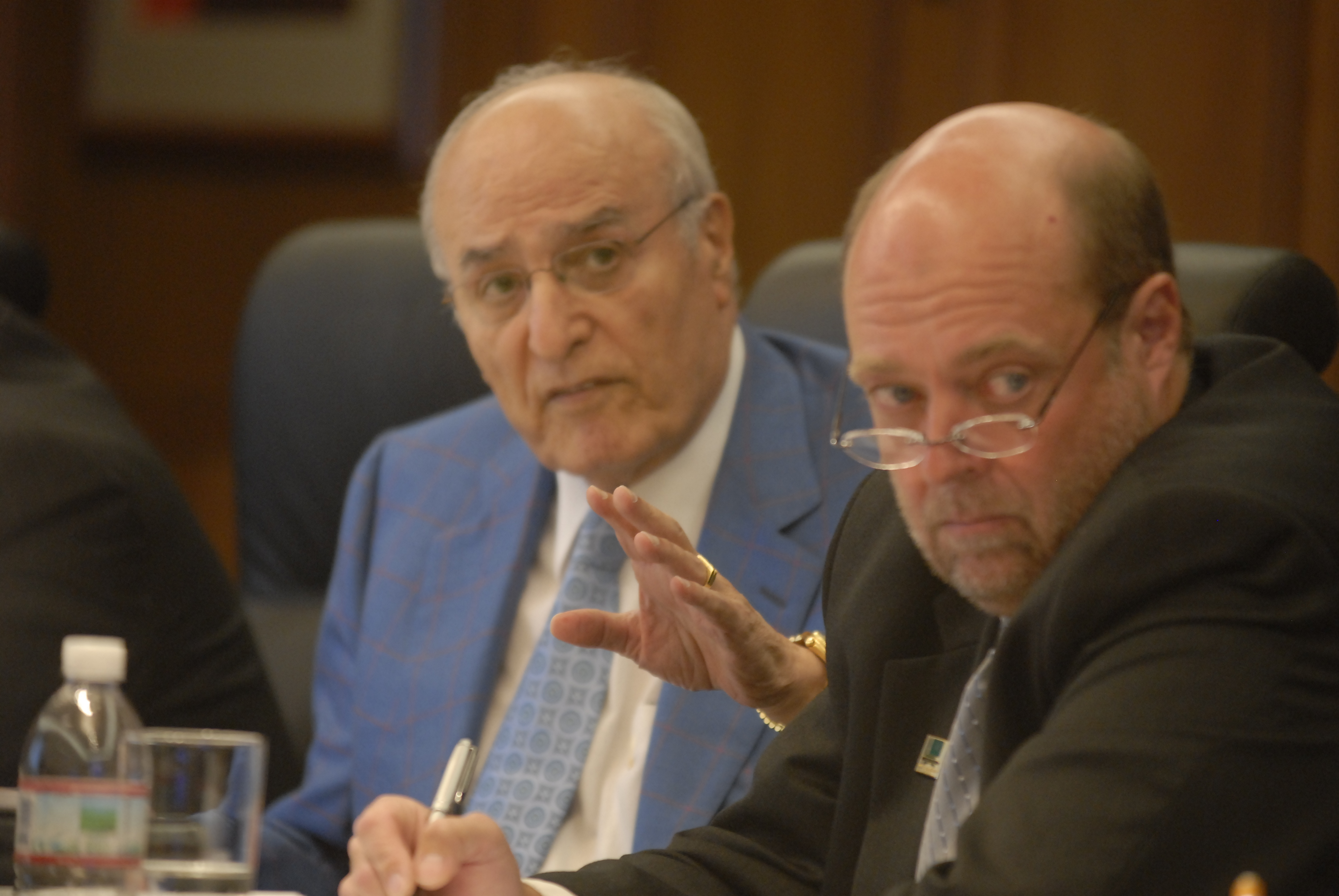
George Farha, left, Kansas University Hospital Authority chairman, and Bob Page, KU Hospital CEO, receive questions Tuesday during the hospital authority board meeting.
Westwood ? Missouri-based St. Luke’s Hospital would get to call itself a teaching and research hospital of Kansas University Medical Center under a draft agreement between the university and St. Luke’s, presented Tuesday to the KU Hospital Authority board.
KU Hospital officials have worried that sharing that brand will enable St. Luke’s Country Club Plaza location, the only one that could use the KU language, to better compete with KU Hospital for patients and dilute the name KU Hospital has built.
The agreement provides, in broad terms, for medical residencies, undergraduate clinical experiences and joint research at St. Luke’s, in exchange for St. Luke’s paying Kansas University’s School of Medicine a to-be-agreed-upon amount of money. KU School of Medicine Dean Barbara Atkinson told the Hospital Authority board that the agreement follows almost exactly the guiding principles KU Hospital and the university agreed to in March and disclosed in greater details in July.
“There are no significant differences that I know of,” Atkinson said. “I think they’re identical.”
This is the first version of an actual agreement between the university and St. Luke’s, and a KU spokeswoman said it represents a major step in the effort to form an affiliation between the School of Medicine and St. Luke’s.
Work to do
Also left out of the agreement is how this affiliation would affect the quest for designation as a National Cancer Institute, which is a major goal for the university and KU Hospital. Atkinson said the university wanted to form educational and research agreements with St. Luke’s and continue to work on the cancer care agreement separately.
“KU Hospital has been working on this for years,” hospital authority Chairman George Farha said. “This branding of the cancer center is the single most important item in this document and a future document.”
The guiding principles define the future of the relationship between the university and KU Hospital and serve as the basis for negotiations for a new affiliation between the two. That negotiation remains ongoing and is not materially affected by this new agreement. KU Hospital CEO Bob Page said he and Atkinson thought progress was being made, but were staying out of the deliberations.
The lack of an agreement between KU Hospital and the university before the St. Luke’s agreement moved forward disappointed Kansas House Speaker Melvin Neufeld, R-Ingalls, an outspoken critic of the process.
“It is critically important the affiliation agreement with (KU Hospital) be completed before KUMC enters into any other affiliation agreement so that our state’s higher education system, medical research potential, and medical education system are protected,” Neufeld said in a statement provided to the Journal-World. “It is my belief Dean Atkinson and KUMC should not go ahead with their affiliation agreement with St. Luke’s Hospital until they complete the affiliation agreement with (KU Hospital). This is the best way to protect our state’s health care system now and in the future.”
The agreement
The 37-page affiliation agreement covers everything from under what law any disagreements would be judged – Kansas law – to how joint public relations can be done – each side must agree to the joint effort- as well as the somewhat thorny issue of using the Kansas University brand.
“This agreement refers to St. Luke’s as being able to refer to itself as a teaching and research institution of KUMC, but it doesn’t require any support to do that,” said Dave Kerr, a former Kansas Senate president who now sits on the hospital authority board.
The guiding principles state St. Luke’s may call itself a teaching and research hospital of the Kansas University Medical Center. Under the proposed agreement, St. Luke’s may do just that, as well as add the word “major” if it provides a significant level of unrestricted educational and research support to the medical school.
Atkinson and Kansas University Chancellor Robert Hemenway said they brought this new agreement to the hospital authority to comply with a request the board made when negotiations began.
“The board requested of the Med Center the opportunity to see the agreement that is being worked out with St. Luke’s prior to any action being taken,” Hemenway said. The draft agreement will go to St. Luke’s board of directors later this month, but there is no timetable for approval.
The hospital authority does not have jurisdiction over the KU-St. Luke’s affiliation.
So far, the affiliation agreement makes no mention of how much St. Luke’s will pay KU in unrestricted research and educational funds, and it also leaves out how many medical residents will be added.
As a practical matter, Atkinson said, the discussion has focused on adding 100 medical residents over the next 10 years. She said it would be impossible to add any more residents any more quickly than that. St. Luke’s already has agreed to pay for the additional residents that KU recruits under that program. KU Hospital has also agreed to support additional residents.
As for the new residents, however, Atkinson said there were none dedicated to St. Luke’s or to KU Hospital. The 100 new residents would go into the same pool as the existing residents. They’d then rotate, perhaps, among KU Hospital, the VA Hospital and St. Luke’s, based on their program and hospital needs. At any one time, St. Luke’s might have 100 residents, but it wouldn’t be the same residents all the time.
Atkinson also committed the program directors to be at KU Hospital, which Farha said was extremely important.
Once St. Luke’s and KU come to an agreement, the affiliation need only be approved by Atkinson and Hemenway. Hemenway said the Kansas Board of Regents has been briefed on the process and would be briefed again once an agreement is reached. No action on their part is necessary.
State Government

From half-empty classrooms to canceled factory shifts, southwest Kansas communities feeling impacts of ICE raids
Lobbyist tells court that seeing transgender lawmakers in Statehouse bathroom made her ‘uncomfortable’ and she’s glad that new law banned them

Kobach’s team puts on parents, cops, other witnesses to support Kansas’ anti-trans law SB 244
State’s anti-trans law harms people while not making anything better, experts testify
Trans plaintiffs challenging state law testify in Douglas County about harms they’ve suffered