Preschool program gives head start in life
Early childhood center works to help 'at-risk' families
It might look as if the preschoolers who are stacking blocks are just having fun.
“You and I would look at it and think, ‘These kids are just playing,'” said Cris Anderson, principal of the East Heights Early Childhood Family Center. “But what they’re doing is they’re exploring concepts at the most basic level.”
Giving young children the opportunity to be successful in school is the goal of the prekindergarten Readiness program at the center, which is operated by the Lawrence School District, she said.
The Readiness program is for children who are considered socioeconomically “at-risk,” who come from families who qualify for the school district’s free lunch programs.
About 120 children attend the center, which has two other programs: a preschool special education program and a Parents as Teachers program.
The center has about 50 certified teachers, therapists and classified staff.
A typical day at East Heights starts with an optional breakfast followed by large-group activities such as singing songs and listening to stories, Anderson said.
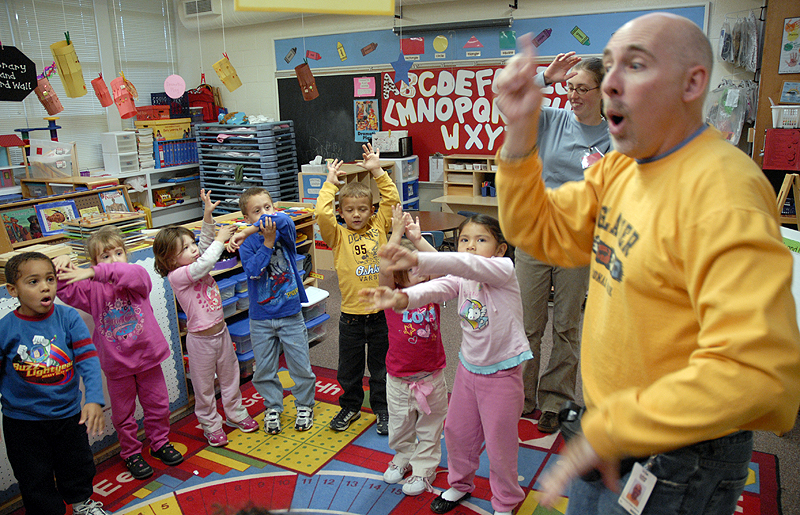
Jim Immel, right, teacher at East Heights Early Childhood Center, 1430 Haskell Ave., leads preschoolers in a song during class. The center helps preschoolers develop skills needed for academic success through cooperation among school, home and community.
Then the preschoolers move into smaller groups, where they start learning the building blocks of what they’ll need later in school.
“They might be at the puzzle table, but what they’re working on is some problem-solving skills,” she said. “It’s a little bit of time in large groups, times in small groups, times as individuals, one-on-one time, outdoor time and indoor time.”
And the time they spend learning such basic preschool skills pays off in the long run, Supt. Randy Weseman said, referring to a landmark study.
He said the High/Scopes Perry Preschool study, which tracked the effects of high-quality early care and education on low-income 3- and 4-year-olds, showed dramatic results.
It showed that adults at age 40 who participated in a preschool program in their early years have higher earnings, are more likely to hold a job, have committed fewer crimes and are more likely to have graduated from high school. Overall, the study showed a return to society of more than $17 for every tax dollar invested, Weseman said.
More about the East Heights program
“It’s not just educators that talk about the importance of it,” Weseman said. “It’s people in the business community and anyone that’s looked at the data and has worked with trying to invest money in a worthy place understands this is money well-invested.”
Susan Esau, executive director of the Lawrence Schools Foundation, said the foundation provides about a third of the funding for the pre-K program, amounting to about $150,000 a year.
“It’s a great program,” Esau said. “You can just tell that educators out there are very, very committed. It meets the needs of so many kids in this community. It gets them ready to learn.”
City Government

Developer seeks incentive from City of Lawrence to build 131 units of housing near Wakarusa and Queens

Lawrence city leaders will consider whether to keep Community Building open, make 2 other rec centers free to access
A STAR Bond application raises questions for city leaders about Costco and housing west of the SLT

Soccer gear honoring Lawrence history’s all-star team is now on sale as part of city’s public art exhibition
To honor public servants, Lawrence’s July 4 celebration will have a whole gallery of their photos on display; submissions open now