

Guaranteed tuition proposal advances
Kansas University students might not be able to predict rising costs for textbooks, campus fees or rent. But they could see steady base tuition rates under a proposal taken to the Kansas Board of Regents on Thursday.
“It’s not a cost-savings effort,” Provost Richard Lariviere said. “The cost will be essentially the same, but it will be predictable. (Students) will know coming on the campus as freshmen what the tuition will be.”
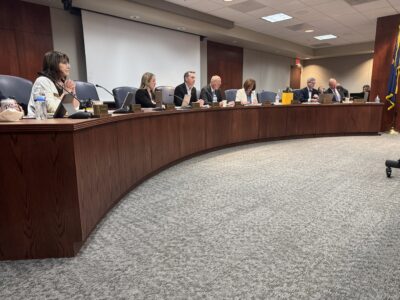
The regents approved the concept and gave KU the OK to continue investigating its “guaranteed tuition” proposal, which would give incoming freshmen a steady base tuition rate for four years.
KU has yet to attach specific rates to the plan, which will require final regents approval in the spring.
The proposal doesn’t mean KU’s tuition rates would freeze. The regents each year would approve a rate that would be set for each incoming class.
And the plan won’t include costs for campus fees, housing and differential tuition rates, which are the additional costs tacked on to the base tuition for students enrolled in specific schools or programs.
Differential tuition costs range from $13 per credit hour in journalism to $125 per credit hour in pharmacy.
Lariviere said base tuition accounts for roughly 25 percent of the total cost of attending KU.
“We would be misleading people if we gave them the impression that as a result of this effort today they’re going to be able to write eight checks, one for each semester” and all KU students would face the same costs, he said. “That is not going to be the case.”
KU administrators tout the plan as a way to encourage students to graduate in four years – a goal most KU students don’t achieve. About 29 percent of KU students graduate in four years, according to the 2005 Graduate in Four task force.
“It definitely shocks me,” KU senior Tyler Childs said of the statistic.
KU makes it easy for students to linger, Childs said, because some required classes might be offered only in the fall and advisers either are not aware of the limited offerings or simply don’t warn students.
He said the statistic also could be chalked up to laziness or the lack of a real motivator to keep students on track, and that’s where the tuition plan might help.
“What is the incentive to graduate in four instead of four and a half or even five years?” he said. “Nothing’s better than a financial incentive to motivate people.”
Under the plan, undergraduates would have a set rate for four years. But after that, they would be cut loose and charged the regular tuition rate – a figure that hasn’t been set but is guaranteed to be higher than the guaranteed tuition rate.
And students who drop out early also would feel a pinch.
The guaranteed tuition rate would be frontloaded, which means students would pay more than the actual rate their first two years and less than the actual rate in their final years. Those who leave early wouldn’t get the same benefit as those who stay the four-year course.
KU
KU professors would be limited in how they could present the idea of systemic racism in future classes

The annual summer solstice tour of the KU Native Medicinal Plant Garden will be held later this month

KU Homecoming parade to return to campus after seven-year absence
‘Backyard’ allows even more fans to cheer on Jayhawks

Dole Institute of Politics announces summer lineup celebrating America’s 250th anniversary
KU Hospital Authority says CVS stole nearly $62M in drug savings
The University of Kansas Hospital Authority is suing CVS and its subsidiaries, alleging the mega pharmacy company ...