KU fires up long-dormant kiln
It takes a small army to fire up Kansas University’s massive anagama kiln.
That may be why the 23-foot-long fired brick structure has been dormant three years.
In a rare move, Kansas University has invited art and design faculty and students from across the state to Lawrence this weekend for the first Anagama Woodfire, a gathering for artists to use the ancient Japanese-style kiln.
“It’s all about sharing,” said Greg Thomas, professor and chairman of KU’s design department. “We’re one of the few places in the country that has this. We’re not using it enough, so why can’t we have our neighbors and friends use it?”
About 35 faculty and students are expected to take part. Participants began loading the kiln Saturday.
It will be no ordinary process.
KU students built the kiln on KU’s west campus in 1999. The long tube structure uses burning wood to fire clay.
It takes two days just to load the kiln. The fire and smoke move through the kiln, exiting through a chimney. And it’s not simply a matter of tossing the pieces inside.
“How you stack the kiln dictates the way the fire moves,” said Marshall Maude, a ceramist who lectures at KU and who is organizing the event.
The loading is followed by the laborious process of firing.
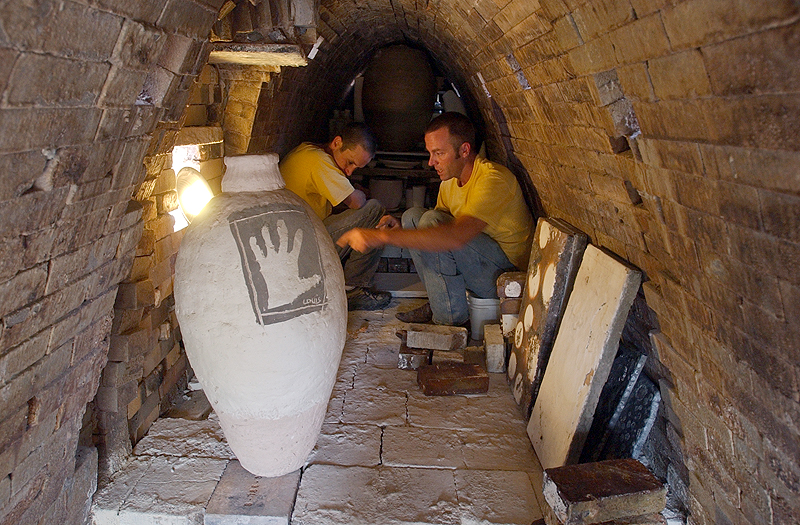
Ted Adler, head of ceramics media at Wichita State University, right, talks with Marshall Maude, Kansas University ceramics instructor, about how they can securely fit all of the ceramics in the kiln to fire for the first Anagama Woodfire on Saturday. The kiln is on KU's west campus. Students and faculty from several universities are participating in the event, which will fire the ceramics for four days starting Thursday.
The kiln, which fires at 2,400 degrees Fahrenheit, requires a continuous supply of wood. Beginning Thursday,participants will work in shifts around the clock for four days, tossing wood into the kiln. The ash from the firing creates a glaze on the pieces.
The result: one-of-a-kind objects with the unique marks of the flames.
“The effects are real dramatic and directional,” Maude said. “It leaves a history of the flame on the pieces.”
The event is organized by the recently formed Kansas Design Alliance, a consortium of collegiate design programs.
Thomas said he hopes the event strengthens the alliance between artists and institutions in Kansas.
Glenda Taylor, chairwoman of the art department at Washburn University, said many in the ceramic arts do know one another, but KU has been rather separate from that group. The event not only brings schools together, but gives some schools a chance to use equipment they might otherwise not be able to work with.
“It gives our students the opportunity to see something that we don’t have here at Washburn,” she said.
More about the kiln
KU

The annual summer solstice tour of the KU Native Medicinal Plant Garden will be held later this month

KU Homecoming parade to return to campus after seven-year absence
‘Backyard’ allows even more fans to cheer on Jayhawks

Dole Institute of Politics announces summer lineup celebrating America’s 250th anniversary
KU Hospital Authority says CVS stole nearly $62M in drug savings
The University of Kansas Hospital Authority is suing CVS and its subsidiaries, alleging the mega pharmacy company ...