Federal funds bolster local safety efforts
State share tops $87M for current fiscal year
Topeka ? From monitors to mobile command centers, local governments and the state of Kansas have received a hefty windfall from the federal government in homeland security funding since the Sept. 11, 2001, terrorist attack.
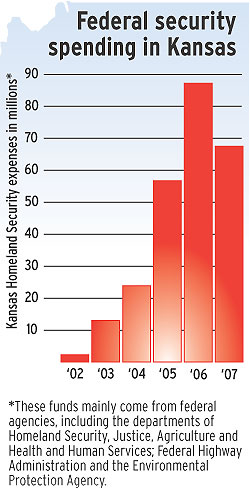
More than $87 million will be spent on security projects statewide this fiscal year, compared with $2.3 million the year after the 9-11 attacks in New York and Washington, D.C., according to Gov. Kathleen Sebelius’ budget report.
Kansas’ Director of Emergency Management and Homeland Security Maj. Tod Bunting said it has been money well-spent.
He often is kidded by colleagues from more populous states about the chance of terrorists targeting the Heartland.
“I know the New Yorks and New Jerseys have more people, but I always say, ‘Who feeds those people?'”
An attack on Kansas agriculture could be just as disruptive to the nation as 9-11 or Hurricane Katrina, he said.
“A safe and reasonably priced food supply is a big part of the quality of life of Americans,” Bunting said. “Anything that would have an impact on that would have a big impact on people. We’re America’s breadbasket.”
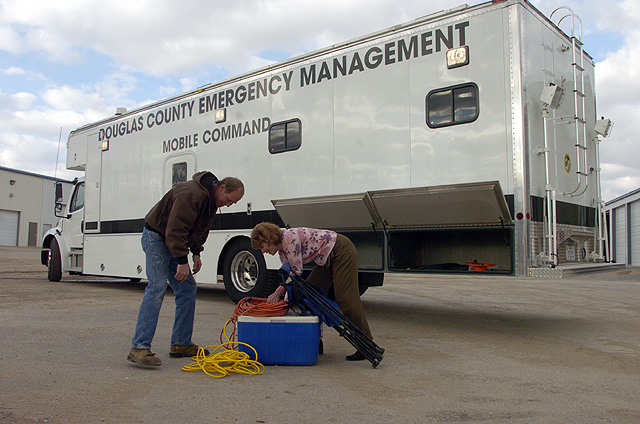
Thanks to funding for homeland security, Douglas County was able to purchase a mobile command van. Mike Muckey, left, of Douglas County Public Works, assists Teri Smith, assistant director of Douglas County Emergency Management, outside the mobile command center Tuesday. This fiscal year, more than 7 million will be spent in Kansas on homeland security projects, up from .3 million the year after the Sept. 11, 2001, attacks.
Kansas is the country’s No. 1 wheat producer and No. 3 cattle producer.
In addition to agriculture, Kansas is crisscrossed by thousands of miles of natural gas, oil and water pipelines. And a strike on Kansas, in the heart of the United States, would be a symbolic trophy to foreign terrorists, Bunting said.
Rep. Lee Tafanelli, R-Ozawkie, who recently returned from Iraq where he served as a commander in the Kansas National Guard, said federal spending on homeland security was starting to shift more to urban centers.
But, he said, it would be a mistake to overlook rural areas as potential targets.
“One of the biggest fears in the Midwest is the contamination of the food supply,” said Tafanelli, who serves on the House-Senate Committee on Kansas Security. “That would be a national and global disaster.”
Local governments will spend about $34.5 million of the state’s $87.2 million federal allotment.

Despite the rapid buildup of federal funds, Bunting said he thought the state had kept a close watch on how the money has been spent.
“We watch the news and see people who point out inappropriate expenditures elsewhere,” he said. “Kansas is pretty frugal with a dollar.”
Some problems
There have been complaints in recent years from some small businesses in Kansas upset with Fisher Scientific Corp., the New Hampshire-based company that handles emergency-preparedness purchasing for the state and local jurisdictions.
The businesses claimed they were unable to sell equipment to their local emergency agencies.
But Sen. Jay Emler, R-Lindsborg, chairman of the Security Committee, said he thought many of those problems resulted from a breakdown in communications. He said emergency responders always had been able to try to shop locally through Fisher but might not have known it.
“The consensus of the committee is that there may be things needed for fine-tuning, but the system is not broken,” Emler said.
Appropriations falling
Federal largesse in homeland security also is shrinking.
Kansas’ $87.2 million for homeland security is expected to decrease to $67.5 million in the next fiscal year, which starts July 1.
That is because federal funding in this area is starting to decrease, and some one-time expenses to develop new programs are elapsing, according to the Sebelius administration.
Paula Phillips, Douglas County Emergency Management director, said her office received nearly $1 million for homeland security in the last two years.
Most of the money has gone to training, research, equipment and increased security in various places, such as water treatment plants and other utilities.
“That’s been an identifiable need for years, but the additional revenue hadn’t been there,” she said.
Tafanelli said the expenditures locally and statewide also had improved the ability to respond to natural disasters.
“Still there is much that needs to be done in protecting the nation’s food supply,” he said.
homeland security expenditures
Here are some examples of federal homeland security expenditures in Kansas, according to the governor’s budget report:
¢ $1.25 million in each of the current and next fiscal years at Kansas University Medical Center to provide statewide terror response training to 5,000 first responders.
¢ $50,000 for the current and next fiscal years to install security cameras, monitors and transmission and recording devices in Allen Fieldhouse and Memorial Stadium.
¢ $153,687 to the state fire marshal to help fund a statewide explosives investigations unit.
¢ $34.5 million in grants to local governments in the current fiscal year and $31.4 million recommended in the next.
¢ $18.4 million in the current fiscal year to improve statewide radio communications so that all law enforcement officials, fire departments and first responders can communicate simultaneously.
¢ $5.3 million for hospital preparedness in the current fiscal year, and $4.5 million recommended in the next fiscal year.
¢ $143,000 to establish procedures to identify animal burial sites in the event of an act of terrorism to any of the confined animal feedlot operations in the state.
City Government
Developer seeks incentive from City of Lawrence to build 131 units of housing near Wakarusa and Queens

Lawrence city leaders will consider whether to keep Community Building open, make 2 other rec centers free to access
A STAR Bond application raises questions for city leaders about Costco and housing west of the SLT

Soccer gear honoring Lawrence history’s all-star team is now on sale as part of city’s public art exhibition
To honor public servants, Lawrence’s July 4 celebration will have a whole gallery of their photos on display; submissions open now