Bush administration maps emergency response changes
Washington ? Before the next big hurricane’s winds howl ashore, Homeland Security officials want an emergency communications network operating, emergency medical facilities treating patients and teams dispatched to search for victims at the likely ground zero.
In the wake of congressional hearings that exposed the breathtaking failures of the federal response to Hurricane Katrina, the Bush administration is retooling its disaster plan to react more quickly to the next catastrophe.
Michael Brown, now the ex-chief of the Federal Emergency Management Agency, became the public face of Katrina’s failure. But the administration is reviewing how other leaders also failed in August to execute a playbook approved just eight months earlier to handle such a disaster.
For example, Brown’s boss – Homeland Security Secretary Michael Chertoff – did not invoke special powers in the National Response Plan that would have rushed federal aid to New Orleans when state and local officials said they were swamped.
The department rejected the authority, concluding that it should be invoked only for sudden catastrophic events that offer no time for preparation and not for slow-approaching hurricanes.
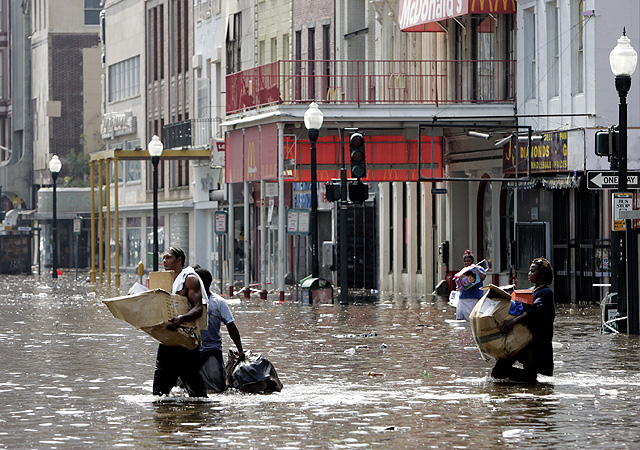
Looters make off with merchandise from downtown businesses in New Orleans after Hurricane Katrina hit. Chief among the changes to the original disaster response plan are ideas for rushing federal resources. They include helping catch looters and snipers by providing federal law enforcement officers.
That will not happen next time, according to officials who described to The Associated Press some of the changes in the administration’s evolving disaster response plan.
“There has to be a way to apply federal resources when state and local resources are overwhelmed,” said Joel Bagnal, a special assistant to the president for homeland security who is involved in the administration’s lessons-learned review.
Chief among the changes to the original 426-page plan are several ideas for rushing federal resources to a stricken area. They include:
¢ Dropping small military or civilian vehicles, packed with communications gear, into a disaster zone by helicopter or driving them from nearby staging areas.
¢ Setting up portable hospitals with federal emergency medical teams to augment local facilities.
¢ Helping local and state police catch looters and snipers by providing federal law enforcement officers if requested.
The union representative for FEMA headquarters workers worries about how well the agency will respond next time. FEMA reacted quickly to big disasters when it operated independently, he said, but fell short in its first big test as a member of the massive Homeland Security Department.
“You broke your toy and now it doesn’t work,” said Leo Bosner, himself a veteran FEMA disaster specialist.
Those on the front lines hope to have a unified philosophy that values flexibility and quick thinking to adapt solutions to a rapidly unfolding human disaster.
“When you have a disaster, nothing goes by any kind of plan,” said Dr. Arthur Wallace, leader of the Oklahoma 1 FEMA medical team that was dispatched from its staging area too late to beat Katrina to New Orleans.
The administration officials and responders interviewed by the AP offered a few of their own horror stories that they do not want repeated. They also help illustrate changes in the evolving plan.
36 hours late
Dr. Wallace’s 34-member medical team from Oklahoma left its Houston staging area Aug. 28 after receiving a request from Louisiana officials to head for the Superdome.
Katrina made landfall in Louisiana just after 6 a.m. on Aug. 29, but the team did not arrive until that night. It did not receive its first patients until dawn on Aug. 30.
That was 36 hours after FEMA began reporting grave medical problems in the stadium, such as 400 people with special needs, 45 to 50 patients in need of hospitalization and a dwindling supply of oxygen.
In the future, the administration wants medical teams in position before the storm strikes.
Emergency communications
U.S. military communications with Louisiana and Mississippi officials were so poor that commanders were forced to use couriers to transmit messages, said Paul McHale, the assistant defense secretary for homeland defense.
FEMA’s “Red October” mobile command center rode out the storm at Barksdale Air Force Base near Shreveport, La., six hours from New Orleans. The oversize trailer can establish communications in a stricken area and serve as the nerve center for directing emergency relief. But it did not arrive in the city until several days after Katrina had struck.
Quicker deployment
For several days, thousands of people at the New Orleans convention center had no food, water or medical help. National Guard forces were preoccupied with rooftop rescues and lacked the manpower to feed or assist hungry refugees.
“Every single resource we had from Tuesday (Aug. 30) through Thursday (Sept. 1) was committed to picking people off of rooftops and saving people,” recalled Louisiana National Guard Lt. Col. Jacques Thibodeaux, a deputy U.S. marshal in civilian life.
It wasn’t until Friday, Sept. 2, that Thibodeaux was told to lead a rescue mission to the convention center.
The White House is pressing Congress to establish the exact circumstances and legal authority that would determine when the active military should take over a disaster.
Help for police
The 18-member, Dallas-based Bureau of Alcohol, Tobacco and Firearms special response team had the very skills needed to cope with looters and snipers, but its members did not arrive in New Orleans until Sept. 2.
“By the time we got here, it wasn’t as bad as the first nights after the storm,” team leader Charles Smith said.
The team was trained in serving arrest warrants and executing search warrants, hostage situations, rescues, and riot and crowd control.
The team showed its capabilities two nights after arriving when gunshots were reported in a neighborhood. Smith dispatched agents with night-vision goggles and, as a helicopter appeared overhead, the team observed a shooter in a four-unit housing project. Smith personally talked two men out of the building and arrested one without firing a shot.
In the future, the administration wants such teams ready to move as soon as local law enforcement needs assistance.
National
Unhealthy air quality in California city as huge warehouse fire burns for 3rd day
Judge orders Trump administration to restore National Park changes at sites that ‘disparaged’ US
Teens’ reading and math scores have stagnated, US test results show
WASHINGTON (AP) — Younger students have regained ground academically after the pandemic's disruptions while older ...
Lawyers for man accused of killing Charlie Kirk try to block death penalty

Trump’s name poised to come off Kennedy Center