School cost study holds key to session
Never has so much ridden on a single report, state leaders say
Topeka ? When the Legislature was last in town, it ended a raucous summer special session by approving a $290 million increase for public schools.
That was done under pressure from the Kansas Supreme Court, which had earlier ruled the school finance system was unconstitutionally under-funded and inequitable.
Problem solved. Roll credits.
But wait.
Just hours after lawmakers left, the court approved the new school finance law, but added that the new funding was just a down payment, the court would retain jurisdiction and await the results of a school cost study.
Now, that study is due for release Monday, the first day of the 2006 legislative session.
Welcome to school finance – The Sequel.
All questions about the state budget, public schools, politics and gambling depend on what the cost study says.
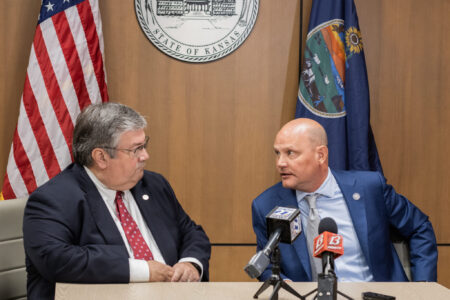
“We’ll have a better idea what we are up against once we get the report,” Senate President Steve Morris, R-Hugoton, said.
The report was done by the Legislative Division of Post Audit and is to be released at 9 a.m. Only members of the audit committee and staff will have access to the report before then, officials said.
“This is most tight-lipped group of people you will ever meet,” House Speaker Doug Mays, R-Topeka, said. “Those people are sworn to secrecy.”
State leaders say they don’t remember a time when so much was riding on a single report at the start of a session.
“I don’t recall anything ever being focused quite so tightly on one thing,” said Rep. John Edmonds, R-Great Bend, chairman of the audit committee.
Aside from the secrecy and theatrics of its release, all sides in the school finance debate say they hope the study will tell lawmakers the cost for a school system that provides opportunity for each student to reach a high degree of proficiency.
Plaintiffs in the case – school districts with high minority populations – have been waiting since 1999 to resolve the issue.
“If the study is not what the court ordered, and does not get us to adequacy, then you can expect the plaintiffs to ask the court to review it,” said Alan Rupe, an attorney for the plaintiff school districts.
The only studies currently before the court dealing with school finance indicate that $600 million more is needed. This would probably require a tax increase, or another revenue generator, such as expansion of gambling.
Recently, state leaders, including Gov. Kathleen Sebelius and Mays, have been talking about a multiyear approach to increasing school funding.
Rupe said the state needed to get to a constitutional level of funding immediately.
“My clients, when they hear that (a multiyear approach), they are insulted,” he said. “They know how to make a difference in Kansas kids’ education with the money that is needed,” he said.
State Government

KU professors would be limited in how they could present the idea of systemic racism in future classes
State legislators push back against federal energy regulators ending competitive bids
TOPEKA — Two Kansas legislators asked federal energy regulators to ensure competitive bidding occurs on ...
Senate confirms 1st of 3 Kansas nominees to U.S. District Court
Corporate income tax collections falling sharply in Kansas; Republican, Democratic leaders disagree on what it means
TOPEKA — Corporate income tax collections in Kansas have almost halved since last year, while other sources trend ...
Candidate’s campaign manager created website with documents used to attack rival
TOPEKA — Kansas U.S. Senate candidate Patrick Schmidt’s campaign manager left his digital footprint on ...