KDOT trying to improve safety on two-lane highways
'Rumble strips' get road test
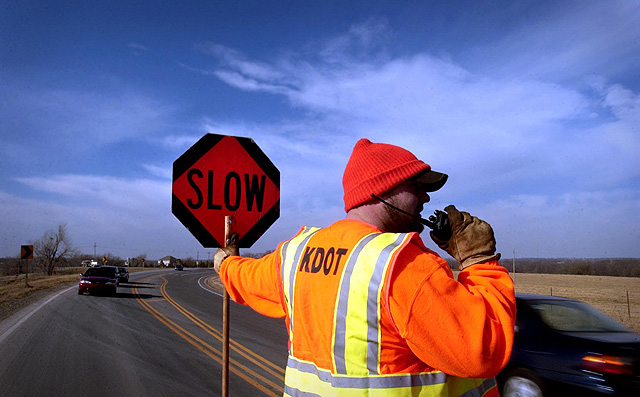
Kansas Department of Transportation worker Andy Frost, Lawrence, speaks on his radio as he directs the flow of traffic on U.S. Highway 40 in a construction zone west of the junction with Kansas Highway 10. A variety of safety improvements have been made to the highway, including wider lanes and rumble
Big Springs ? Jim Weaver is a big fan of “rumble strips.”
He lives near U.S. Highway 40 between Lawrence and Topeka, which has been the scene of a number of gruesome head-on car accidents over the years. So he’s glad state authorities put the strips along the center line of the highway, to warn drivers when they’re crossing into oncoming traffic.
“I love ’em. The road’s treacherous enough; we’ve seen enough fatalities,” Weaver said Tuesday afternoon while doing some outdoor maintenance at Big Springs United Methodist Church, just a few dozen feet from the highway. “If it saves a few lives, it’s worth it.”
Kansas drivers are already familiar with rumble strips – grooves in the asphalt that produce a loud noise and vibration when a car passes over them – on the sides of four-lane highways.
But when the Kansas Department of Transportation resurfaced U.S. 40 last summer, it decided to include the center-line strips, part of an experiment on several two-lane highways across the state.

Rumble strips are common on shoulders of four-lane highways, but KDOT is experimenting with using them along center lines of two-lane roads. The strips will alert drivers who cross the line into the oncoming lane.
“There’s very few accidents that are more traumatic, more dangerous than a head-on, especially with highway speeds like that,” said Joe Blubaugh, a spokesman for KDOT’s northeast Kansas district. “If you fall asleep or drift and hit those rumble strips, the goal is to get your attention.”
Blubaugh said state transportation officials would review accident records along the highway after a couple years to decide whether the strips should be used on other two-lane highways across Kansas. He couldn’t provide exact costs for the project, saying that it was “minimal.”
Officials with traffic-enforcement agencies said they haven’t tracked statistics to know whether the new devices made a difference in the accident rate after a half-year.
“We welcome anything that’s going to improve road travel in Douglas County and keep our citizens safe,” Douglas County Sheriff’s Lt. Kari Wempe said.
Lt. John Eichkorn, of the Kansas Highway Patrol, agreed.
“Anything that can be provided to assist motorists in staying in their lane will be beneficial,” he said. “It just takes a very small error to create a very serious situation.”

City Government
Developer seeks incentive from City of Lawrence to build 131 units of housing near Wakarusa and Queens

Lawrence city leaders will consider whether to keep Community Building open, make 2 other rec centers free to access
A STAR Bond application raises questions for city leaders about Costco and housing west of the SLT

Soccer gear honoring Lawrence history’s all-star team is now on sale as part of city’s public art exhibition
To honor public servants, Lawrence’s July 4 celebration will have a whole gallery of their photos on display; submissions open now