

Play together, stay together
KU researcher uncovers common traits among diverse happy families
Basketballs fly. Amanda shouts as a friend yanks her braids. And little Chandler, off in the yard, dangles upside down from a tree limb.
“It’s chaos,” Gabby Shawley said as she watched over her brood and the neighborhood kids who gathered outside her house after school Wednesday. “If I had one word to describe our family, it would be ‘chaos.'”
The Shawleys aren’t to be mistaken for the Cleavers of the 1950s sitcom “Leave it to Beaver.” But they’re a happy clan.
And, according to Kansas University professor Barbara Kerr, you don’t have to be a “Beaver” Cleaver to hit the family jackpot.
Kerr, a distinguished professor of counseling psychology, for several years has studied happy families to find out what their secrets are. Kerr plans to publish the research in a book titled “Smart Families.”
The reality, she said, is that all sorts of families – of all ethnicities, religions and socioeconomic levels – can be happy.
“They’re incredibly diverse,” Kerr said of the happy families she’s studied. “These were not the Waltons or the Cosbys.”
Many families buck tradition these days. Married-with-children households are on the decline – dropping from about 40 percent of all American households in 1970 to about 23 percent in 2003. Ten percent of American men reported being divorced and not married in 2003, up from 3.5 percent in 1970, according to census reports.
So what is the key to familial bliss?
Kerr, whose research aims to explore the origins of creative lives, said she found that happy families often had several things in common. Parents support children’s interests without sacrificing their own needs and goals.
Family meals are often special, serving as a time for conversing as well as eating.
Happy families document their lives in photos or journals. And they have their own unique, even quirky, traditions.
When neighborhood kids flock to the house, Kerr said, that’s likely a sign that the family is happy.
“Generally neighborhood kids will tend to gather not where the best TV is, but where the family makes room for them and makes them feel like they’re safe and having a good time,” Kerr said.
At home, there often are many places for play and creative expression. Happy homes often have gardens, books, pets and places where kids can make messes. And even in large families, each member has a special place for respectful privacy.
The Shawleys are a blended family. Gabby Shawley had two children with her first husband and three with her second. The seven-person clan lives in a small house.
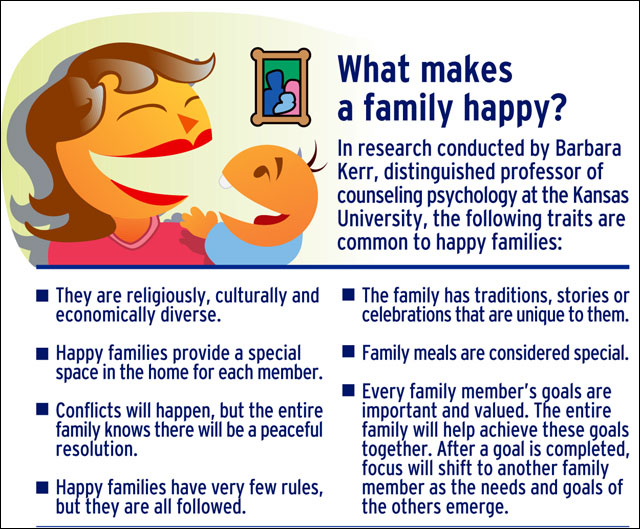
Research by Barbara Kerr, professor of counseling psychology at KU.
“We just all get along,” Shawley said. “We have fun together. We talk about everything.”
Shawley said she tried to spend time with each child individually. And she doesn’t spend much time with discipline.
“There’s a point in a kid’s life that they respect you so much they would rather please than disappoint. They don’t want to disappoint me.”
And the kids do their thing. Shawley’s 12-year-old daughter, Amanda Welcher, wrestled on the junior high team. Hunter Shawley, 9, is in Boy Scouts. And the whole family gets together for church activities. Church, good communication, laughter and support are all key pieces to the family, Gabby Shawley said.
“We laugh a lot in this house, over the dumbest things,” she said. “The only thing that keeps people going is laughter and happiness and joy. : All I want for my family is for them to be happy.”
Related Content
KU
KU professor hopes ‘average places’ postcard project helps people connect to Langston Hughes’ Lawrence upbringing

KU professors would be limited in how they could present the idea of systemic racism in future classes

The annual summer solstice tour of the KU Native Medicinal Plant Garden will be held later this month

KU Homecoming parade to return to campus after seven-year absence

‘Backyard’ allows even more fans to cheer on Jayhawks
