Lower lakes, higher concern
Corps releases raise Perry boaters' anxiety
Boat owners at Perry Lake are seeking reassurance they won’t see a repeat of several years ago when they had to scramble to get their boats out because the U.S. Army Corps of Engineers released massive amounts of water from the lake.
“They let out so much water, many boats were threatened. We had to pull boats out of the harbor,” said Bruce Liese, a former head of the Perry Yacht Club at the lake northwest of Lawrence.
But the corps says it is under legal obligation to release water in order to help navigation along the Missouri River.
These two conflicting arrangements – recreational boating versus federally required releases for industrial watercraft on the Missouri – will be the topic of a meeting at 6:30 p.m. Tuesday in the banquet hall of the Wyandotte County Fairgrounds in Kansas City, Kan.
Boaters, corps leaders and state officials will be on hand to discuss the issue.
Earl Lewis, operations manager for the Kansas Water Office, said he hopes a solution can be worked out.
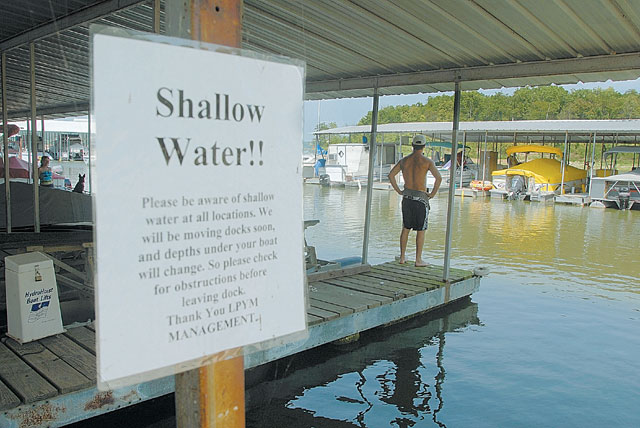
A sign at Perry Lake lets boaters known that water levels are low, creating potential hazards. Scott Carter of Topeka looked out at the lake waters last week.
“We don’t think the navigation releases make a whole lot of sense,” Lewis said. He said the downstream benefit of the extra water was minimal compared with the economic damage it could cause at the lakes.
But in July, the corps started releasing water from Perry, Milford and Tuttle Creek lakes, defending the move as necessary. Those three reservoirs are part of the federal government’s operation of the Missouri River basin. Clinton Lake is not a part of that operation.
The lakes are owned by the corps. When drought conditions exist – as they do currently in the Missouri River basin – the corps releases water to maintain river flows to sustain tugboats and barge traffic on the river below Kansas City, Mo.
“We released water for navigation support, in terms of meeting the minimum requirements for water flow,” said Allen Tool, chief of the hydrologic engineering branch at the corps’ district office in Kansas City, Mo.
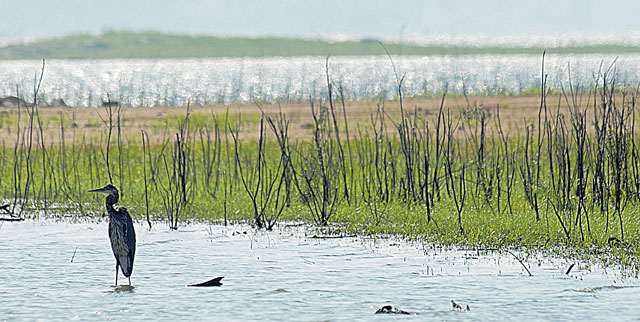
A great blue heron searches the low water at Perry Lake. While lower lake levels are not good for boaters, they also create more feeding grounds for wildlife. The U.S. Army Corps of Engineers says it must balance recreational lake uses with its obligation to industrial watercraft using the Missouri River downstream.
Boater safety
But when lake levels fall, boaters are exposed to more rocks and tree stumps, and some areas may become too shallow for watercraft to operate.
Under its operating plan, the corps can drop Perry Lake 3 feet below the multipurpose pool level before Oct. 1 and 3 feet after Oct. 1.
“The water is far below pool,” said Liese, a professor at the Kansas University School of Medicine. “I believe we are between 2 and 3 feet below pool. Under those circumstances, we don’t have much farther to go.”
Paul Johnston, a spokesman for the northwestern division of the corps in Omaha, Neb., said the corps wasn’t planning more releases at Perry Lake this year.
“There is no need to take any more water out of Perry because we are shutting down the navigation season early,” Johnston said.
But Johnston disagreed with the claim that the releases from Perry, Milford and Tuttle Creek had little or no benefit to downstream users.
“The release from the three reservoirs does indeed help,” he said. “The tributary inflow into the Missouri was at times this summer comparable to the Dust Bowl of the 1930s.”
Discussions needed
Tony Andressen, the current commodore at the Perry Yacht Club, said he was glad to hear the corps planned no more releases this year.
But, he said, more discussions are needed with the corps.
“We’re looking for a permanent solution instead of the uncertainty we have year after year,” Andressen said.
State Government
KU professors would be limited in how they could present the idea of systemic racism in future classes
State legislators push back against federal energy regulators ending competitive bids
TOPEKA — Two Kansas legislators asked federal energy regulators to ensure competitive bidding occurs on ...
Senate confirms 1st of 3 Kansas nominees to U.S. District Court
Corporate income tax collections falling sharply in Kansas; Republican, Democratic leaders disagree on what it means
TOPEKA — Corporate income tax collections in Kansas have almost halved since last year, while other sources trend ...
Candidate’s campaign manager created website with documents used to attack rival
TOPEKA — Kansas U.S. Senate candidate Patrick Schmidt’s campaign manager left his digital footprint on ...