

Students put focus on African crises
'Die for Life' protest includes campaign to divest from Sudan
Cory Keller, a Kansas University freshman, had just finished a tough math test on Thursday when he stumbled across a row of bodies in front of Strong Hall.
“Did anyone call an ambulance?” he asked, joking.
About 10 students, in shorts and T-shirts, lay motionless, some face down. Their arms and legs were strewn in all directions; eyes closed.
Signs enumerating those killed in humanitarian conflicts overseas were spread across their chests.
The “Die for Life” spectacle was the students’ latest effort to raise awareness of injustices in Uganda, Sudan and the Democratic Republic of Congo.
“There’s no way students can walk by something like this and not be forced to recognize that these conflicts are happening,” said Mark Skoglund, president of the newly formed student group Fighting Ignorance of Global Humanitarian Threats, FIGHT.
The demonstration lasted three hours, with up to 25 students participating at one point.
Skoglund said about 60 students dropped in over the course of the day. Some picked up notes with directions on how to call U.S. Sen. Sam Brownback, R-Kan., and make a statement about the issues.
Freshman Kelly Jenkins took out her cell phone and dialed Brownback’s office.
“I’m a constituent,” she said, reading from the statement. “The atrocities in Sudan and northern Uganda have been called the worst humanitarian emergencies in the world. For this reason, I urge Sen. Brownback to commit U.S. financial support to regional peacekeeping efforts…”
Brownback spokesman John Rankin said the office had received 50 calls from students. He said the calls, along with other contact from constituents, is compiled in a report that is given to Brownback each week.
Freshman Nathan George dropped in to lie on the ground for awhile.
“I came out here to ‘die’ today,” he said. “It seems like a no-brainer to me. Anytime you have an opportunity to stop another human being’s suffering, I think it’s immoral not to get involved.”
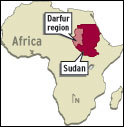
The demonstrators said there isn’t enough attention drawn to the acts of genocide in the Darfur region of Sudan, the abduction and slavery of children in Uganda and bloody conflict in the Democratic Republic of the Congo.
Rebekah Heacock, a KU student and president of KU for Uganda, traveled to Uganda recently to attend a global youth conference. She visited an orphanage that is home to former child soldiers and orphans of the AIDS epidemic.
Heacock said some may think that in some countries the residents are used to the pain and disruption, but that’s not true. Such atrocities are just as jarring for the children she saw as they would be to anyone else, she said.
“They’re not used to it,” she said. “It’s not anything normal for them.”
Some students also have formed a Sudanese Divestment Task Force and are attempting to bring to the university a Sudanese divestment campaign that has been taken up elsewhere. They want the university to expunge any investments supporting the Sudanese government.
The students have taken the plan to KU Chancellor Robert Hemenway and say they were encouraged by their talk. They have requested information about KU Endowment’s investments and university pension plan investments, but have not yet learned whether or to what extent there are investments supporting the Sudanese government.
“What we don’t know and what the chancellor doesn’t know is if KU is invested in those companies directly,” said Marc Langston, president of KU Young Democrats, who is working on the issue. “It may be that we have no investments, in which case we can say that we’re proud.”
KU
KU professors would be limited in how they could present the idea of systemic racism in future classes

The annual summer solstice tour of the KU Native Medicinal Plant Garden will be held later this month

KU Homecoming parade to return to campus after seven-year absence

‘Backyard’ allows even more fans to cheer on Jayhawks

Dole Institute of Politics announces summer lineup celebrating America’s 250th anniversary
KU Hospital Authority says CVS stole nearly $62M in drug savings
The University of Kansas Hospital Authority is suing CVS and its subsidiaries, alleging the mega pharmacy company ...