

KU pharmacy school still has prescription for success
Paola Galaviz first wanted to be a pharmacist in high school, when she got a job working the register at the drugstore in Ulysses.
She liked the way the pharmacist there helped people learn about their medications and the way people in the community respected him.
“I fell in love with it,” Galaviz said.
So Galaviz enrolled in the Kansas University School of Pharmacy, where she’s now completing the fourth year of a six-year program.
She joined throngs of students who, despite talk of a booming Canadian drug industry and the impact of mail-order drugstores, are flocking to a pharmacy career that promises flexibility and good pay.
The KU pharmacy school had 413 applicants for the 105 student slots open for this fall. Application numbers have increased by about 200 in the past four years.
Research shows there is a need for more pharmacists, with a shortage seen in some parts of the country, including rural parts of Kansas. According to a 2003 survey by the American Foundation for Pharmaceutical Education, 4.6 percent of retail pharmacy positions and 5.6 percent of hospital pharmacy positions were vacant.
“The population continues to age in this country,” said Gene Hotchkiss, associate dean of the School of Pharmacy. “With that comes exponential growth in the pharmacy industry.”
KU fills much of the need for pharmacists in the state. Hotchkiss estimated 70 percent to 80 percent of the state’s pharmacists were KU graduates, and 85 percent to 90 percent of the applicant pool come from within the state.
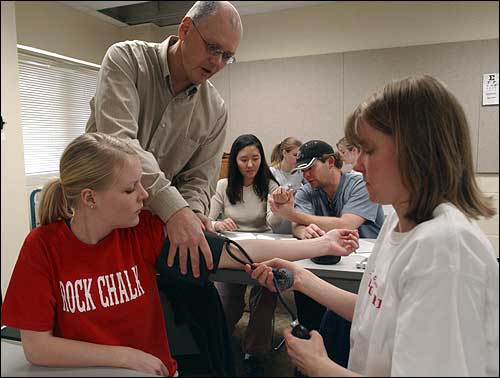
Robert Emerson helps Kansas University pharmacy students Renee Jacobs of Claflin, left, and Linda Schieferecke of Eudora with a blood pressure test during a physical assessment class. Students practiced Friday in Malott Hall.
The pharmacy school includes 45 faculty members, 400 undergraduate students, 160 graduate students and 80 postdoctoral fellows. It ranks 20th in the nation among public universities, and last year it ranked third in the amount of research funds received from the National Institutes of Health with $13 million.
Its nationally known faculty includes Gunda Georg, who directs an NIH center devoted to cancer research; Jeff Aube, who is working on a project that will create “libraries” of molecules; Ron Borchardt, known for his work in biochemistry and drug delivery; Eli Michaelis, who studies how oxidants affect the aging process; and Valentino Stella, who studies drug delivery.
The school currently is headquartered in Malott Hall, with offices and labs in four other buildings. Ken Audus, who became dean in April 2004, has hopes of raising funds for a new building for the school, which would help the student body expand to help meet the demands of the pharmaceutical industry.
He said he understood why pharmacy was an attractive career — those who earn the six-year degree can have starting salaries of $80,000 to $90,000.
“It’s a good job,” he said. “The starting salaries are incredible.”

 KU pharmacy school still has prescription for success
And Hotchkiss said the flexibility of the career — with jobs in hospitals, research or retail — offered students multiple possibilities.
“Health care is 24/7,” he said. “But you can make lemonade out of the lemons to give you some flexibility.”
Changing industry
That flexibility is a plus for Galaviz. She’s still not sure which route she’ll take for her career.
“A lot of it has to do with patient interaction,” she said. “In the independent and retail chains, you get to interact a lot more with the patients, and it’s comprehensive. In the hospital, you see them when they’re down and out. It’s tougher to handle emotionally, but it’s important.”
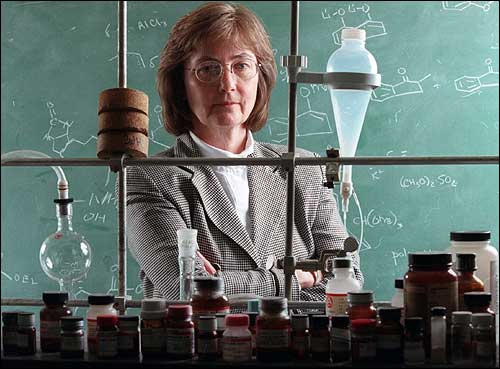
Gunda Georg is among the KU School of Pharmacy's nationally known faculty. Georg directs a National Institutes of Health center for cancer research.
She said she didn’t think most students were driven by money. For many, she said, pharmacy is a way to break into health care without spending the years and money it takes to become a doctor.
“I think most of the people in my class are in it for the benefit of helping people,” she said. “People say we’re interested in higher pay, but I really think that’s a bonus. It’s just an immense feeling of satisfaction when you go home knowing you helped somebody.”
Brandon Schminke, a third-year pharmacy student from Dodge City, said he also wasn’t sure which route his career would take. Though he said he thought health care would change in the time before he retires, he dismissed the notion that drug sales in Canada and over the Internet could make traditional pharmacists obsolete.
“I think that idea comes from a misconception of what pharmacists do, that they just count and hand out drugs,” he said. “They do so much behind-the-scenes stuff and are being given more responsibilities within hospitals.
“We don’t know what things are going to change, but it’s a pretty sure thing they’re going to change. It may be tougher for pharmacists, but you can still do it.”
New pharmacist
David Rziha is testing that theory in Council Grove.
Rziha graduated from KU in May 2004 and entered into an agreement to buy the Aldrich Apothecary in Council Grove, the 3,800-population town’s only pharmacy. He grew up a few miles down the road in Tampa.
Rziha has already seen what the pharmacy means to residents there.
“If you lose a pharmacy, every month the elderly people have to drive to another town,” he said. “If you’re at Wal-Mart or somewhere else already, you’ll go ahead and do other shopping there. It kills the small-town economy.”
He said he didn’t know how changes in the drug industry would affect the future of his business. But he said he didn’t expect the demand for prescriptions would be lessening anytime soon.
“I will have a job,” he said. “Will it be a profitable job? We’ll wait and see.”
KU

KU professors would be limited in how they could present the idea of systemic racism in future classes

The annual summer solstice tour of the KU Native Medicinal Plant Garden will be held later this month

KU Homecoming parade to return to campus after seven-year absence

‘Backyard’ allows even more fans to cheer on Jayhawks

Dole Institute of Politics announces summer lineup celebrating America’s 250th anniversary
KU Hospital Authority says CVS stole nearly $62M in drug savings
The University of Kansas Hospital Authority is suing CVS and its subsidiaries, alleging the mega pharmacy company ...