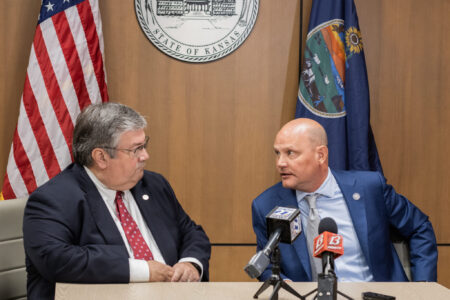
Kline requests money
Funds needed for Supreme Court cases
Topeka ? Attorney General Phill Kline’s office needs an additional $200,000 to cover expenses associated with taking a death penalty case and another appeal to the U.S. Supreme Court, a top aide told legislators Monday.
Eric Rucker, Kline’s chief of staff, said the attorney general’s budget for the fiscal year beginning July 1 is tight enough that it cannot absorb the additional costs, which include producing documents and preparing for arguments before the nation’s highest court.
The U.S. Supreme Court said last month it would review a Kansas Supreme Court ruling striking down the state’s capital punishment law. Also, in February, the nation’s highest court agreed to consider a federal appeals court ruling prohibiting states like Kansas from taxing motor fuels shipped to Indian reservations.
“We’d like to have some certainty in budgeting,” Rucker told the Senate Ways and Means Committee.
The panel is reviewing spending proposals before a special legislative session, set to begin Wednesday.
Chairman Dwayne Umbarger, R-Thayer, said the committee will vote on the request Tuesday. Asked whether members believe the attorney general’s office needs the additional money, Umbarger said, “There’s still some debate.”
The Kansas’ court’s 4-3 ruling invalidated the death sentences of six convicted murders. They included Jonathan and Reginald Carr, convicted of killing five people in a December 2000 crime spree in Wichita, and John E. Robinson Sr., who was convicted of killing three women in Kansas and pleaded guilty to five other murders in Missouri.
Another capital murder defendant, Gary W. Kleypas, had his sentence overturned in 2001 and is awaiting resentencing, with death still an option.
The tax case generated less attention, but attracted the notice of officials in 13 other states that impose motor fuels taxes and have Indian reservations within their boundaries.
Prairie Band Potawatomi leaders argue that the state’s attempt to tax fuel shipped onto its reservation violates its sovereignty. State officials argue they are imposing a tax on non-Indian businesses on fuel that will be sold off the Potawatomi reservation, north of Topeka.
State Government
KU professors would be limited in how they could present the idea of systemic racism in future classes
State legislators push back against federal energy regulators ending competitive bids
TOPEKA — Two Kansas legislators asked federal energy regulators to ensure competitive bidding occurs on ...
Senate confirms 1st of 3 Kansas nominees to U.S. District Court
Corporate income tax collections falling sharply in Kansas; Republican, Democratic leaders disagree on what it means
TOPEKA — Corporate income tax collections in Kansas have almost halved since last year, while other sources trend ...
Candidate’s campaign manager created website with documents used to attack rival
TOPEKA — Kansas U.S. Senate candidate Patrick Schmidt’s campaign manager left his digital footprint on ...