

Blessed occasion
University's Danforth Chapel turning 60 this year
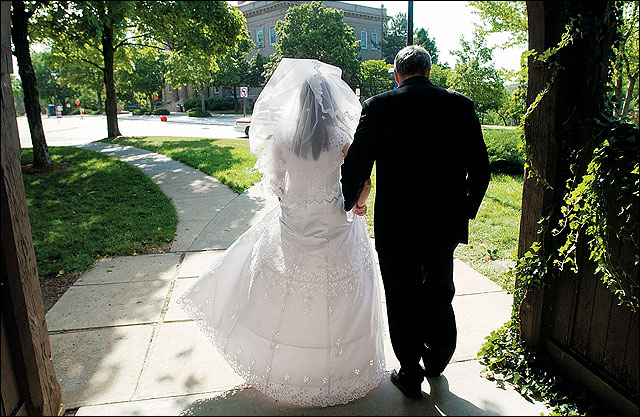
A couple departs Danforth Chapel on their wedding day. In recent years, the chapel is the site for an average 120 weddings a year, and about 200 student organizations use the facility.
When Kansas University students need a quiet place to get away from the grind of daily classwork or maybe seek a little divine help during finals week, some of them head for a little limestone building with stained-glass windows at the east edge of campus.
Danforth Chapel has been serving that purpose since it was built on Lilac Lane nearly 60 years ago.
“It’s number-one use is personal meditation,” said Danny Kaiser, KU’s assistant dean of students.
The chapel, built and dedicated in 1946, also has been a popular spot for weddings, christenings and as a meeting place for various student religious groups. Thousands of weddings have been performed there. In recent years, Danforth has been the site of an average of 120 weddings a year – with the highest number being 196, records show. On average, more than 200 student organizations use it annually.
The Rev. Thad Holcombe, campus minister at Ecumenical Christian Ministries, performs about six weddings a year at Danforth. He gets requests to do more but declines them because of time constraints.
“They are almost always KU students or former KU students,” Holcombe said of the newlyweds who have come out of Danforth. “They have some connection to KU.”
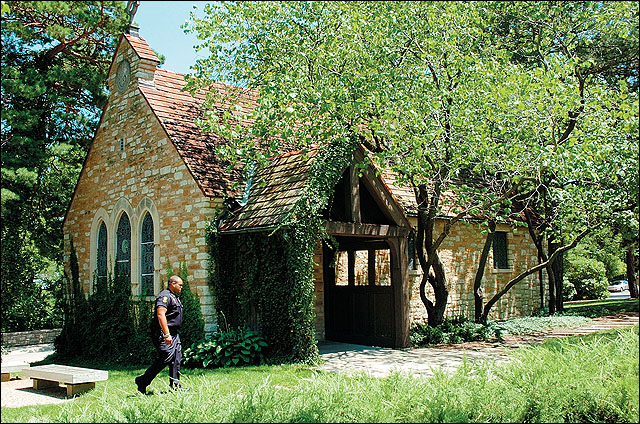
Danforth Chapel will turn 60 this spring; it was dedicated April 2, 1946, after a two-year fundraising campaign. The largest contribution came from William H. Danforth, chairman of Ralston Purina Co. in St. Louis.
Notable history
In 1944, KU Chancellor Dean Mallott launched an effort to build a campus chapel that carried an estimated cost of $25,000. Most of the money contributed for the chapel’s construction came from students, faculty, alumni and Lawrence residents. The largest contribution – $5,000 – came from William H. Danforth, chairman of the Ralston Purina Co. in St. Louis. The Danforth Foundation was making donations for chapel construction on other college campuses, thus, when the KU chapel was completed it was given the Danforth name.
The chapel’s architect, Edward W. Tanner, of Kansas City, Mo., who was the first graduate of KU’s Department of Architecture and helped design Kansas City’s Country Club Plaza, donated his work for free.
Some of the limestone used to build the chapel came from a campus rock quarry. Many of the workers who built the chapel were German prisoners captured in North Africa during World War II. About 200 of the prisoners were held at a prison camp in Lawrence, one of 14 such sites in Kansas. Luckily, some of them were stonemasons and more than willing to lend a hand, according to historical accounts.
On April 2, 1946, KU formally dedicated the completed chapel.
Makeover planned
Today the chapel and its grounds need renovation and repairs estimated from $212,000 to $225,000. The Kansas University Endowment Association is attempting to raise $250,000 for the project. Private donors also will be called upon.
The chapel needs a new roof and restrooms – including one which is handicapped-accessible – and has stained-glass windows that need to be resealed.
The KU Class of 2005 has pledged $6,000 to pay for landscaping improvements, especially to the garden area at the north end of the chapel.
“There are some benches and some nice walkways, but the only plantings are evergreen,” Kaiser said. “They just want to provide some different kinds of plants and shrubbery, just to give it some nice colors and make it a more attractive area to be in.”
The building renovations might begin next spring, officials said.
Because of the need for continued maintenance and its continued popularity as a wedding site, couples are now charged fees to have their weddings in Danforth. KU students pay a $35 wedding fee, while others pay $75.
Place of peace
Although it began strictly as a Christian chapel, Danforth has evolved into an interdenominational place of worship.
“There are several places on campus where a student or faculty member can go for a kind of quiet, sacred place,” Holcombe said. “It could be a bench in a garden or a park. But Danforth has that special significance, and it does in an interfaith perspective, too. It’s not just used by Christians, but others as well.”
KU
KU professors would be limited in how they could present the idea of systemic racism in future classes

The annual summer solstice tour of the KU Native Medicinal Plant Garden will be held later this month

KU Homecoming parade to return to campus after seven-year absence
‘Backyard’ allows even more fans to cheer on Jayhawks

Dole Institute of Politics announces summer lineup celebrating America’s 250th anniversary
KU Hospital Authority says CVS stole nearly $62M in drug savings
The University of Kansas Hospital Authority is suing CVS and its subsidiaries, alleging the mega pharmacy company ...