Publishing company promotes writers’ works
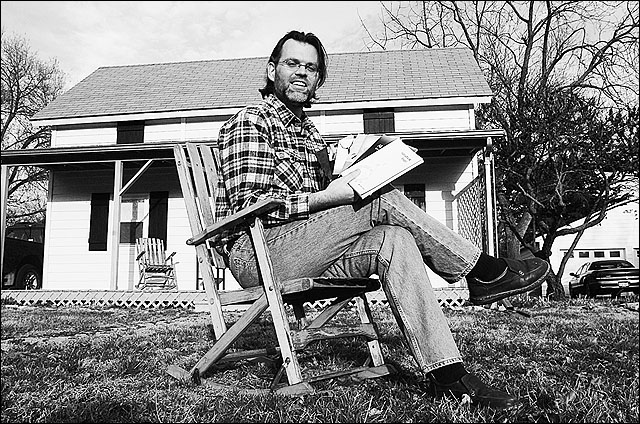
JASON WESCO has put out seven books since starting 219 Press in 2002. The 32-year-old's debut poetry collection was Between
If Jason Wesco’s entree into the publishing world had been a terrific, tragic failure, he would have chalked it up to experience and called it quits.
But that’s not what happened.
Instead, the 32-year-old started 219 Press in 2002 on the strength of his own debut poetry collection, “Between the Letters,” and has put out six additional books since. Two of them have sold out and are heading into a reprint.
“The books that we’ve done … people are consuming them,” he says. “Maybe it’s not millions or thousands, but there’s still enough consumption going on. Those books are moving. So I think in terms of just the product, it’s a good product that we put out, and people are responding by buying the product.
“In another way, maybe a more philosophical way, I think what we’ve shown is that we can make a book that looks every bit as beautiful as every other book on the shelf and, in my opinion, better than most. And it’s just some guy in Perry, and his friend the graphic designer and a bunch of really talented poets.”
‘You can do all right’
219 Press, named for Wesco’s street address in Perry, where the business was based until he recently moved to Topeka, was partly the product of frustration.
Frustration that the publishing industry notoriously closes itself off to poetry because it doesn’t sell well.
And frustration that Lawrence poets who were putting out good work – in many cases Wesco’s favorite work – were not getting the exposure they deserved.
PUBLISHED WORKS
Jason Wesco’s 219 Press has published the following titles:
- “Vanishing Point,” by Mickey Cesar, 2005
- “All Cats Turn Gray When the Sun Goes Down,” by Dan Jaffe, 2004
- “Abundance,” by Michael Poage, 2004
- “Touch,” by Shannon Musgrave, 2004
- “Senegal Blues,” by Brian Daldorph, 2003
- “Stories from a Life in Progress,” by Lou Ann Thomas, 2003
- “Between the Letters,” by Jason Wesco, 2002
For more information about the press, visit its Web site at www.219press.com or e-mail publishing@219press.com.
But that situation has changed for local writers such as Shannon Musgrave, Mickey Cesar and Brian Daldorph, who all have published titles under the 219 imprint.
The business has survived, Wesco says, on realistic expectations, a small profit margin and writers who aren’t afraid to promote their work.
“We do not have a marketing budget,” Wesco says. “Our titles are available through Amazon and on our Web site, but you’re talking about a lot of competition if your book’s just sitting on the shelf with everybody else’s.”
So the authors have to hustle, taking their books along when they do readings. A couple of 219’s titles have been adopted in college courses, which also has boosted sales.
A typical press run is 500, and it takes about six months and $3,000 to put out a book. That includes editing, designing, printing and limited marketing. The writers front half of the money.
“You can do a nice book for $3 to $4 a copy. And with the volume that we do, if you can sell enough of them, you can do all right,” Wesco says. “Clearly it’s not a money-making thing for anybody, but I’ve not lost money on it – and the authors haven’t either.”
An organic process
Six of the seven 219 Press titles have been poetry books. They range from the lonely but lush travel verse of Daldorph’s “Senegal Blues” to the raw, human, end-of-life moments in Musgrave’s “Touch” to the rhythmic grooves of Dan Jaffe’s jazz libretto in “All Cats Turn Gray When the Sun Goes Down.” The seventh book is a collection of essays by popular Topeka columnist Lou Ann Thomas called “Stories from a Life in Progress.”
Wesco, who directed the Douglas County Dental Clinic for two years and now is director of community development for the Kansas Association for the Medically Underserved in Topeka, spends most of his 219 Press time coming up with a design concept that reinforces the writing. What will the cover look like? Will there be art inside the book? Topeka designer Christine Ewing then transforms the ideas generated by Wesco and the author into visuals that, so far, have failed to disappoint.
“The most fun thing I’ve ever done in my life is taking part in the process of sitting down and trying to think about it when you’ve got nothing but black letters on white paper and going, ‘What could this look like?'” Wesco says. “And then going through the whole process and, at the end, picking up the books from the printer and opening that box and holding that thing in front of you is joyous. It really is like nothing else I’ve ever experienced.”
As for the future, Wesco doesn’t have a five-year plan.
“I don’t believe in plans,” he says.
He and a friend are considering developing a literary journal in the area, but not to the exclusion of publishing books.
“It hasn’t gotten to the point where I hate doing it, and I don’t ever want it to,” Wesco says. “I tend to let it be as organic as possible. I tend to just want to let things happen.”
City Government
North Lawrence study consultants look at possibilities for a grocery store, food truck park, traffic calming and more
Algerian ambassador gives Lawrence a gift for supporting national team – a piece of art
Lawrence City Commission approves incentives for Alarm.com’s office project in downtown building
Lawrence City Commission interested in a moratorium on data center development
Lawrence city leaders defer decision on selling downtown parking lot for senior housing project