

For carillonneur, reminders of war come with territory
For Elizabeth Berghout, subtle signs of war are everywhere.
When she steps into the Campanile each day to play the carillon contained within, she is reminded both of the American soldiers in Iraq today and those who died more than 60 years ago.
The Campanile and its carillon were constructed in 1950 to honor Kansas University students and faculty members who died in World War II. It was dedicated in 1951.
“Every time I go in and out, I see the list of names. It’s a visual reminder to me of what the Campanile and carillon are for,” Berghout said.
As university carillonneur, Berghout plays the carillon for weekly concerts and special concerts to honor such occasions as the third anniversary of the 9-11 attacks. She also teaches students, faculty and residents to play the 53-bell instrument.
Berghout is one of more than 100 certified carillonneurs in the United States, said William De Turk, archivist of the Guild of Carillonneurs in North America. De Turk said there were only about 180 carillons in the United States.
“I was fascinated with the physical aspect of playing it, and I fell in love with the sound of the bells,” said Berghout, who began playing in 1997.
The carillon has a key arrangement similar to that of a piano, but instead of black and white keys, carillon keys are spaced farther apart and look like broomstick handles.
The instrument is played by striking the keys with a fist. Like an organ, the carillon also has keys that are played with the feet.
“It’s a beautiful instrument, very powerful and subtle at the same time,” said graduate student Lon Mitchell.
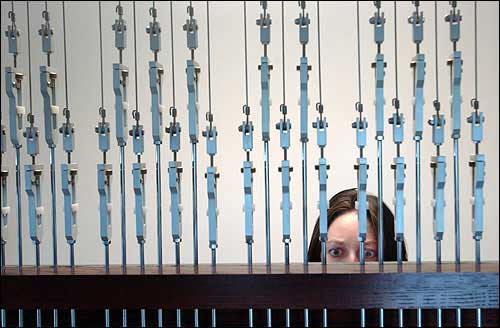
Erin Morrissey, a Kansas University senior from Portland, Ore., rehearses on the carillon atop the memorial Campanile. KU's Campanile, a memorial to the university's World War II dead, is one of about 180 carillons in the United States.
Mitchell, who is pursuing a doctorate in math, said he didn’t know what a carillon was when he came to KU. He majored in music as an undergraduate and began taking lessons from Berghout four years ago. Mitchell now practices from four to six hours a week.
“Sometimes I have to remind myself what I came here for,” Mitchell said.
Those interested in learning to play the carillon can enroll in one of several KU classes at the undergraduate or graduate level. The number of credits earned depends on the amount of time spent in practice each week.
Sharon Hettinger, Lawrence, is not in Berghout’s class, but plays the carillon a few days a week. Hettinger said her favorite time to play is early in the morning, amid the mist and silence.
| Carillon concerts are at 5 p.m. Sundays and 7 p.m. Wednesdays at the Kansas University Campanile. Starting Nov. 7, Sunday concerts will begin at 3 p.m. |
“The tone of the bells has almost a magical sound. It hovers when it’s humid and foggy,” Hettinger said.
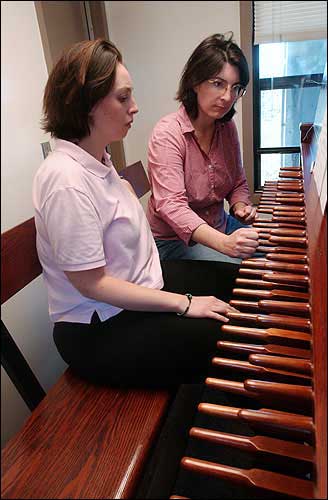
Erin Morrissey, left, receives instruction from Elizabeth Berghout, university carillonneur. Berghout is part of an elite group who has achieved the status of certified carillonneur.
After students learn to play the carillon, they have the option of becoming a certified carillonneur like Berghout. To do so, they must play a 30-minute recital in front of members of the Guild of Carillonneurs in North America at its annual June congress. An examinations committee and members of the guild must approve the recital for the performer to receive certification.
Graduate student Lara Walter said she planned to submit a tape of recorded music for the first step in the certification process. If she passes the first test, Walter will prepare for the June recital by practicing carillon pieces from a required list and her own repertoire.
She said one career option for her after school would be to find a job at a church or school that has a carillon. But there’s just one catch.
“You have to go somewhere where there is one,” she said. “And they aren’t everywhere.”

 6News video: Campanile to have name added (9-20-04)
 Name to be added to KU’s Campanile
KU
KU professors would be limited in how they could present the idea of systemic racism in future classes

The annual summer solstice tour of the KU Native Medicinal Plant Garden will be held later this month

KU Homecoming parade to return to campus after seven-year absence
‘Backyard’ allows even more fans to cheer on Jayhawks

Dole Institute of Politics announces summer lineup celebrating America’s 250th anniversary
KU Hospital Authority says CVS stole nearly $62M in drug savings
The University of Kansas Hospital Authority is suing CVS and its subsidiaries, alleging the mega pharmacy company ...