State pension plan problems persist
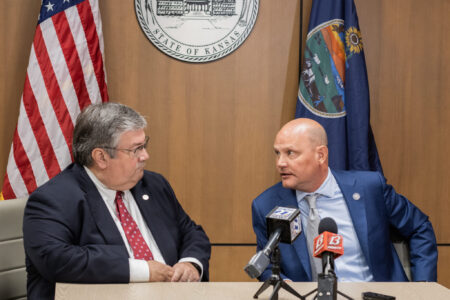
Topeka ? State lawmakers said Wednesday that major changes were needed to Kansas’ $10.3 billion public-pension system in the face of growing liabilities.
But they seemed at odds over which direction to take.
“We have got a massive hill to climb to pay for the benefits we already have in place,” said Sen. Dave Kerr, R-Hutchinson.
Kerr’s comments came as officials announced improvement in the fiscal shape of the Kansas Public Employees Retirement System but pointed to short- and long-term problems.
“There are still challenges,” said Patrice Beckham, a consulting actuary with Milliman Consultants and Actuaries, which reviews KPERS each year.
KPERS officials said there was no immediate danger to current pensions. The system has 148,000 active members in state and local governments and school employees, and provides benefits to 59,000 retirees.
But one of the short-term problems is market volatility. KPERS has a return on investment of 2.6 percent for the current calendar year, far short of the 8 percent state officials said they expected when they approved borrowing $500 million in March to shore up the system.
Now, only months later, officials say the 8 percent mark will be hard to hit without becoming more aggressive in the fund’s investment strategy.
“It’s a very, very significant challenge to generate that return without exposing ourselves to volatility,” said Rob Woodard, chief investment officer for KPERS.
Stay the course

 KPERS home page
 6News video: KPERS funding needs fix (7-29-03)
Several members of the House-Senate Committee on Pensions, Investments and Benefits said they weren’t too concerned about the 2.6 percent return over the past three quarters because of the ups and downs of the market.
“You stay the course,” said Rep. Ray Cox, R-Bonner Springs, an investment broker. “Long term, you’re going to be fine.”
Glenn Deck, executive director of KPERS, said looking at short-term snapshots of the fund’s performance might do more harm than good.
“People need not be too positive when the trend is up, or too negative when the trend is down,” he said.
In the long term, however, Kerr said the state was facing huge increases in contributions to public employee pensions, especially those for schoolteachers.
He asked Deck to come back to the committee in November with a proposal that would reduce the state’s costs. But other members of the legislative committee said they would like to see proposals to increase benefits, specifically providing cost-of-living adjustments for retired employees.
Contribution questions
Deck said one proposal would be to offer a package of benefits for incoming employees that would reduce contributions and increase the retirement age but also would reduce the amount of time it took for an employee to be vested in the system.
Currently, employees cannot be vested until having worked 10 years, which is double the time required by most employers, Deck said. The proposal also would put new state employees immediately into the system, instead of having to wait one year as is the current practice.
Andy Sanchez, executive director of the Kansas Association of Public Employees, an employees’ union, said he favored reducing the amount of time to be vested, but disagreed with the notion of the state reducing its contribution.
“The state has not been contributing what it should have over the years,” Sanchez said. “When you go asking to get more out of the employees, that is the wrong direction to go.”
State Government
KU professors would be limited in how they could present the idea of systemic racism in future classes
State legislators push back against federal energy regulators ending competitive bids
TOPEKA — Two Kansas legislators asked federal energy regulators to ensure competitive bidding occurs on ...
Senate confirms 1st of 3 Kansas nominees to U.S. District Court
Corporate income tax collections falling sharply in Kansas; Republican, Democratic leaders disagree on what it means
TOPEKA — Corporate income tax collections in Kansas have almost halved since last year, while other sources trend ...
Candidate’s campaign manager created website with documents used to attack rival
TOPEKA — Kansas U.S. Senate candidate Patrick Schmidt’s campaign manager left his digital footprint on ...