

KU takes shot against meningitis
Vaccinations required in group housing next year
Kansas University students living in on-campus group housing must be vaccinated for meningitis beginning in fall 2005, officials said Tuesday.
The policy comes seven months after KU student Andy Marso was nearly killed by the bacterial infection, raising awareness of the disease on campus and leading to a spike in student vaccinations.
“We definitely think it’s a good thing to protect against a threat that most people doesn’t even know exists,” said Dan Marso, Andy’s brother.
The vaccine requirement will apply to the 4,800 students living in residence halls, scholarship halls and Jayhawker Towers.
KU officials said 11 states, including Oklahoma, required students living in university housing to get the vaccine. The American College Health Assn. estimates 125 students are diagnosed with meningitis each year. Five to 15 die.
“We’re taking a proactive step to help our students be protected,” said Kathryn Tuttle, associate vice provost for student success.
She said the diagnosis of Marso — who remains in the Kansas City area undergoing rehabilitation and surgeries — led to heightened awareness on campus and a four-fold increase in the number of vaccinations administered at Watkins Student Health Center. More than 1,000 students have received the vaccine since July, Tuttle said.
During an October news conference, Marso said all colleges should require the vaccine. “It should be mandatory — you don’t enroll until you are vaccinated,” he said at the time. “It only makes sense.”
But Tuttle said the vaccine requirement wasn’t in response to Marso’s suggestions or his diagnosis.
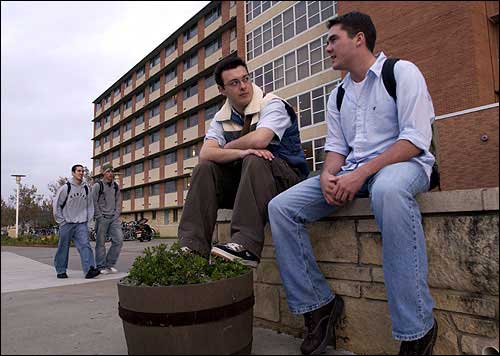
KU students Mike Peterson, left, a Blue Springs, Mo., sophomore, and Devin Fuchs, an Overland Park freshman, hang out outside Lewis Residence Hall. KU announced Tuesday that it will require students living in group housing to get meningitis vaccinations next fall. Peterson and Fuchs said they already had opted to get the vaccinations this fall.
The shot costs $75 and covers 80 percent of the bacterial strains that cause meningitis. The shots will be available at new student orientation sessions and Watkins, or students can provide documentation saying they received the vaccine from a different health care provider, Tuttle said. Students will pay the cost of the shots.
Students also will have the option of signing a waiver form saying they understand the dangers of meningitis and are opting not to receive the vaccine.
Meningitis typically occurs as a single, isolated infection, but clusters of cases are possible. A study published in 2001 showed freshmen living in residence halls were six times more likely than other students to contract the disease.
Meningitis is a severe bacterial infection of the bloodstream and lining of the brain and spinal cord. It can lead to brain damage, hearing loss, learning disability, limb amputation and kidney failure.
KU previously has distributed information to students about meningitis through the mail and at orientation sessions. The information stressed to students the warning signs such as headaches, stiff neck and fever.

 6News video: KU taking steps to protect students from meningitis
 Meningitis survivor stresses vaccination (10-24-04)
Because the vaccine covers only 80 percent of cases, those warning signs still will be stressed to students, said Dr. Myra Strother, chief of staff at Watkins.
“It’s a good vaccine — a safe vaccine,” she said. “But we still want them to know the warning signs, too, to make sure you’re safe.”
Dan Marso said his brother planned to lobby insurance agencies to get them to cover the cost of the shot. Eliminating the cost, he said, would help prevent the disease even more.
| $75Cost of meningitis vaccination11States that mandate vaccinations for college students125Average number of students who get meningitis each year |
“It’s $75, and his medical bills have been millions,” Dan Marso said of his brother. “Logically, it only makes sense.”
— 6News anchor/reporter Janet Reid contributed to this report.
KU
KU professor hopes ‘average places’ postcard project helps people connect to Langston Hughes’ Lawrence upbringing
KU professors would be limited in how they could present the idea of systemic racism in future classes

The annual summer solstice tour of the KU Native Medicinal Plant Garden will be held later this month

KU Homecoming parade to return to campus after seven-year absence
‘Backyard’ allows even more fans to cheer on Jayhawks
