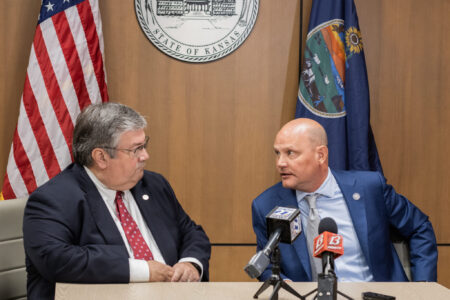
Senators confident Sunday sales will pass but House members unsure
Topeka ? Senators last year rejected a measure allowing Sunday liquor sales not because of strong opposition to the concept, but because it didn’t have a tax increase attached to it.
This week, the Senate is expected to debate a bill that permits local decisions on Sunday sales, makes the state’s Liquor Control Act uniform and raise taxes on all forms of alcohol.
Sen. John Vratil proposed the increase in the gallonage tax last week when the Federal and State Affairs Committee debated the bill.
Vratil, R-Leawood, is one of a few senators who voted against last year’s bill — which failed 19-18 — but say they support the new version.
“A number of people who voted against it felt like if we give Sunday sales to the industry, there needed to be a tax increase,” Vratil said.
The measure would raise the tax on beer to 30 cents a gallon from 18 cents; on fortified wine, to $1.50 from 75 cents a gallon; on light wine, to 60 cents from 30 cents a gallon; and on alcohol and spirits, to $4 a gallon from $2.50.
For a six-pack of beer, the increase would be about 7 cents.
Sen. Jim Barnett, R-Emporia, proposed a steeper tax increase that would have raised about $300 million over five years, to be earmarked for education. His plan was considered too drastic because it would have raised taxes by 20 percent on most forms of liquor but by 388 percent on beer, or 50 cents per six-pack.
Senate leaders think the liquor bill will clear their chamber and move to the House, which approved a Sunday sales bill last year.
The tax provision this year probably helps the measure’s chances with senators, said Senate President Dave Kerr, who opposed last year’s measure but said he would support the current bill.
“That’s a tax that hasn’t been altered since 1977, and consequently it’s one of those things that needs to be adjusted from time to time,” said Kerr, R-Hutchinson. “It seems to me to be a tough case to make that it doesn’t need some adjustment.”
But the tax increase could doom the bill in the House, said Speaker Doug Mays, R-Topeka.
“I think there are a lot of people who really don’t want to vote for Sunday sales that are willing to vote for it just to get the uniformity,” Mays said. “But you add taxes in there, and I think the whole thing collapses.”
Several cities — mostly along the border with Missouri, where Sunday sales are legal — have passed Sunday sales ordinances in the 16 months since a Wyandotte County judge ruled that provisions of Kansas’ Liquor Control Act did not apply uniformly to all communities. The state’s appeal of that ruling is before the Kansas Supreme Court.
This year’s legislation expressly forbids local governments from exempting themselves from parts of the liquor law and creating their own alcohol statutes.
“There’s a lot of interest in making that law uniform again rather than just have individual counties and cities opt out and do their own thing,” said House Minority Leader Dennis McKinney, D-Greensburg.
But he said excise taxes on alcohol don’t bring in much money, are unfair and tend to make people angry.
“I don’t think there’s much of a chance the House will pass an increase in taxes on beer,” he said. “People get angry over raising sales taxes, but that angers them less than taxing beer.”
He predicted that the measure will pass this year without the tax increase.
Vratil said uniformity of the state’s liquor laws is probably the most important aspect of the bill, though he acknowledged Sunday sales would probably have a more direct impact on Kansans overall.
He thinks the liquor bill will pass, with or without the tax increase attached.
“The concept of selling liquor on Sundays conforms with reality,” Vratil said.
State Government
KU professors would be limited in how they could present the idea of systemic racism in future classes
State legislators push back against federal energy regulators ending competitive bids
TOPEKA — Two Kansas legislators asked federal energy regulators to ensure competitive bidding occurs on ...
Senate confirms 1st of 3 Kansas nominees to U.S. District Court
Corporate income tax collections falling sharply in Kansas; Republican, Democratic leaders disagree on what it means
TOPEKA — Corporate income tax collections in Kansas have almost halved since last year, while other sources trend ...
Candidate’s campaign manager created website with documents used to attack rival
TOPEKA — Kansas U.S. Senate candidate Patrick Schmidt’s campaign manager left his digital footprint on ...