

Numbers increase for ROTC programs
Army, Navy and Air Force ROTC programs at Kansas University have seen a slight increase in numbers since the Sept. 11, 2001 terrorist attacks, but officials say the intensity of students in the three programs is what has changed the most.
“We’re a country at war and we’ve got a great bunch of young Americans who are wanting to go out and serve,” said Lt. Col. Brian DeToy, the outgoing director of the Army ROTC program at KU.
“What makes me feel good about the kind of students joining is that in today’s stretched Army, everybody is going,” DeToy said. “Everybody who’s joining now knows there is a possibility they may serve in a zone of combat; it’s not a theoretical possibility. They know what the requirements are going to be.”
When DeToy came to take over the program in August 2001, it had approximately 70 students. Last spring that number jumped to 80, but the quality of cadets in the program has improved significantly, DeToy said.
In 2001, the program had a grade-point average of 2.87, just below the university’s average. This year it is 3.2. Physical fitness averages have also gone up.
“I’m very proud of the quality,” DeToy said. “The numbers have only gone up by, say 10, but there’s a change in the quality of the cadet that comes into the program and now completes the program.”
The increased emphasis in GPA at KU is helping Army cadets when the graduate. DeToy said the Army has changed the way officers are assessed when they come on to active duty by giving more weight to academics
“It’s now 50 percent of how it turns out which branch they’re going to be in is based on their GPA,” DeToy said. “It really fits well for our KU students because we made that new emphasis three years ago.”
Air Force
Air Force Capt. Robb Johnson said there were about 60 cadets in the Air Force ROTC at KU in 2001. After the terrorist attacks, that number ballooned to 75 and has stayed steady.
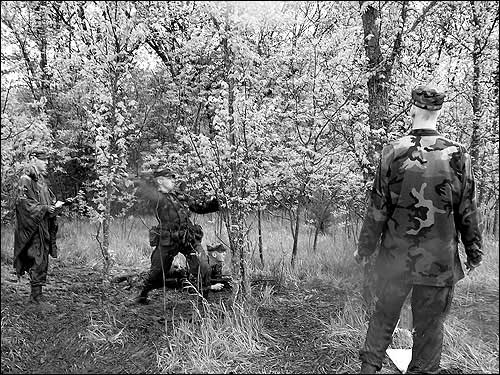
Cadet Nicholas Potter, left, judges an event during the Best Ranger Buddy Competition in April at Clinton Lake.
Johnson said the economy contributed to increased numbers.
“The economy is not that good right now,” Johnson said. “This gives you the security of having a job upon graduation.”
Getting into the Air Force ROTC has become more competitive in the past few years because active duty positions are being cut back, Johnson said.
“Three or four years ago if you met all the minimum criteria, you’d get an enrollment allocation,” Johnson said. “Now, if you just barely met the requirements, there’s a chance you don’t get one.”
Navy
The Navy ROTC program at KU has seen the number of cadets go down over the past 10 years, but that decrease has stopped with the number of cadets staying near 75 cadets over the past three years, Cmdr. Christopher Orwoll said.
“The total drain has steadied out,” Orwoll said. “We’ve lost a lot of full-ride scholarship students who have a tendency to go to Notre Dame or USC (University of Southern California), places like that.
“On the other hand, we’ve gained a lot of college-program students, who are students who come in here without a scholarship, and enlisted personnel who are here under the Navy and Marine Corps officer commissioning programs.”
Orwoll taught at Cornell University 12 years ago as part of the Naval ROTC program. He said the quality of student has stayed the same, but what the students want to do after they graduate has changed.
“We’ve seen more students go into aviation and surface ships here,” Orwoll said. “There are less going into submarines. Nationwide that’s not true, though.”
Diversity of experience
All of the services agree that ROTC is a valuable tool in building the best military possible. The variety of officer experiences prior to joining the military full time helps in defending the country.
“I want them to have that diversity of experience, because that’s what makes us the best military in the world,” DeToy said. “It’s a nonlinear battlefield; it’s a foe that is always seeking to evolve and change. We need people who can think and operate outside of the box.”
John Gassman, Riley senior, joined the Army ROTC three years ago as a freshman. He said KU students were intrigued by international affairs.
“People at KU aren’t afraid to discuss what is going on in the world,” Gassman said. “There have been times in class when people will be kind of critical (of the war in Iraq). But for the most part, people are more critical of political figures, not so much of the people fighting the war. When you’re a soldier you don’t get to ask why. The people fighting are just trying to get their jobs done.”
Gassman had just joined the Army ROTC when the 9-11 attacks occurred. He since has witnessed the wars in Afghanistan and Iraq.
“(The attacks) showed us what we were doing wasn’t just for fun, that it was really important and we were going to be needed once we graduated,” Gassman said. “It really hit home when the group that graduated when we were freshmen got deployed.”
Gassman said he came to college as a journalism major but changed to political science and international relations with a minor in Arabic language after the 9-11 attacks.
He said he would like to eventually move into military intelligence.
KU
KU professors would be limited in how they could present the idea of systemic racism in future classes

The annual summer solstice tour of the KU Native Medicinal Plant Garden will be held later this month

KU Homecoming parade to return to campus after seven-year absence
‘Backyard’ allows even more fans to cheer on Jayhawks

Dole Institute of Politics announces summer lineup celebrating America’s 250th anniversary
KU Hospital Authority says CVS stole nearly $62M in drug savings
The University of Kansas Hospital Authority is suing CVS and its subsidiaries, alleging the mega pharmacy company ...