

KU faculty, staff learn about Kansas sites
For several years, I’ve believed every location has something appealing about it. Sometimes it’s great scenery, or wonderful weather. Sometimes it’s a great place to eat, or the friendly people. A corollary to that view is that the interstate system — marvel of engineering and commerce that it is — does more to separate us than bring us together. The 2004 Wheat State Whirlwind confirmed my beliefs.
The six-day, 1,500-mile tour of Kansas on some of its less traveled highways and roads by nearly 40 faculty and staff members of Kansas University was an opportunity to interact with people from across the state. It was a chance to find out what they love about their locale and learn the challenges they face. It was an exploration not only of longitude and latitude, but also of the aptitude and attitude of our fellow Kansans.
The following is a partial account of what the assembly did and saw along the way:
May 21
Stop One: Kansas Speedway
KU alumnus Jeff Boerger offered a quick tour of the speedway at 8 a.m. It was a far cry from the roar of race day. There wasn’t a soul in sight in this massive facility, but one could sense the excitement of the races from the sheer size of the place. We were taken to the roof to view from the team spotters’ roost where we faced a very stiff Kansas wind. We then traveled to the lush President’s Suite view box for a discussion of the success of Kansas Speedway and the bountiful financial impact it has had on the region. Boerger led us to the track, where we boarded the bus and took a victory lap. With Boerger serving as pace car for the bus, we circled the track at a whopping 19.8 mph.
Stop Two: Leavenworth and Fort Leavenworth
After a quick drive through Leavenworth to see a few historic structures and lovely homes, we made a beeline for Fort Leavenworth, the oldest continuously operated military installation this side of the East Coast. A historian for the fort boarded our bus and gave us some delightful nuggets of fort history. Our tour included a stop at the Buffalo Soldier Memorial and the fort’s Frontier Army Museum. As we headed toward our next stop, we drove by the facility that most Americans undoubtedly associate with the region — the penitentiary.
Stop three: Atchison
Lunch was at the River House, second floor, with its fabulous view overlooking the Missouri River. Karen Seaberg, who helped pull together the Lewis and Clark Commemoration, told tour members of the transformation taking place in Atchison. Not that Atchison needs it. The city has some great aspects to it. The Victorian homes display amazing detail. Some of the homes are even said to be haunted. We spent some time at the birthplace of Amelia Earhart — a nice Victorian home, though not the best in town. The home sits atop a bluff overlooking the Missouri River. It’s easy to imagine a young Earhart wanting to fly as she woke up to a summer sunrise climbing over the river. A trip to Atchison isn’t complete without a stop at Nell Hill’s, an amazing collection of the latest in decorative trends. The store would make Martha Stewart envious. Before we left town, many of us trotted across the pedestrian plaza from Nell Hill’s to the Ball Bros. Drug Store for a treat at the fully functional soda fountain. Some folks were up for an authentic Green River soda. I can vouch for the chocolate malt. Mmmmm.
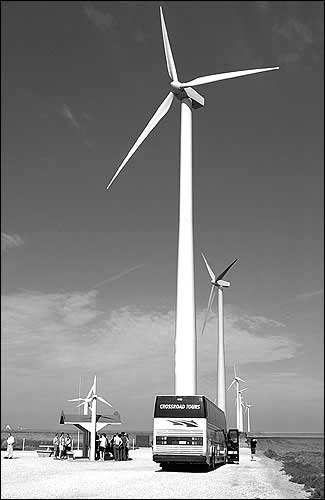
KU faculty and staff visit wind turbines May 26 near Montezuma.
May 24
Stop one: Topeka
A very early departure for the Kansas Capitol tendered a before-hours audience with Gov. Kathleen Sebelius. Shortly before her arrival, KU folks gave themselves brief unguided tours of the building and its amazing art and offered each other tidbits of their best recollection of the structure’s art history. The governor met us under the rotunda. She talked a bit about the recent presentation by former President Clinton at KU and discussed the strengths of the Kansas Legislature as well as its recent failing (school finance).
Stop two: Monroe School and the Brown v. Board of Education National Historic Site, Topeka
The site was an amazing interactive display that nearly brought me to tears. The schoolhouse classrooms have been converted to museum exhibits — each presenting a different piece of the social puzzle represented by the case. The first classroom I entered featured several video touchscreens that demonstrate the difficulty faced by people who worked for racial equality across the nation. Four large video screens create walls that channel visitors through a gauntlet of actual video demonstrating the racial hatred that permeated the country. Visitors are forced to walk through this funnel of hatred — taunts and jeers ringing in their ears — before they can leave the classroom. Others on the tour reported feeling this sense of humility from the exhibits. For one used to National Park visitor centers with overused and under-imagined exhibits, Monroe School presents a fresh and introspective departure.
Stop three: Ritchie Ranch
Ritchie Ranch is smack in the Flint Hills, southwest of Emporia. I’ve always said late May and early June find Kansas in its most beautiful outward show and I wasn’t disappointed. The ranch was a beautiful example of the charm of the Flint Hills. Scott Ritchie gave us a brief overview of a cattle ranch operation and the challenges such ranches have faced in recent years, especially with last year’s mad cow scare.
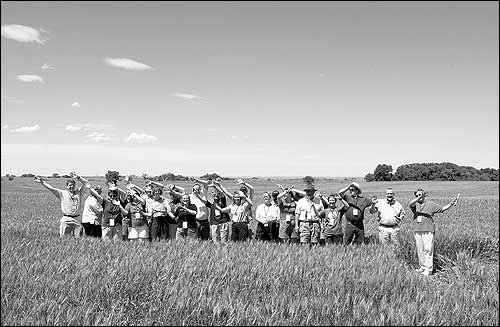
KU'S Wheat State Whirlwind bus cruises around the Kansas Speedway track on May 21 at Kansas City, Kan. The bus circled the track at 19.8 mph.
Stop four: Sedan
We pulled into Sedan in late afternoon and many were thrilled to find a gift shop that sold good espresso. The Red Buffalo, owned by broadcaster Bill Kurtis, features high-toned gift items and turns a good business on the side selling coffee to lost souls. Another local spot that turned out to be a hit was the Sugar Mining Co., a candy store that makes its goods on the premises and offers a “hootenanny” tour with lots of whoopin’ and hollerin’. The main street of Sedan is paved with named yellow bricks. A special corner features names of mostly dead celebrities, such as Bob Hope and Michael Landon.
Stop five: Winfield
The tour bus took us to Winfield for dinner at Galloways. We didn’t get much of an opportunity to look around the town, however we did have an illuminating discussion with David Seaton, the publisher of the Winfield Daily Courier. Immense thunderheads loomed around the city for a glorious view of the sky during the evening.
May 25
Stop one: Harper
The group visited DewEze Manufacturing.
Stop two: Medicine Lodge
The Gypsum Hills, or “Gyp Hills” as rancher Bob Larson calls them, are lovely red buttelike hills dotted with brown cattle and green cedars. Larson gave us a homespun overview of his style of cattle ranching — a cow-calf operation — well mixed with the history and economics of the region.
Stop three: Mullinville
M.T. Liggett’s kinetic art is a testament to all that one can communicate with a roadside stretch of pasture, scrap metal, a welding torch and paint. Hundreds of large structures line up along the fence, some moving, some standing as still as a Buckingham Palace guard, all of them jockeying for attention. Our bus was not the only vehicle to stop and let its passengers spill out for a better look.
Stop four: Meade
Lunch was to be at the Chuckwagon. The diner’s staff went to amazing lengths to feed the group when they experienced plumbing failures at their restaurant. They quickly set up a luncheon for our large group at a local church hall. The chicken was great.
Stop five: Liberal
Tour members had an opportunity to see where some KU students begin their college experience when the bus took us to visit Seward County Community College.
Liberal is also where we found Dorothy’s home, complete with a yellow brick road and a great gift shop that sells everything Oz.
The unexpected find of the day was the Mid-America Air Museum. Dozens of amazing aircraft, many experimental or military aircraft, are artfully arranged in a retired Beech manufacturing center. The site is billed as the fifth largest collection of military and civilian aircraft in the United States and it reminded me of walking into the National Air and Space Museum in Washington, D.C.
May 26
Stop one: Just outside
Liberal
We get another early start on the day with a visit to an active drill site for an oil well. KU mechanical engineering alumnus George Rosel made arrangements for the tour to stop at a drilling operation under way a stone’s throw south of Liberal in the middle of a dry, well-trampled pasture liberally peppered with cattle and a lone windmill and watering stock tank. We got to see, hear and smell an industry in action that is so tied to the present and future of the United States and the world.
Stop two: Outside Montezuma
The windmills at the Gray Wind Farm are a far cry from the one we saw at the day’s first stop. Impressive 300-foot high wind turbines — dozens of them — buzz overhead. Displays at the site give the producer’s spiel on an energy source that’s generating as much political heat as it is energy.
Stop two-and-a-half
Back to Montezuma for a quick restroom break at the Strauth Museum — a must-see gem in the off-the-beaten-path burg of Monte. The Strauths traveled the world and brought back hundreds of cultural and artistic items, coins and photographs. It’s an impressive collection — all artfully and tastefully displayed and supplemented with enlarged photos the couple took of their journeys.
Stop three: Garden City
The United Methodist Mexican-American Women’s Health Center provided the inspiration story of the tour. The center is a tiny clinic and social agency that is working to help guide the Hispanic laborers in the region toward U.S. citizenship as it also addresses the social and health issues that these people and their families face on a daily basis. They are doing an immense job on few funds and fountains of faith.
Stop four: Garden City
School’s out for Garden City Community College, too, but our group met with top administrators to find out what KU can do to strengthen its ties to the school and encourage more GCCC students to continue at KU.
Stop five: Logan County
Keystone Gallery is part fossil museum, part art gallery, part earthy gift shop and all charm. Take two steps out the door and you’re at the Duff Ranch and ready for a ride where the buffalo roam. The first thing one notices is the quiet. As I rode the flatbed truck, holding on for dear life every time the truck lurches over a cow trail, I realized I could hear the call of meadowlarks above the rumble of the vehicle. Black specks mark the faraway hills under a stretch of blue sky so big it wraps you like a blanket. The inky specks become much more distinct as the truck draws near. These big dark brown creatures are as sturdy as linemen, curious, charming and show they are as fast as the dickens.
Stop six: Monument Rocks
Monument rocks drew the crowd out of the bus for a spell long enough only to stretch legs, take pictures and get sand blown into our eyes. In spite of the discomfort-causing dirt, the outcrop is fascinating. I vow to come back on another day with the sky just as blue, or die trying.
Stop seven: Oakley
Few stops drew as much prearrival conversation as Oakley, particularly as it related to the world’s largest prairie dog, which many had seen in their previous travels along Interstate Highway 70. Now, Oakley has something else big to talk about: the bronze statue of Buffalo Bill unveiled the week before. The detail on this two-times-actual size monument is remarkable.
May 27, 2004
Stop one: Colby
The day began with a trip to the Prairie Museum of Art and History on the edge of Colby to view one woman’s amazing demonstration of obsessive-compulsive disorder. The museum is both enthralling and a reality check for anyone who displays packrat tendencies. Nothing can compare with this Kuska amazing and endless assembly of collectibles (art glass, buttons, pins, jewelry, ceramics, clocks, stamps, toys, and much more). The museum also features a several buildings, including the Cooper Barn and an old church complete with a functioning church bell.
Stop two: Nicodemus
We came at a gloomy time for this tiny village. Ernestine VanDuvall, the matriarch of Nicodemus and proprietor of Ernestine’s Bar-B-Que, died before our arrival. The town was indeed very quiet, in fact it resembled a ghost town with an important and proud past.
Stop three: Palco
The first of many stops in Palco was at the grain elevator, where we learned how elevators operate, physically and financially. It was here that many people realized that farmers not only possess a love of the land, but also a keen sense of the markets. After a lunch with many of the townsfolk, we took a short walk to the high school to learn about the distance education program they produce with three other area high schools. The bus then took us a short hop out of town for a firsthand look at an operating wheat farm. A walk across the street led us to the Kysar Machine Shop to see small-town America making a big impression on the way people work. The shop has identified a niche market and provides production line lifting machines for firms such as Goodyear and Hallmark. Another stop up the road took us to the John Steeples saddle-making workshop so we could see a leatherwork craftsman in action.
Stop four: Plainville
Who would have thought that corporate offices for a high-end, elite furniture maker would be found in Plainville, Kan.? DessinFournir furniture falls into the category that if you have to ask, you probably can’t afford it. The pieces are very elegant and the firm is making waves on the national scene. It’s easy to see why after a stroll through the catalog production room filled with thousands of photographs.
Stop five: Plainville
At the other end of the spectrum in Plainville is Sticks and Stones, which crafts limestone markers and monuments. The small and dusty operation is successful in its endeavors, but is shifting its focus to creating limestone monuments rather than the personalized rock posts with which it found initial success.
Friday, May 28, 2004
Stop one: Hays
Morning began with an early rise and quick jaunt to the Hays Medical Center where we toured the hallways to see the art collection.
Stop two: Victoria
St. Fidelis Catholic Church, the cathedral of the Great Plains, is indeed a large church for this town of diminished size. What the church offers in size, it matches in spiritual majesty. A large cross made of woven wheat is displayed in the sanctuary. It’s truly an inspired work of art that blends the resources of the region with the deep faith of its people.
Stop three: Lucas
We had a drive by tour of the blue green waters of Wilson Lake as we headed toward Lucas. Once in Lucas, we found not only the famous Garden of Eden, but something worth coming back for: Brant’s Meat Market. The dry-cured bacon and beef jerky are well worth a repeat visit. The stop gave us ample time to walk through Lucas and explore the Grassroots Art Museum, where one can find amazing folk art items such as a large car and motorcycle crafted from thousands of soda can pull tabs.
Stop four: Marquette
In Marquette we met the mayor and looked at the development taking place as part of the town’s immensely successful land giveaway project. The town has made 50 lots available. The waiting list is 100 families long and the town owns more land it can devote to the cause. Kansas ingenuity is alive and kicking.
Stop five: Lindsborg
Lindsborg “Little Sweden” has more culture per square inch than probably any other town in Kansas. Of course, it’s almost all Swedish culture. The town is much like a littler Lawrence, with a Swedish theme. Art galleries, small local shops, tasty restaurants all populate the downtown region and give Lindsborg a flavor all its own. By the way, the Swedish meatballs at the Swedish Crown restaurant are well worth a try. While at the restaurant, Marci Penner, of Kansas Sampler, spoke with the group. Kansas Sampler focuses on getting more people in the state to explore other parts of the state, especially the rural areas, and offer a grassroots style of revitalization.
After the afternoon visit in Lindsborg, the bus loaded and headed straight for Lawrence.
The trip provided a number of revelations for me even though I’ve lived in the state for more than 30 years. The varied and beautiful landscape was appreciated, but more refreshing were the discoveries of people, places and philosophies. This state possesses a tremendous reservoir of business acumen, talent and dedication. The lasting lesson I’ve gained from the experience is this: Get off the interstate; a whole world awaits you, but it isn’t on I-70.
KU
KU professors would be limited in how they could present the idea of systemic racism in future classes

The annual summer solstice tour of the KU Native Medicinal Plant Garden will be held later this month

KU Homecoming parade to return to campus after seven-year absence
‘Backyard’ allows even more fans to cheer on Jayhawks

Dole Institute of Politics announces summer lineup celebrating America’s 250th anniversary
KU Hospital Authority says CVS stole nearly $62M in drug savings
The University of Kansas Hospital Authority is suing CVS and its subsidiaries, alleging the mega pharmacy company ...