

KU professor finds innovation in nests
Ant project mushrooms into medical marvel
The more than 50,000 ants in Cameron Currie’s lab take the term “ant farm” to a new level.
Inside small plastic containers, nests ranging from a few dozen to 10,000 leaf-cutter ants cultivate mushrooms, weeding out fungi contaminated by mold — and using antibiotics to keep the mold from wiping out their food source.
“Potentially there is lots we can learn from understanding this (ant) system,” said Currie, a Kansas University assistant professor of ecology and evolutionary biology. “Ants may have unique ways of dealing with disease that we never thought of.”
Scientists have known for more than a century that many ants grow fungi. Currie is a research pioneer who discovered the ants’ farming and pharmaceutical abilities.
The ants he is studying, found almost exclusively in the tropics of the Western Hemisphere, plant the mushrooms in their nests and cultivate them using chewed-up leaves as a sort of mulch.
In the wild, those nests can be as large as a room and contain as many as 7 million ants.
“It’s more like a small-scale garden operation than major industrial agriculture,” Currie said.
Fossil evidence shows the leaf-cutter ants have been farming for at least 50 million years. In contrast, humans only began cultivating grains about 10,000 years ago.
But in 1999, while a doctoral student at the University of Toronto, Currie discovered there was more to the process than originally thought.
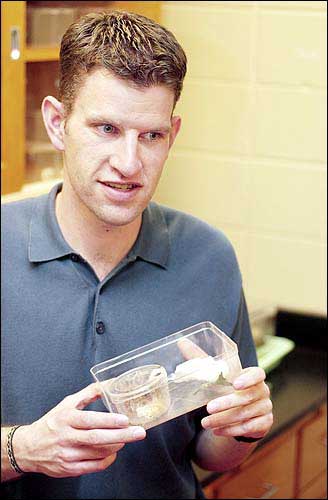
Cameron Currie, assistant professor of ecology and evolutionary biology at Kansas University, displays some leaf-cutter ants in his lab. During his research, Currie discovered the ants cultivate mushrooms and use antibiotics to keep the mold from destroying their food source.
He determined there is a mold, known as Escovopsis, that can spread rapidly over the mushroom crop. But there is a group of guardian ants to detect the infected fungi and cart them to a dump outside the nest.
Currie also discovered that the ants have an antibiotic-producing bacteria on their bellies, just beneath their heads, that can be used to combat the parasitic mold.
His current research includes mapping the evolution of the bacteria. Currie already has mapped the history of the parasite. One goal is to determine why the antibiotic is found on the ants’ bodies and not on the mushrooms themselves.
“It may be that the antibiotics’ introduction to the pathogen encourages resistance,” Currie said. “If the pathogen is always being exposed to the antibiotic, it gives it a chance to build a resistance.”
And insight into that issue, experts say, could help lead to practical applications for humans.

 Antcolony.org
“Understanding this use of antibiotics by ants could be directly relevant to human survival,” said Ted Schultz, an insect specialist at the National Museum of Natural History in Washington, D.C.
Conceivably, researchers could turn up a new drug like penicillin, which was discovered by accident in 1928 and put to medical use in 1941. More likely, he said, are insights into how infectious agents, such as SARS or HIV, are spread and controlled.
Currie said the possibilities were amazing, considering 3,000 papers had been published about the fungi-growing ants before his discoveries of the ant antibiotics in 1999. He said the study was a reminder of how much humans have left to understand.
— Journal-World wire services contributed to this report.
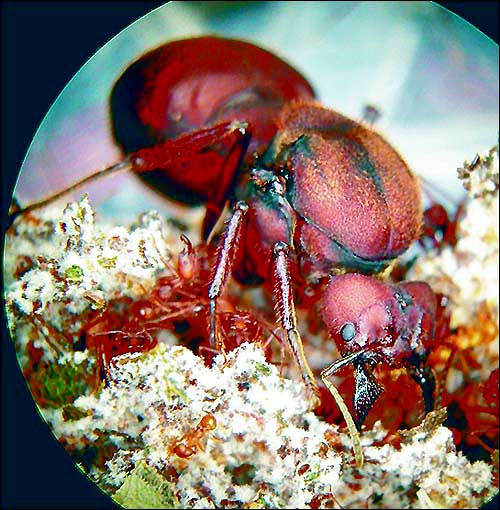
This ant is seen in a magnified view through a dissection microscope.
KU

KU professors would be limited in how they could present the idea of systemic racism in future classes

The annual summer solstice tour of the KU Native Medicinal Plant Garden will be held later this month

KU Homecoming parade to return to campus after seven-year absence

‘Backyard’ allows even more fans to cheer on Jayhawks

Dole Institute of Politics announces summer lineup celebrating America’s 250th anniversary
KU Hospital Authority says CVS stole nearly $62M in drug savings
The University of Kansas Hospital Authority is suing CVS and its subsidiaries, alleging the mega pharmacy company ...