

KU professor finds baseball a perfect field of study
English instructor to present paper during Cooperstown trip
James Carothers went to the batting cages last week to prepare for an at-bat or two in Cooperstown, N.Y.
“I didn’t fall over, so I figured it was a success,” Carothers said.
The Kansas University professor of English on Thursday will be at the Baseball Hall of Fame in Cooperstown to present a paper on baseball in American literature.
But he hopes the highlight of his trip will be taking a few pitches at Doubleday Field, where baseball greats often give hitting exhibitions when they return to the Hall of Fame.
“I’m taking a bat,” Carothers said. “I may get to hit while I’m there. That would make the whole trip worthwhile.”
Carothers, a lifelong baseball fan, has taught a KU course on baseball and literature every few semesters since 1974. He’ll teach it again in spring 2004.
The paper he’ll present this week to the “Baseball and American Culture” symposium compiles much of the information he uses in the course. The paper is titled “Baseball in American Fiction: Background and Foreground.”
But Carothers admits the “smart-aleck” title is “Why Guys Like Baseball Better than Women.” That’s because baseball — unlike romance — isn’t complicated, he said.
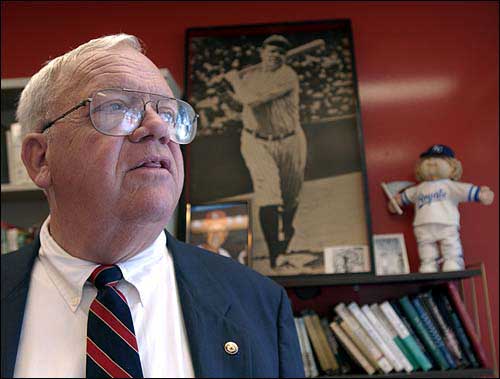
Kansas University English professor James Carothers will travel this week to Cooperstown, N.Y., and the baseball Hall of Fame to present a paper on baseball in literature. Carothers is a big baseball fan and has taught courses at KU on the subject.
“It seems to me that baseball in serious American fiction functions in about the same way,” he said. “It’s an adolescent or childhood ideal, against which all adult things are measured. It’s complicated to be grown-up in a world with sex and death and work and war. There is sort of a nostalgic yearning for baseball.”
Among his favorite baseball references is in “Portnoy’s Complaint” by Philip Roth, in which the main character, Alexander Portnoy, rushes from visiting his mother in the hospital to play center field for his softball team.
Carothers’ 25-page paper mentions a wide array of literary references and includes authors such as Ernest Hemingway, William Faulkner, Mark Twain and John Dos Passos.
Carothers has visited the Hall of Fame several times before, but he said he planned to visit the new George Brett memorabilia at the site and the exhibit of his childhood hero, Stan Musial.

 6News video: KU professor to head to Baseball Hall of Fame
 KU news release
Symposium participants also are planning a game of “town ball,” a 19th-century forerunner of baseball that used stakes for bases, a square playing field instead of a diamond and had no limit on the number of fielders.
Carothers said the upcoming trip to New York made him realize how fortunate he was to enjoy his job.
“I always felt lucky to do what I do,” he said. “My pastime and my vocation happen to intersect.”
KU
KU professors would be limited in how they could present the idea of systemic racism in future classes

The annual summer solstice tour of the KU Native Medicinal Plant Garden will be held later this month

KU Homecoming parade to return to campus after seven-year absence
‘Backyard’ allows even more fans to cheer on Jayhawks

Dole Institute of Politics announces summer lineup celebrating America’s 250th anniversary
KU Hospital Authority says CVS stole nearly $62M in drug savings
The University of Kansas Hospital Authority is suing CVS and its subsidiaries, alleging the mega pharmacy company ...