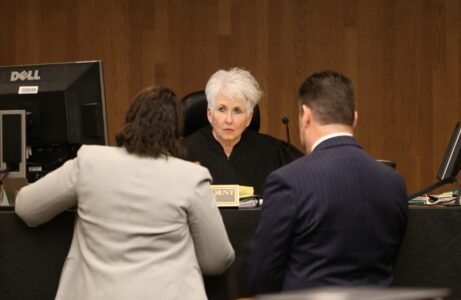
Firefighters keep tabs on crowd safety
The sight of a firefighter in the middle of a nightclub surprised the young crowd Thursday night at Cadillac Ranch.
“I was on the dance floor and I turn around and there’s a fireman in his full jacket behind me,” said Kristen Landes, a Gladstone, Mo., sophomore at Kansas University. “I thought something might have happened. You don’t expect to see a fireman out at a bar at 1 in the morning unless something’s wrong.”
Lawrence firefighters have done regular night checks the past 15 years at bars and clubs, including Cadillac Ranch, 2515 W. Sixth St., but their presence probably will be more noticeable to young patrons after back-to-back nightclub calamities, first Monday in Chicago, then Thursday in Rhode Island.
The Rhode Island fire killed at least 96 people and injured nearly 200. Fireworks during a concert ignited the blaze that consumed the nightclub. The incident came just four days after 21 people died in a stampede at a Chicago nightclub.
Lauren Royall, a KU senior from Tulsa, Okla., said the nightclub tragedies were awful.
“I saw the fire on the ‘Today’ show,” Royall said Friday. “I just think, ‘Aw, that will never happen to me.’ It won’t stop me from going to clubs, but I’ll be checking around for the fire exits from now on.”
Rich Barr, fire marshal with Lawrence-Douglas County Fire & Medical, said fire officials tried to prevent such tragedies in Lawrence, but the threat of a similar nightclub disaster remained.
On the prowl
Barr said Fire & Medical used a night consultant program to check Lawrence bars and theaters. The program employs six firefighters, including the one seen Thursday night at Cadillac Ranch.
The firefighters go out at 10 p.m. and patrol for three or four hours to ensure all fire exits are open and unblocked in the venues they visit. They check exit signs and emergency lighting to make sure they’re functioning.
Firefighters also determine how many people are inside and if the venue has too many occupants.
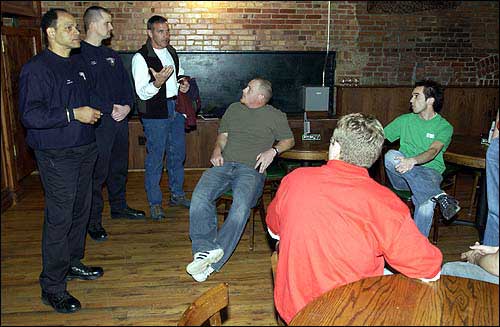
From left, Lt. Pete Easterwood of Lawrence-Douglas County Fire & Medical, firefighter Steve Welter and Fire Marshal Rich Barr speak to employees at Abe & Jake's Landing, 8 E. Sixth St., about emergency evacuation procedures. The conversation Friday occurred in the wake of nightclub tragedies in West Warwick, R.I., and Chicago.
“If they walk in and it appears that the building is getting pretty crowded, then they determine a count,” Barr said. “If it’s overoccupied, they ask the manager to reduce the number of people. If it’s far over occupancy, they will issue a notice to appear in municipal court.”
Barr said the department had used the night consultant program for about 15 years at the behest of Fire Chief Jim McSwain. He began the program because of concerns about bars overcrowded with young people and buildings not adhering to occupant loads.
“Six pretty dedicated guys are out there to make sure we don’t have a situation where exits are locked and people are so packed in that they don’t have the opportunity to get out if something were to happen,” Barr said.
Clearing the exits
In Chicago, 21 people died even without the presence of fire. Overcrowding and locked exits during a stampede were blamed for the deaths. In Rhode Island, officials said most of the clubgoers tried to get out the main exit, neglecting smaller side exits.
Barr said Lawrence fire code mandated the main entrance of a place be the biggest one in the building.
“If something is happening and scaring you, you’re not going to want to go exploring,” Barr said. “The human response is, if everything is going to heck around me, I don’t want to look around. I want to come out that way I came in. People panic and people die from it — and not as a result of the fire, but as a result of their panic.”
Where the crowds are
Barr said his team focused on venues they knew drew large crowds. He said large clubs such as The Granada, 1020 Mass., and Abe & Jake’s Landing, 8 E. Sixth St., worried him because of their size and crowd appeal.
“We know there are certain businesses that routinely run close to occupancy or go over,” Barr said. “We tend to start going there more frequently to make sure they don’t get out of hand. Abe & Jake’s was cited to appear last weekend, and they’re working with us. I’ve been in contact with the manager and property owner and they have concerns about these recent issues.”

 6News video: Local club owners respond to night club tragedy
 Lawrence night clubs
He said The Granada did a good job keeping aisles clear and making sure exits were accessible though the club usually came close to exceeding its occupancy load.
In the late 1980s the department approached the Lawrence City Commission to make occupancy fines more substantial. The commission complied and put the maximum fine at $2,500 per violation, but Barr said he had never seen anyone fined that much. A judge could give the club manager or owner up to six months in jail or the $2,500 fine.
The responsibility for adhering to fire codes lies with the bar manager and its employees, Barr said. Even when the property owners and managers are doing everything to comply with fire code, an employee can cause a violation.
Several nightclubs, including The Granada, had contacted Barr and requested he talk with their staff about the importance of fire safety.
“I’d like to have an opportunity to sit down with the staff of every assembly venue in this town and tell people it’s not like Rhode Island and Chicago aren’t Lawrence,” Barr said. “That kind of thing can happen here.”
— Kelly McNearney is a Kansas University senior.
Public Safety
Lawrence sex offender facing 20 years in prison sentenced to three years of probation

Jury convicts woman who shot at Lawrence police in April 2025 standoff
LDCFM crews put out house fire caused by lightning strike during Tuesday morning’s storms; it was one of 28 weather-related incidents
Lightning from Tuesday morning storms produced one Lawrence house fire
Storms that rolled through Douglas County early Tuesday morning produced lightning strikes that caused one house ...
LPD says a scammer is using its number and officer’s name to fish for money