

KU recruiters take show on the road
Admissions officials make university's case
Montezuma ? Brett Hathaway stares in awe at the windmills.
Besides tumbleweeds, the 170 turbines near Montezuma are the first interesting piece of landscape he’s seen in several days of crisscrossing western Kansas.
“I’ve never seen anything like that,” he says. “It’s like science fiction.”
When your job is to go to small high schools day after day, giving the same presentations about Kansas University, answering the same questions about scholarships and drinking and cute basketball players, windmills are exciting.
Hathaway is one of seven admissions representatives who recruit Kansas high school students to KU. They’re part Jayhawk cheerleaders, part encyclopedias on all things Mount Oread.
Sports focus
Ask a high school student in western Kansas about KU, and he’ll likely talk about basketball. Ask him about Kansas State University, and he’ll talk about football.
Convincing him that college is really more about studying and getting involved on campus is task No. 1.
This week, Hathaway is on a five-day trip to visit 10 schools, including Satanta, Liberal, Garden City and Dodge City.
He arrives at South Gray High School in Montezuma, 30 miles southwest of Dodge City, in the afternoon. From his state-issued station wagon, he looks for towering football-field lights, a trick of the trade to find the high school.
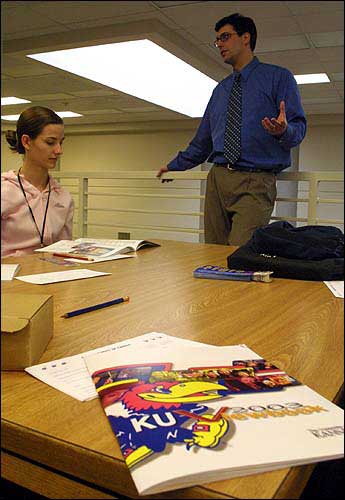
Brett Hathaway, an admissions counselor for Kansas University, speaks to prospective students at Garden City High School. Hathaway takes promotional materials with him on visits to western Kansas to encourage students to come to KU.
Seven students are gathered in their counselor’s room to hear him talk.
He starts his spiel. It varies school by school, but usually includes the following KU facts:
- KU was founded in 1858.
- To be admitted, you must have a 21 on your ACT, rank in the top third of your high school class or have at least a 2.0 GPA in a college-bound curriculum.
- KU recommends you live on campus your first year.
- KU has support services such as Robinson Gymnasium, the Multicultural Resource Center and the Freshman/Sophomore Advising Center.
- KU has more than 400 clubs and organizations.
- Students from more than 100 countries attend KU.
- Some classes are big, but the student-to-faculty ratio is 15 to 1. (The Office of Institutional Research and Planning actually puts the ratio at 17.3 to 1).
- Lots of students choose to study abroad.
- Lawrence is a fun, diverse community close to Kansas City.

 Find maps, information about buildings, traditions, top salaries, hot spots around campus and more
He’s already given the same speech three times this week. He’ll give it 11 more times before he’s done.
“Sometimes,” he admits, “I’m talking and not really even thinking about what I’m saying.”
‘Surface area’
After his presentation, he answers questions. That’s when the fun begins.
“We have to know the surface area of the university,” he says. “It’s not that deep outside the admissions process.”
In Montezuma, the first question comes from Whitney Love, a junior who says she’s split between attending KU and Brooks College, an interior design school in Los Angeles.
She raises her hand, then asks: “Is Kirk Hinrich single?”
Hathaway laughs, then politely says he doesn’t know.
Another student stops by while roaming the hallways. He’s already opted to attend Fort Hays State University next year but wanted to ask: “When’s Wayne Simien coming back?”
Barrage of questions
Often, though, the questions are serious and specific. A sampling of the questions Hathaway will field this week:
- When will I know whether I’m admitted?
- Why didn’t I get a scholarship?
- Who’s the head of athletic training at KU?
- Can I get out of the big classes?
- Are any of the coaches also professors?
Once, while attending a college fair in Dallas, a student pulled out his wallet and asked, “Can you check out my fake ID to see if it’d get me into the bars in Lawrence?”
“I could lose my job over something like that,” Hathaway recalls. “I think I just told him if it’s good enough for Dallas, it’s probably good enough for Lawrence.”
Soft sell
KU admissions representatives don’t take a hard-sell approach to the high school students. They say they want to simply provide information to the students to help their college decisions.
“I don’t get paid any more if I get 50 students from a school than I do if I get one student,” he says. “I’m supposed to spread information about the university and the town of Lawrence.”
Sometimes just getting over stereotypes about KU can be a big challenge, says David Burge, the interim associate director of the Office of Admissions and Scholarships. Many students assume KU is more expensive or selective than KSU, neither of which are true.
“But we’re proud of what we’re doing here — and I guess I’m flirting with ‘snob hill,'” he says. “I hate using that term. We’re more accessible than people realize.”
In some areas, KU faces a competitive disadvantage to KSU, whose extension service sponsors many programs in rural communities.
But as far as actual recruiting goes, the two universities have similar approaches, said Lisa Pinamonti, interim director of admissions and scholarships.
“I don’t think they’re more present than we are,” she says. “We’re out there, too.”
Faith in KU
Most admissions representatives only stay in the job a year or two, opting to go to graduate school, to advance in admissions work or to pursue another career.
Hathaway graduated last May from KU with a degree in communication studies. He says he’s not sure how long he’ll keep this job, though it won’t be more than a few years.
He started his job in July, got married in August and hit the road a few weeks later. Being a newlywed away from his wife, Sally, can be stressful.
“It’s tough,” he says. “Of course it’s tough. I do miss her.”
Despite the monotony of the road, Hathaway says he truly believes in KU and the education he received.
“If you didn’t have that attitude in the interview you wouldn’t get the job,” he says. “I think we have just as many things at KU as you’re going to have in a Division I school anywhere. We may not have an ocean to look at or mountains, but we definitely have respected degrees that get you out in the real world and the chance to have a fun, great experience in the process.”
KU

KU professors would be limited in how they could present the idea of systemic racism in future classes

The annual summer solstice tour of the KU Native Medicinal Plant Garden will be held later this month

KU Homecoming parade to return to campus after seven-year absence
‘Backyard’ allows even more fans to cheer on Jayhawks

Dole Institute of Politics announces summer lineup celebrating America’s 250th anniversary
KU Hospital Authority says CVS stole nearly $62M in drug savings
The University of Kansas Hospital Authority is suing CVS and its subsidiaries, alleging the mega pharmacy company ...