Humanitarian project on global display
KU architecture students design award-winning AIDS treatment station
The work of three Kansas University architecture students is touring the world, spreading the word about the AIDS epidemic in Africa.
The mobile AIDS testing and treatment facility was designed as part of an international competition organized by Architecture for Humanity, a New York-based organization.
The facility, with its solar panels and pop-out areas coming off a cylinder, might look more in place orbiting Earth than in the desert of Africa.
“It’s a little futuristic,” said Lee Shradar, a junior from Omaha, Neb. “It might be a little ahead of what people need now.”
Shradar, along with juniors Christian Kerrigan, of Ireland, and Jacob Hodges, of Sterling, entered the proposal last fall as part of an annual competition that focuses on using architecture to help people. One recent competition sought proposals for low-cost housing in Kosovo.
The KU design was one of 30 selected from 530 entries for an international tour. The display is in the Art and Design Museum in Los Angeles, and will be heading to stops in England, South Africa, the Netherlands and New Zealand.
The KU students designed the mobile unit that was a 15-foot-long cylinder with an 8-foot diameter. It could be dropped from a helicopter, transported by truck or floated behind a boat.
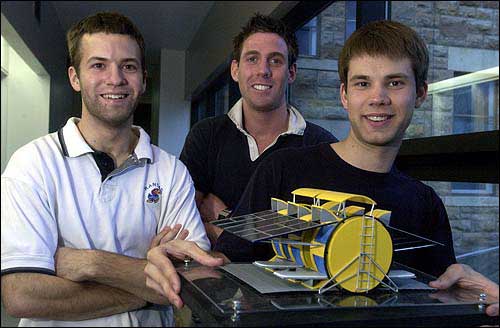
From left, Kansas University third-year architecture students Lee Shradar, of Omaha, Neb., Christian Kerrigan, of Ireland, and Jacob Hodges, of Sterling, won an award for their design of a mobile AIDS testing and treatment facility for the African desert. Their design was selected for an international tour.
The mini-hospital has pop-out features — such as those on some recreation vehicles — that allow it to expand for treating patients. It has an inside room to test people for HIV, and room for four beds outside underneath large shades to treat patients.
The roof of the shades has solar panels to provide the unit’s electricity.
“We tried to make patients as comfortable as we could, but we were also limited by the fact it was a portable thing,” Hodges said. “Obviously it’s not air-conditioned, but we figured they’d be used to that somewhat.”
The students e-mailed doctors in Africa to learn what it would take to treat the multitude of AIDS patients there. There are an estimated 30 million people with HIV or AIDS living in Africa; 2.4 million died of AIDS in 2002 and 3.5 million new infections were estimated last year.
Phillippe Barriere, the associate professor who advised the students, said the assigned project was difficult.
“It’s isolated,” he said. “It goes from village to village. It has to be in many different situations.”

 More on the Mobile HIV/AIDS Health Clinic Project
One of Barriere’s former students at KU, Nicholas Gilliland, was another winner in the program. Gilliland works for a design firm in Paris.
Although the students’ design may never be built, Kerrigan said he hoped the touring display would make people think about the AIDS problem in Africa.
“They wanted to find a way to help with the epidemic,” he said. “They’re trying to make an awareness of the epidemic through architecture proposals.”
KU

The annual summer solstice tour of the KU Native Medicinal Plant Garden will be held later this month

KU Homecoming parade to return to campus after seven-year absence

‘Backyard’ allows even more fans to cheer on Jayhawks

Dole Institute of Politics announces summer lineup celebrating America’s 250th anniversary
KU Hospital Authority says CVS stole nearly $62M in drug savings
The University of Kansas Hospital Authority is suing CVS and its subsidiaries, alleging the mega pharmacy company ...