Accident raises safety questions
Fatal wreck occurred in same area a year ago
For Bill Hack, the scene Sunday morning was deja vu.
Outside his back window, near 15th Street and Bobwhite Drive, emergency workers were removing the body of a young man who had been driving too fast, missed a curve and hit an embankment.
The accident occurred almost exactly one year after a similar wreck. He said both accidents proved the city must do something to make the street safer.
“They’re identical accidents,” Hack said. “Something’s got to be done to keep these kids from treating this as a four-lane racetrack.”
The latest accident happened at 1:13 a.m., just west of 15th Street and Bobwhite Drive, which is about 200 yards east of Corpus Christi Catholic Church.
Carol Ray Knisley III, 23, was driving a 2002 Acura RSX east on 15th Street when he lost control of his car on the curve, went off the south side of the road and hit an embankment, tree and fence. He was pronounced dead at the scene.
“We are investigating excessive speed as a factor in the accident,” said Sgt. Mike Pattrick of the Lawrence Police Department. He declined to speculate on how fast Knisley may have been traveling.
Pattrick said there was no indication alcohol was a factor in the accident, though the investigation would determine that for certain.
Knisley, a native of Independence, was a former Kansas University student studying computer science but hadn’t been enrolled since fall 2001, a university spokesman said.
The crash was nearly identical to the Nov. 9, 2001, accident, which killed Chansanouk Sengchan, a 20-year-old KU student from Winfield. Pattrick said high speed and alcohol contributed to that accident, though he declined to say how fast Sengchan was traveling. The posted speed limit is 40 mph.
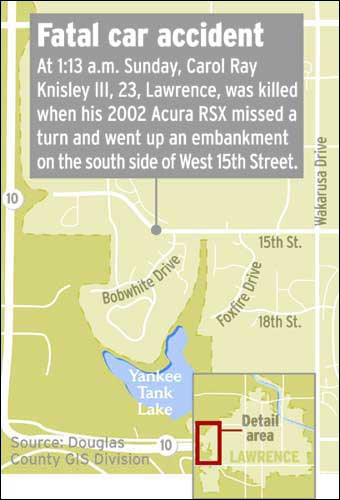
Sengchan’s car – a 1996 Acura – landed about 50 feet east of Sunday’s accident site. A makeshift memorial of a bowl, rose and champagne bottle still mark the site.
Hack said neighbors began discussing the road’s safety after the first accident. Now, he said, they’re going to take their complaints to the city.
“Fortunately, as tragic as it is to have those kids lose their lives, they haven’t taken anyone else out with them,” Hack said. “Our biggest concern is one of these times, a westbound car is going to get right in front of them, and there’s going to be a terrible tragedy. They’re going to wipe out a family of four in addition to themselves.”
Hack said he wasn’t sure what would curtail speeding in the area. He suggested a traffic-calming device could make a difference.

 6News video report: KU student dead in auto accident (11-10-02)
 KU student killed in one-car wreck (11-10-02)
But David Woosley, the city’s traffic engineer, said the street probably wasn’t a good candidate for such a device.
“Usually you don’t put traffic-calming devices on arterial streets,” he said. “They’re usually reserved for local streets.”
He said the city hadn’t received complaints about the road in the past. But Hack said he planned to call Woosley.
“Two accidents – one a year – isn’t really a high number,” Woosley said. “If we had a lot of vehicles running off the road, that would be different. Certainly if there’s a problem it needs to be looked at, but you have to look at the circumstances of the crash – was the roadway the problem, or was the driver the problem?”
Hack said he rarely saw police officers patrolling the area. Pattrick said police would consider watching speeders in the area more closely.
“If the manpower exists, we could see if that would work,” he said. However, “we can’t have police presence running radar in every part of the city.”
Public Safety

Perry-Lecompton school district implements AI gun detection technology to protect students and staff from threats
Man convicted of battery against Douglas County corrections workers dies at El Dorado facility
A man convicted of battery against three Douglas County corrections workers died in his cell at the El Dorado ...
‘If it ain’t broke, don’t fix it’: Retired Judge Sally Pokorny tells residents why she opposes electing Supreme Court justices
Lawrence police seek info on alleged child sex crime involving former teacher; incident occurred over 25 years ago
Lawrence sex offender facing 20 years in prison sentenced to three years of probation