Services offered to disabled students
Thirty years ago, it was hard to imagine students in a wheelchair going to Kansas University. For starters, the students had no way to get up or down the hill, and even if they did, few buildings were accessible for students with disabilities.
Heck, there weren’t even any “curb cuts” on Jayhawk Boulevard.
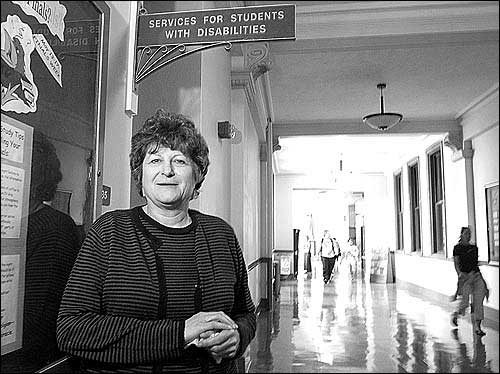
Lorna Zimmer is director of KU's Services for Students with Disabilities. Last year, her department ensured accessibility to 705 students.
The chances of a blind or hearing-impaired student making it were somewhere between none and a cruel joke.
Like most state universities, KU was not a friendly place. Today it is, thanks to the federal Rehabilitation Act of 1973.
“The law says a student cannot be excluded or impeded because of disability. The university has to provide equal access to its programs, services and facilities,” said Lorna Zimmer, director of KU’s Services for Students with Disabilities, in Strong Hall, Room 135.
Last year, the office ensured accessibility to 705 students with disabilities. For the blind, that meant finding either tape-recorded versions of textbooks or computer software that converts scanned words to spoken words.
For the hearing impaired, it might have meant reserving a front-row seat in the classroom or supplying enhanced listening devices.
Wheelchair accommodations are much improved, Zimmer said.
“I’m quite proud to say that someone (in a wheelchair) can go from the Campanile to Watkins Health Center by using accessible entrances and elevators,” Zimmer said. “We are more than happy to show anyone the route.”
By the start of the 2002-2003 school year, a map of the route should be available at Zimmer’s office. Also, KU on Wheels provides front door-to-front door transportation services to anyone with a physical disability.
“The only thing we ask is a 24-hour notice of when it is they need a ride,” Zimmer said. Students, she said, are encouraged to log their requests for rides as soon as they know their semester schedules.
“It’s usually not a problem,” she said.
The Services for Students with Disabilities office isn’t just for someone who’s in a wheelchair or who has trouble hearing or seeing. The office also provides assistance for learning disorders; attention deficit hyperactivity disorder; chronic medical conditions, including diabetes, lupus, heart disease and chronic fatigue syndrome; clinical, diagnosed depression; and mobility impairments.
All the services are free.
“The law is very clear on that,” Zimmer said. “It says a student with a disability cannot be asked to pay more than any other student.”
But, she said, that doesn’t mean students with disabilities get a free ride. Instead, it only levels the playing field.
“It’s been my experience and I’ve been working in this field 35 years that people with disabilities only ask for what they need,” she said.
The most successful students, she said, are those “who say ‘My disability is not my fault, it’s my challenge, and with some accommodations I can do the work that comes with being in college.'”
Zimmer offered a couple of tips to incoming students with disabilities:
Apply for services early; a lot of documentation is required.
“It helps to get started while you’re still in high school,” she said. “Your sophomore year is not too early.”
It also takes time to line up the services.
Don’t be shy.
“Some people, I know, are hesitant to come in because they don’t want the ‘disability label.’ It makes them uncomfortable,” Zimmer said.
“That’s fine, and we understand that, but we hope they’ll at least find out what’s available; then, if they don’t want it, it’s OK. Whether they get services or not is nobody else’s business.”
KU

The annual summer solstice tour of the KU Native Medicinal Plant Garden will be held later this month

KU Homecoming parade to return to campus after seven-year absence

‘Backyard’ allows even more fans to cheer on Jayhawks

Dole Institute of Politics announces summer lineup celebrating America’s 250th anniversary
KU Hospital Authority says CVS stole nearly $62M in drug savings
The University of Kansas Hospital Authority is suing CVS and its subsidiaries, alleging the mega pharmacy company ...