

Crime incidents down on campus
Kansas University is in decline in the area of reported crime incidents, that is.
KU has seen four years in a row of decreasing crime on its Lawrence campus, according to statistics compiled at the conclusion of 2001 by the KU Public Safety Office.
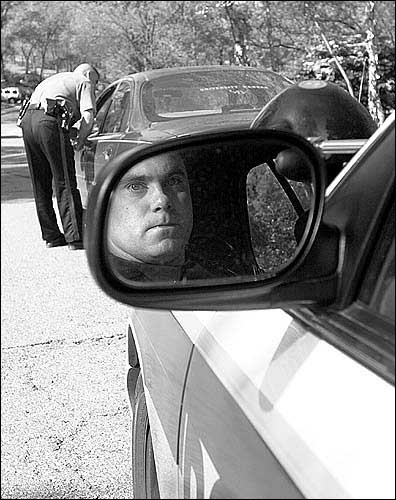
A KU Police officer provides backup help while another officer issues a ticket. Campus crime has decreased the past four years, according to statistics compiled by the KU Public Safety Office.
Property crimes such as thefts and car burglaries were among those in the declining categories.
“Property crimes account for the highest percentage of crimes reported to us,” Lt. Schuyler Bailey said.
For example, burglaries to vehicles and residences totaled 343 in 1997 and have since dropped to 155 in 2000 and 154 in 2001.
There are many possible reasons for the decline, Public Safety Director Ralph Oliver said. In addition to an overall national trend toward crime decreases, several steps have been taken by KU to increase crime awareness and take away opportunities for criminals, he said.
During the past few years KU police have worked with the Student Senate’s Campus Safety Advisory Board to increase lighting for parking lots and other locations on campus, Oliver said.
“That has really made things a lot safer,” Oliver said.
 |
|
|
|
|
|
|
|
|
|
|
Oliver also credits the chancellor’s office with allowing his department to hire a second detective.
KU officers also take part in new student orientation sessions, Oliver said.
“This is a way we can touch all new students coming onto campus,” Oliver said.
A major factor in deterring campus crime is the students themselves, Oliver said. That means doing the little things such as shutting and locking dorm-room doors.
“Don’t leave your backpack unattended, even if you’re just going a few feet away,” Oliver said. “Don’t walk alone at night. Some people meet somebody new that they don’t really know and take off with them.”
KU officers also conduct safety and anti-crime seminars in the campus dorms.
For the first time in at least four years, there were no reports of rape on campus, statistics show. There were four reported in 2000 and seven in 1997.
“Even though no rapes were reported to us in 2001, we know that does not mean that rape didn’t happen on campus,” Bailey said. “We recognize that rape, especially date or acquaintance rape, is an underreported crime.”
There have been no robberies reported since 1999, when there were two.
The big jump in crime occurred in the category of embezzlement. There were 11 cases in 2001 and none in 2000.
Students who find themselves in need of police, fire or ambulance can call 911. They also can use the campus emergency telephone system, which has phone boxes placed at locations throughout campus that connect directly to KU police dispatchers. There are also a few phone locations just off the campus. The phones are at 23 outdoor and 33 indoor locations marked by a blue cube light above them.
A map and listing showing the locations of the emergency phones can be found at the Public Safety Office Web site, www.ku.edu/~kucops. The Web site also shows the campus crime statistics and other public safety information.
Shannon Snapp, a Belleville sophomore and member of the safety advisory board, said the board discussed ways to improve campus safety. Under study now is expanding the hours the SafeRide Program is available for students. The program gives rides to students on campus who, for example, don’t want to walk home after studying late at a library.
New locations for public lighting are also being scouted, Snapp said.
Snapp said she thought most KU students felt safe.
“I think the biggest concerns come from freshmen or students who come to campus from a small town,” Snapp said. “For the most part I really haven’t heard any complaints about crime.”
Criminals see their best opportunities for crime in the immediate weeks after school starts in late summer, when students tend to be careless about leaving items unattended, Oliver said.
KU

KU professors would be limited in how they could present the idea of systemic racism in future classes

The annual summer solstice tour of the KU Native Medicinal Plant Garden will be held later this month

KU Homecoming parade to return to campus after seven-year absence

‘Backyard’ allows even more fans to cheer on Jayhawks

Dole Institute of Politics announces summer lineup celebrating America’s 250th anniversary
KU Hospital Authority says CVS stole nearly $62M in drug savings
The University of Kansas Hospital Authority is suing CVS and its subsidiaries, alleging the mega pharmacy company ...