Legislators still huddling to work out budget deal
The status of the 2002 legislative session Thursday changed from hour to hour.
At one moment, lawmakers were announcing breakthroughs on tax negotiations, and then a little later everything appeared near meltdown.
 |
|
|
|
|
|
|
|
|
|
|

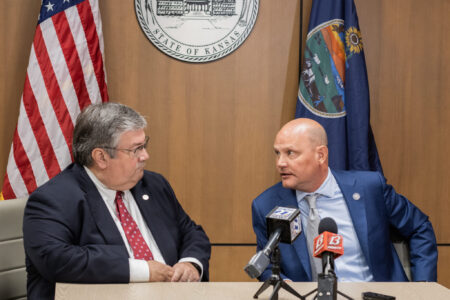
Late in the afternoon, Gov. Bill Graves huddled behind closed doors with legislative leaders and emerged from one meeting appearing angry and refusing to answer reporters’ questions.
Early in the morning, a group of Republican and Democratic House members, including Rep. Barbara Ballard, D-Lawrence, had hammered out a $250 million tax bill that they said their House colleagues would accept and Graves said he would sign into law.
But Senate President Dave Kerr, R-Hutchinson, said no deal. He said the proposal took away some business tax breaks that senators wanted.
He also said the Senate would probably end the session tonight if the House doesn’t pass a tax bill.
The proposal that the group of Democrats and Republicans put together would increase the state sales tax from 4.9 cents per dollar to 5.3 cents per dollar and the cigarette tax by 46 cents per pack from 24 cents per pack to 70 cents per pack. Earlier proposals would have raised the cigarette tax by 65 cents per pack to 89 cents per pack.
The proposal, as in previous ones, would re-establish inheritance taxes on distant relatives and unrelated heirs.
Democrats gave up on trying to install new income tax brackets on the wealthiest Kansans, according to lawmakers. Republican negotiators agreed to remove Kansas from a state tax break tied to a new federal acceleration of equipment depreciation, which will save the state $25 million.
The agreement also removes the exemption on sales taxes on computer software, increases the state’s match of the earned income tax credit, and removes an earlier proposed tax break for railroads.
As part of a separate measure, the Legislature is considering a two-cent per gallon increase in the state motor fuels tax.
On redistricting, the Senate was approving, by a 23-14 vote, a map that split Lawrence. But the vote was being kept open for two senators to cast their votes. Once those senators voted, the map would be on its way to Graves for his consideration.
Under the proposed map, Lawrence would be split roughly along Iowa Street.
Sen. Sandy Praeger, R-Lawrence, voted against the proposal, saying she wanted to keep Lawrence wholly in the 2nd or 3rd districts. But, she said, she didn’t believe that splitting the city would cause any problems.
“I think Lawrence will be fine and we will get good representation from two members of Congress,” she said. The 3rd District is represented by Democrat Dennis Moore and the 2nd is represented by Republican Jim Ryun.
Earlier House members offered the Senate a proposed congressional plan that would split Lawrence in a finger-like fashion between the 2nd and 3rd districts. But the Senate rejected that idea.
Rep. Troy Findley, D-Lawrence, who fought for a year to keep Lawrence in the 3rd was disappointed that the city would be divided between two districts.
But, he said, “Our community will rise to the challenge and take advantage of the opportunity and make the most of it.”
State Government
KU professors would be limited in how they could present the idea of systemic racism in future classes
State legislators push back against federal energy regulators ending competitive bids
TOPEKA — Two Kansas legislators asked federal energy regulators to ensure competitive bidding occurs on ...
Senate confirms 1st of 3 Kansas nominees to U.S. District Court
Corporate income tax collections falling sharply in Kansas; Republican, Democratic leaders disagree on what it means
TOPEKA — Corporate income tax collections in Kansas have almost halved since last year, while other sources trend ...
Candidate’s campaign manager created website with documents used to attack rival
TOPEKA — Kansas U.S. Senate candidate Patrick Schmidt’s campaign manager left his digital footprint on ...