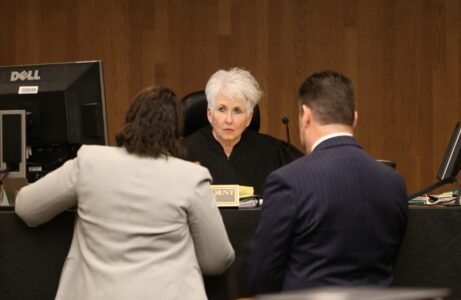
Sentencing Commission’s report stresses treatment, not punishment
In the early 1990s, “getting tough on drug offenders” were buzz words among law enforcement officers, prosecutors and politicians.
But that attitude had its limits, some in the criminal justice system discovered, especially when it came to nonviolent offenders with addictions.
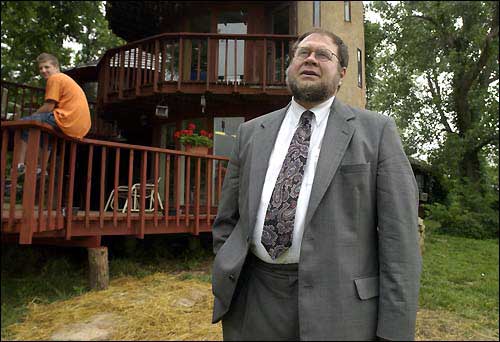
Lawrence attorney John Solbach was a legislator in the early 1990s who played a key role in getting sentencing guidelines for nonviolent drug offenders passed. The Kansas Sentencing Commission wants the Legislature to take a second look at the statewide drug policy a policy it says needs to focus on treatment instead of punishment. If the Sentencing Commission seeks changes in the guidelines for nonviolent drug offenders, it should base them on medical evidence, Solbach said.
That’s why the Kansas Sentencing Commission is recommending development of a comprehensive statewide drug policy to focus on treatment instead of punishment.
“Instead of incarcerating nonviolent drug offenders, we’re looking at making treatment mandatory,” said Barbara Tombs, the commission’s executive director.
The sentencing commission plans to have a new proposal about drug sentencing laws before the Kansas Legislature next year. That proposal is still in the works, Tombs said.
But a preliminary report already has been sent to lawmakers. It outlines a conflict between the medical world’s view of drug addiction and the criminal justice system’s view. That conflict has led to a constant recycling of drug offenders through the Kansas court and prison system, the report concluded.
A change of attitude toward small-possession and nonviolent drug offenders would free up from 400 to 800 beds in the Kansas prison system, the report said.
Overdue change
 |
|
|
|
|
|
|
|
|
|
|
That comes as no surprise to some Lawrence criminal defense attorneys. The state’s attitude is ripe for change, they say.
“If you ask people, ‘Do you think our money is well spent incarcerating (someone) for simple possession of drugs,’ I think the resounding answer is going to be ‘no,'” Lawrence attorney John Frydman said.
“It sounds like it’s a step in the right direction,” said another Lawrence attorney, Elbridge Griffy.
The state’s sentencing guidelines are out of whack, they say, when it’s possible for someone convicted for a third time of possession of a small amount of cocaine to serve almost as much time as someone convicted three times for rape. The difference in length of sentence: nine months.
Another case in point: Someone charged with rape pleads to a lesser charge of attempted rape. A felony rape conviction carries a 155-month sentence (nearly 13 years). Attempted rape cuts the sentence down to 59 months (nearly 5 years).
A plea bargain that involves a first possession of cocaine charge being cut to attempted possession sees a decrease in the sentence of only six months to 140 months from 146.
Marijuana and felonies
State laws concerning marijuana are more lenient than those dealing with cocaine. Nonetheless, a second marijuana conviction makes an individual a felon. That may, for example, keep someone out of law school and prevent financial aid for education.
“You can batter your wife three times in five years before you’re a felon,” Griffy said. “Who is more dangerous? Someone who comes home after work and uses marijuana for recreational purposes or someone who comes home and beats up his wife?”
If there were to be changes in the sentencing guidelines, “maybe it should start with a review of the marijuana laws,” Griffy said.
Sentencing guidelines were approved by the Legislature in 1993. They took effect in 1994. The guidelines use a complex grid system, with drug conviction sentencings on a grid separate from other felony crimes.
The guidelines’ purpose was to reduce sentencing disparity, including racial and regional biases. The Sentencing Commission, established in 1989, developed the guidelines and continues as a link between court and corrections policies. It also looks for policies that could reduce prison overcrowding.
Political realities
Lawrence attorney and former state representative John Solbach was chair of the House Judiciary Committee in the early 1990s when the guidelines were being pieced together. There was an awareness at the time that the guidelines would send nonviolent drug offenders to prison when other alternatives would be better for the individual, Solbach said.
But the attitude of most lawmakers, Solbach said, was to be tough on crime.
“There is almost no one who runs on a platform that says ‘let’s be soft on crime,'” Solbach said. “Most legislators perceive a vote to decrease a sentence as being the beginning of the end of their political career.”
There is flexibility in the guidelines, Solbach said. Judges can depart from them if they find “substantial and compelling reasons” to do so. And some modifications have been made since they were first adopted.
If the Sentencing Commission seeks changes in the guidelines for nonviolent drug offenders it should base them on medical evidence, Solbach said. The Legislature should listen to the Commission, he said.
The Commission outlines medical evidence in its legislative report. Between 65 percent and 75 percent of state prisoners suffer from varying levels of substance abuse problems, the Commission found.
Willpower vs. addiction
The Commission’s report shows how medical professionals allow for relapses by people trying to overcome drug addiction. It can’t be done in a short period of time. Ending drug addiction requires multiple levels of treatment, and relapses are common.
The criminal justice view of drug offenders has always maintained that someone with enough willpower can overcome addiction. Although treatment is often prescribed, that treatment doesn’t allow for relapses. Social circumstances and other factors beyond the control of corrections play key roles in addiction cures.
“The drug sentencing guidelines make no sense they are absurd,” said Dr. Sheldon Whitten-Vile, psychiatrist and medical director at Bert Nash Community Mental Health Center. “There are only a small percentage of drug users who aren’t addicted.”
Prosecutors and law enforcement officials, however, paint a different picture.
Douglas County Asst. Dist. Atty. Dan Dunbar noted that while base sentences for repeat same-crime felons do not always increase as much as repeat drug offenders, criminal history is a factor. If someone has built up a history of convictions not necessarily drugs it increases sentences.
For example, someone convicted of rape a second time with other prior convictions could be sentenced to 253 months in prison.
But Lawrence attorney and former assistant Dist. Atty. Martin Miller also thinks drug offenders are often lumped with violent felons by the state’s laws.
“They can throw the book at drug addicts, and I think there should be more done to treat them,” Miller said.
How many chances?
Dunbar, who prosecutes drug cases for Dist. Atty. Christine Kenney, disagreed. Marijuana laws especially are lenient, he said. The first possession offense is a misdemeanor and 99 percent of the time results in probation, he said.
Though a second marijuana conviction is a felony, probation is still generally ordered, Dunbar said. It isn’t until at least a fourth conviction that a violator could end up in prison.
“How many chances do you need to get your act together?” Dunbar asked.
Douglas County Sheriff Rick Trapp, who prosecuted drug cases as an assistant district attorney, agreed with Dunbar.
“There has to be a cut-off point somewhere,” he said. “I think the drug laws are pretty fair as they are.”
And in most cases, at least in Douglas County, Dunbar and Trapp said, a judge orders nonviolent offenders to get addiction treatment as part of a sentence.
Defense attorneys emphasize their criticisms of the drug laws do not extend to people convicted of crimes combining drugs and violence. And they note that people who are dealing drugs and caught with large amounts usually end up being prosecuted in federal court.
Nevertheless, Frydman, Griffy and Miller think not enough is being done to get increased drug treatment options for addicts who end up in prison.
“In my mind prisons should be reserved for people who are violent to other citizens and a last resort should be locking up people who are nonviolent,” Frydman said.
Challenging the law
For years Mark Creamer has been a familiar site on weekends along Massachusetts Street protesting marijuana laws and advocating the drug’s legalization. He thinks the Sentencing Commission’s review of drug laws is good news.
In 1989, Creamer, 55, protested the president’s push for harsher drug laws by lighting up a marijuana cigarette at the front window in the Lawrence Police Department in order to get arrested. He served six months in the county jail for that publicity stunt.
In the early 1990s, Creamer attended a House Judiciary hearing on sentencing guidelines and spoke his mind about marijuana laws.
“I think this is encouraging,” Creamer said of the Sentencing Commission’s review of the guidelines. “To me marijuana isn’t as bad as alcohol.”
Public Safety
Lawrence sex offender facing 20 years in prison sentenced to three years of probation

Jury convicts woman who shot at Lawrence police in April 2025 standoff

LDCFM crews put out house fire caused by lightning strike during Tuesday morning’s storms; it was one of 28 weather-related incidents
Lightning from Tuesday morning storms produced one Lawrence house fire
Storms that rolled through Douglas County early Tuesday morning produced lightning strikes that caused one house ...

LPD says a scammer is using its number and officer’s name to fish for money