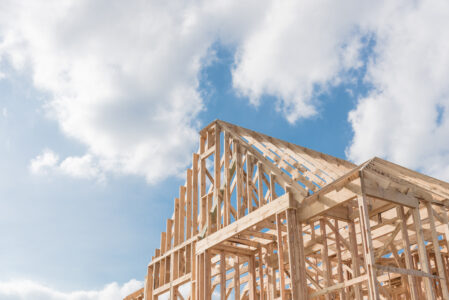
With half the year done, Lawrence again on pace to set record low for single family home construction
Duplex construction has started to increase
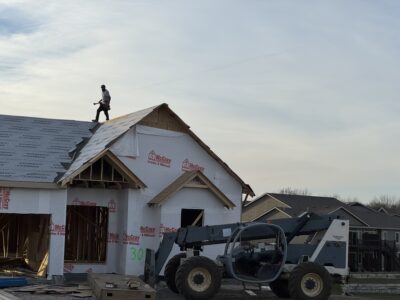
photo by: Chad Lawhorn/Journal-World
A construction worker does roof work on a new home in the 300 block of Dole Road in northwest Lawrence on Jan. 7, 2026.
Lawrence home builders haven’t yet found their “limbo moment.” After setting a new record low for single family housing starts last year, builders in 2026 haven’t yet found the answer to “how low can you go,” according to the latest set of statistics.
With half a year in the books, Lawrence home builders have taken out 15 single family building permits thus far in 2026. That’s down from 19 single family permits issued by Lawrence City Hall during the same period a year ago.
In other words, Lawrence housing starts are on pace to set another record low. If the pace holds, it will be the fourth time in five years that Lawrence has set a new record low for single family housing starts.
There is still time for Lawrence to avoid another record low if builders pick up their pace in the second half of 2026. But the leader of the Lawrence Home Builders Association said she is not necessarily seeing signs that builders are poised to ramp up their activity.
“I’m not seeing a surge yet,” Bobbie Flory, executive director of the Lawrence Home Builders Association, said this week.
Flory said there still are not yet many new building lots available for builders to purchase and start construction of new homes. While there has been an uptick in land owners applying for everything from annexation to platting — both precursors to new neighborhood development — many of those projects still haven’t reached the stage where homes could begin construction.
Flory also said there are other economic factors that are holding back builders.
“Some things outside of local control are coming into play,” Flory said. “Interest rates coming down would be helpful.”
The outlook for 30-year mortgage rates continues to be volatile. Rates have been at about 6.5% in mid-July, up from about 6% at the beginning of the year, but still below levels near 7% at the beginning of 2025. Regardless, the rates are about twice as high as what home buyers had become accustomed to for more than a decade. Until about 2022, rates often were in the 3% range.
The outlook for Lawrence single family home construction has been much easier to predict. For about a half decade, you’ve been relatively safe in predicting a downturn. Last year Lawrence City Hall issued building permits for 36 new single family homes. That was the lowest level on record in Lawrence.
It was the lowest level by a significant amount. The previous record low was set in 2024, when the city issued 57 single family housing permits. More generally, though, the slowdown in single family home construction has been underway in Lawrence for several years.
The city’s building permit records date back to 1956. They show that 2025 was only the fifth time that the city built fewer than 100 new single family homes, with the other years being 2024, 2023, 2022 and 2011. It seems almost certain that 2026 will become the sixth year that Lawrence doesn’t hit the 100 homes mark in a year.
However, there is reason to believe that Lawrence may not end up setting another record low this year. When looking at the number of single family building permits that builders have applied for at Lawrence City Hall, that number currently sits at 31. That’s only five less than the 36 permits that were issued in 2025, so builders are certainly within striking distance of topping last year’s totals.
Flory said Lawrence City Hall officials also are working to make the permitting process more appealing to area builders. The top vote-winners in the most recent City Commission elections — Mike Courtney and Kristine Polian — both ran on a platform that advocated for more home construction as a strategy to help the city deal affordable housing issues.
Flory said Lawrence City Hall has made some notable changes to its building permit process in an effort to reduce the amount of time it takes for a building permit to win approval. For example, the city is now using a system where a builder can submit the exact same plans for a home that already has received a building permit from the city and receive an expedited review.
Ultimately, Flory said her group’s membership is hoping that the city can routinely issue building permits in a week to 10 days, as opposed to a process that can take several weeks or a couple of months currently.
Such issues are important, Flory said, because builders view the building permit process as an element of risk in a project. If they have taken out a loan to buy the building lot, but aren’t able to start construction for several weeks, that produces additional interest and other expenses. That makes builders more likely to look to build in other communities where the building permit process is quicker.
Building permit statistics from the Kansas City metro area show that there are many communities that are experiencing significant increases in single family home construction. The Home Builders Association of Greater Kansas City hasn’t yet released statistics through June, however numbers through May show an approximately 30% increase in the number of new single family building permits, compared to a year ago.
The latest report shows the KC metro area has just more than 2,300 single family home starts from January through May of this year. That’s up from about 1,800 single family home starts during the same period a year ago.
Lawrence’s 19 single family building permits are far below single family building permit totals in a number of area communities, according to the KC report. Here’s a look at building permit totals through May for selected communities:
• Olathe: 262
• Overland Park: 170
• Spring Hill: 184
• Kansas City, Kan.: 126
• Gardner: 98
• Shawnee: 43
• Leawood: 26
• Edgerton: 17
• De Soto: 13
The latest report from Lawrence does show building activity in other areas. The city has issued permits for 36 duplex projects through June of this year. That’s up from 16 permits issued during the same period a year ago.
The city’s new development code has placed an emphasis creating denser residential developments, which includes duplexes, which put two living units on one building lot. Builders have been turning to duplex options with more frequency in an effort to control building costs, Flory said.
A shift to duplex construction, though, may end up having impacts on whether families with children occupy those new homes, which normally are smaller than traditional single family homes. The city’s housing stock has been cited as one of several factors that is putting downward pressure on the school district’s enrollment totals.
Town Talk column
National Weather Service move to Lawrence ramping up; developer Phil Bundy still pursuing a STAR bond project and more news and notes

A former lieutenant governor and his granddaughter fell in love with this Lawrence bar, and now they’re helping preserve it
Lawrence City Commission to weigh whether Costco should be included in STAR bond district

Thanks to a nonprofit that pairs artists and landlords, the Lawrence Potters’ Guild gets a temporary space of its own

After a brief bump during the World Cup, Lawrence is back to collecting less in sales taxes than it did a year ago