Lawmakers approve redistricting maps that will bring major changes to Douglas County House and Senate districts
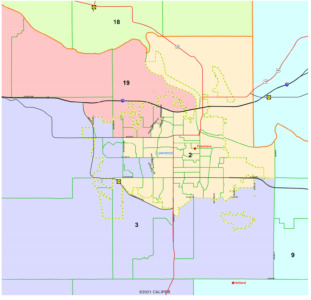
photo by: State of Kansas
Kansas legislators approved a new map redrawing the boundaries of Kansas Senate districts as part of their once-a-decade redistricting process. Above, the area inside and adjacent to the Lawrence city limits is shown.
Douglas County politics for the next few years may look a bit like spring training baseball — several faces you don’t recognize and a fair number of people playing in odd positions.
Lawrence residents already have learned — and largely are upset — that Lawrence will become part of the western Kansas-based 1st Congressional district, placing the state’s most liberal city with the most conservative part of Kansas. Unless the courts make a change, that deal is done.
What’s not quite done, but very nearly so, is the redistricting process for Kansas House and Senate seats. The Kansas Legislature on Wednesday evening approved new maps for both the House and Senate. It approved them with margins that would withstand a veto by Gov. Laura Kelly.
The new maps ensure that many Lawrence and Douglas County residents will have new representatives come the next elections.
One of the biggest changes is that Sen. Tom Holland no longer will represent any part of Lawrence, once the changes become effective. Holland, a rural Baldwin City Democrat, has been one of Lawrence’s two state senators since 2009.
Holland will continue representing his Senate District No. 3 — which includes North Lawrence and large parts of southern Lawrence and portions of eastern Lawrence — until 2024, when elections for the district are held again.
But come 2024, under the new map, Holland’s current residence won’t be in Senate District 3 anymore. It will be in Senate District 9, which creates a real question of whether Holland will be representing anyone in the Kansas Senate going forward. Senate District 9 stretches far into Johnson County, and currently is represented by a conservative Republican lawmaker, Sen. Beverly Gossage of rural Johnson County.
So, if Holland — who was the Democrats’ nominee for governor in 2010 — wants to win that seat, he likely will have to defeat Gossage to do so. He’ll have to do it without the Lawrence population that has produced pretty reliable Democratic votes. He’ll also be a Douglas County politician in a district that has far more population outside of Douglas County. The district has 39% of its population in Johnson County, 23% in Leavenworth County, 21% in Douglas County and 17% in Wyandotte County, which has a good number of Democratic voters historically. So, not impossible, but uphill.
Earlier in the process, Holland was proposing several alternatives to this map, but with the Kansas House and Senate controlled by Republicans, such alternatives from Democratic lawmakers can struggle to get traction.
The change with Holland’s district is one of the more notable, but far from the only one that will impact Douglas County. Here’s a look at others:
• Talk about odd teammates: The map draws a new Kansas Senate district that will create an unusual duo. Large parts of northwestern Lawrence — which is one of the newer and richer areas of town — will be paired with east Topeka, which is not new and historically has been a low-income area. That new district is Senate District 19. There currently is not a member of the Senate who lives within those boundaries, meaning it will be a wide-open election. Given the demographics, that looks like a district that could elect a Democratic legislator. I’m guessing there is an interesting backstory behind the creation of that district. Was it important to some that Shawnee County have at least one Democratic legislator, after longtime Democratic leader Anthony Hensley unexpectedly lost in the last election? I’m not sure. But it does appear that Holland was impacted by it. The new district sucked up some Lawrence population, meaning someone was going to lose Lawrence voters. Holland was the senator who lost those Lawrence voters. The parts of Lawrence included in the new district are basically the area north of Sixth Street and west of Lawrence Avenue. If you live there, stay tuned to who will next represent you.
• Sen. Marci Francisco, D-Lawrence, currently represents that part of Lawrence. She also represents large parts of Jefferson County to the north. Under the new map, she no longer will. Instead, Francisco’s district will be entirely within Douglas County. Notably, she will represent all of North Lawrence, where in the past she only represented a small portion of it. Currently, most of North Lawrence is represented by Holland. She’ll also represent most of Lawrence south of 23rd Street, which currently is represented by Holland.
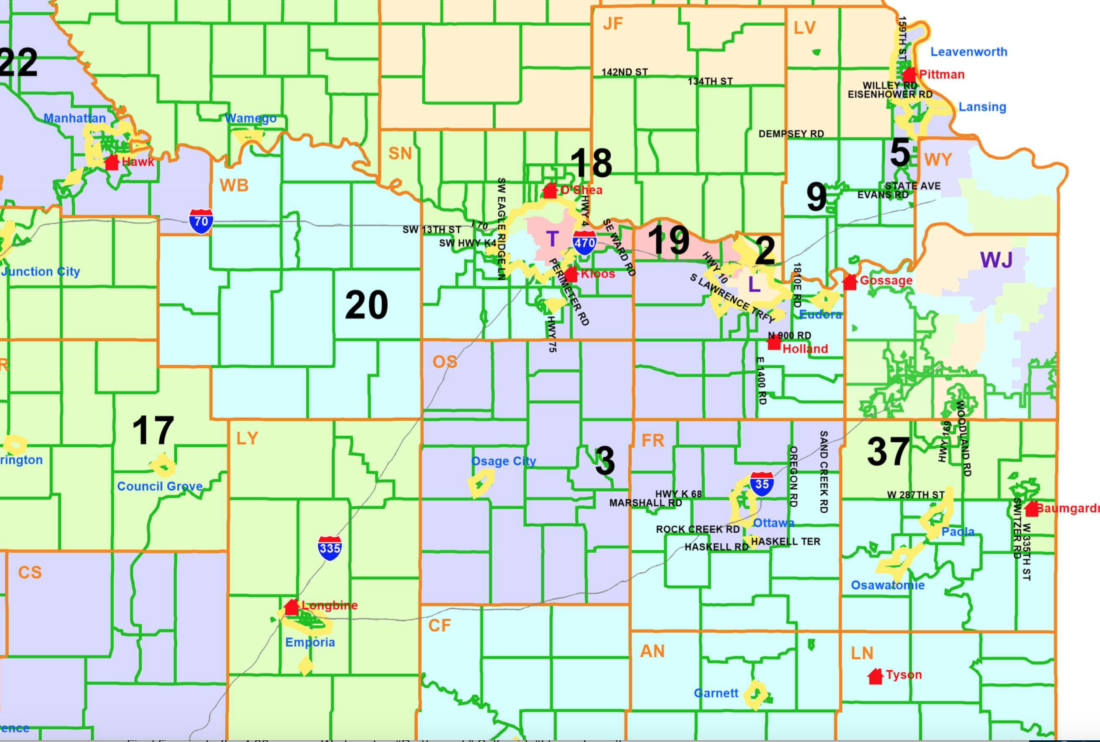
photo by: State of Kansas
Kansas legislators approved a new map redrawing the boundaries of Kansas Senate districts as part of their once-a-decade redistricting process. Above, the region around Lawrence is shown.
• Francisco currently represents Lecompton in northwest Douglas County. But she won’t under the new map. Lecompton will be in the new Senate District 19. Lecompton, however, will stay in Kansas House District 45, which currently is represented by Mike Amyx, D-Lawrence. For a while, it looked like Lecompton would be moved from that district too, but the final map did not make that change.
• Parts of far west Lawrence will be in a Senate district that includes Ottawa and Osage County. Its name will be Senate District No. 3, but it looks nothing like the current Senate District No. 3, which is Holland’s current district. Instead, the lone senator who lives in this newly drawn district is Sen. Rick Kloos, a rural Shawnee County Republican. The parts of Lawrence that will be in this district include most of Lawrence that is west of Wakarusa Drive and south of Sixth Street. A part of it also stretches east of Wakarusa Drive between Bob Billings Parkway and Clinton Parkway. It goes about as far east as Quail Creek Drive. The district also stretches north of Sixth Street, west of Queens Road.
So, the district has a fair amount of territory in Lawrence, and it is territory that is poised to grow. However, as it sits right now, this district is dominated by population outside of Douglas County. Franklin County, which includes Ottawa, provides 29% of the district’s population. Douglas County is next at 25%, then Shawnee County at 23% and then Osage County at 22%. From a geographic standpoint, most of the district’s land is in Osage County. This is the only Senate district that serves Osage County. Where is Osage County? As someone who grew up there but has lived in Douglas County for 30-plus years, I’ve gotten asked that question a lot. Osage County actually shares a border with Douglas County, but it is to the southwest, which is not a direction many Lawrence residents look, near as I can tell. If you ever ventured to Overbrook, you were in Osage County.
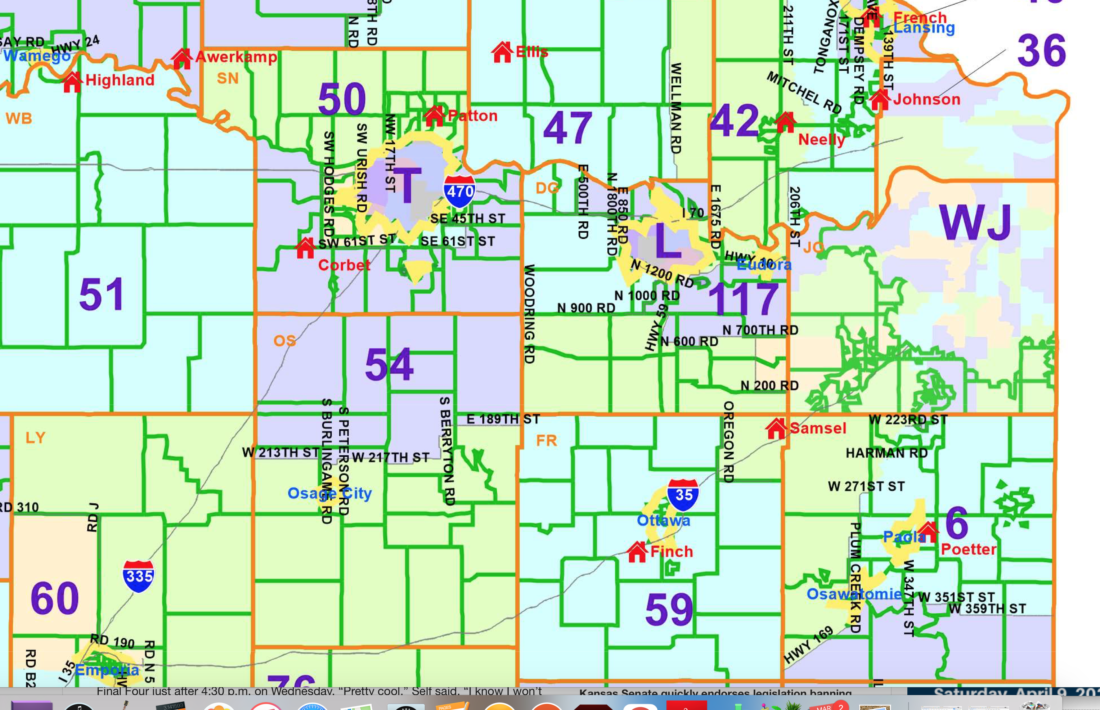
photo by: State of Kansas
Kansas legislators approved a new map redrawing Kansas House districts as part of its once-a-decade redistricting process. Above, the greater region surrounding Lawrence is shown.
• Baldwin City will have a new representative in the Kansas House. Baldwin City no longer will be in the 10th District. That is Rep. Christina Haswood’s district. She’s a Democrat from Lawrence, but her district stretches far to the south to include Baldwin City. Under the new map, Haswood’s district will cover large parts of Lawrence south and east of 19th and Iowa streets, but her district will stop basically at the Wakarusa River.
That leaves Baldwin City in House District No. 5. It currently is represented by Rep. Mark Samsel, a Wellsville Republican. You may remember that name. In May, he was charged with misdemeanor battery involving an incident with a student while Samsel was serving as a substitute teacher at Wellsville High School. That district could get interesting because it has become more of a Douglas County district. Douglas County provides 37% of the district’s population. Miami County is next at 27%, while Johnson is at 22% and Franklin, where Samsel resides, is just 13%.
• Eudora will have two state representatives under the map. Most of Eudora will continue to be in House District 42, which is represented by Rep. Lance Neelly, R-Tonganoxie. But the southern portion of Eudora will be included in a new district, House District 117. Currently, there is no member of the House who lives in the boundaries of that district. Any Eudora residents with their sights set on being elected in that district, however, had better make friends in Johnson County. House District 117 has 83% of its population in Johnson County. The district stretches all the way toward Kansas Highway 7 in Johnson County. That leaves Eudora as a Douglas County community that will be in districts dominated by non-Douglas County population. House District 42, the other Eudora district, has 67% of its population in Leavenworth and Jefferson counties.
• Under the final maps, Douglas County ended up with four Kansas House seats that are entirely within Douglas County. Those are held by Amyx, Barbara Ballard, Haswood and Boog Highberger. All are Democrats. We’ve previously reported that Douglas County’s delegation has been pushing to get five House districts entirely within Douglas County. The county’s population has grown enough to make it mathematically possible. But that proposal never gained traction. Why? Did I mention that all four of Douglas County’s House members are Democrats in a Republican-controlled legislature?
That dynamic means you may want to keep a roster handy as you follow local politics for the next couple of years. There will be new faces.

Kansas legislators approved a new map redrawing the boundaries of Kansas House districts as part of their once-a-decade redistricting process. Above, the area inside and adjacent to the Lawrence city limits is shown.
State and Region
General Election Voter’s Guide
Voters Guide: A look at the candidates for Congress in Kansas’ 1st District
Marshall camp settles unpaid bakery bill after 6 years
HUTCHINSON — The owner of a south-central Kansas bakery did not expect a Facebook post she made last Thursday to ...
Opinion: Lawrence deserved more from its Congressman at Saturday’s candidate forum
Kansas measles cases grow to 5
TOPEKA — Five measles cases reported in Kansas are related to out-of-state travel, health authorities said ...