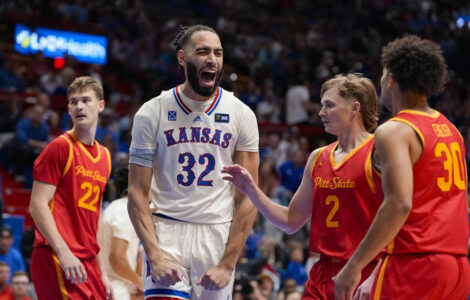
Council suing NCAA in attempt to become eligible for 2026-27 season
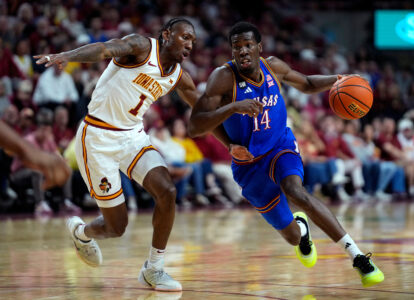
photo by: AP Photo/Matthew Putney
Kansas guard Melvin Council Jr. (14) drives the ball inside as Iowa State guard Jamarion Batemon (1) defends during the first half of an NCAA college basketball game, Saturday, Feb. 14, 2026, in Ames, Iowa.
Updated 5:36 p.m. Monday, July 27, 2026:
Recent Kansas basketball guard Melvin Council Jr. is suing the NCAA in Douglas County in an attempt to become eligible for the 2026-27 men’s basketball season, according to court records reviewed by the Journal-World.
Council spent two years at Monroe College, which is a junior college, before playing one at Wagner, one at St. Bonaventure and most recently one at Kansas — three NCAA Division I schools. He is seeking an injunction that would make him immediately eligible based on the fact that he has played fewer than four years at NCAA institutions.
“We’re aware of Melvin’s legal efforts to pursue an additional year of Division I eligibility, similar to what a number of student-athletes across the country are doing,” KU coach Bill Self said in a statement on Monday. “At this point, we’re simply monitoring the process and allowing it to play out.”
The lawsuit was filed on Thursday by Lawrence attorney Terrence J. Campbell of Barber Emerson, along with a host of Philadelphia-based attorneys from Archer & Greiner. It names both the NCAA and Illinois athletic director Josh Whitman, in his capacity as the chair of the Division I cabinet, as defendants. It accuses them of breach of contract, based on Council’s status as a beneficiary of the NCAA’s agreements with its member institutions, as well as tortious interference with a business relationship, because they are interfering with Council’s ability to sign contracts to play basketball or to profit off his name, image and likeness.
From the court, Council is requesting eligibility for next basketball season as well as, in short, immunity from any additional NCAA rules that may inhibit either him or an institution that chooses to employ him.
Archer & Greiner provided the following statement to the Journal-World: “Archer & Greiner is proud to represent Melvin Council Jr. in this matter. We believe the petition filed on his behalf speaks for itself. Given the pending litigation, we have no further comment at this time.”
Council’s fifth year at KU was possible in the first place because of a blanket waiver the NCAA issued in 2024 allowing all former junior-college athletes whose eligibility would otherwise have expired after the 2024-25 campaign to play for one more season.
The lawsuit contends that the NCAA should not start an athlete’s eligibility clock at all when an athlete enrolls at a junior college. In preventing Council from continuing to play a fourth NCAA season after his two years at junior college, the suit asserts, the NCAA is also preventing him from additional opportunities to develop as an athlete in pursuit of a professional contract and in the meantime to earn money based on his name, image and likeness — opportunities that were not available to the same extent when he was at junior college.
Council had an attempt at an NCAA waiver denied in May. The lawsuit is heavily critical of the NCAA waiver process and references a so-called “denial directive” stemming from an NCAA committee meeting in February 2022 that “recommended that staff deny cases requesting … additional seasons of competition,” which the suit calls “a hallmark of bad faith.”
One of the central points in the lawsuit is “extenuating legal circumstances” that “required” Council to attend a junior college rather than going directly to a four-year university. Specifically, Council was charged with first- and third-degree rape and first-degree sexual abuse during his time in high school in New York.
The suit states that the charges were dismissed, which Council also affirms in a signed affidavit.
KU previously provided the Journal-World a statement from Self in May 2025, soon after Council’s commitment to KU: “During the recruitment process of Melvin Council Jr., his family made us aware that Melvin was the subject of a court action that occurred in 2019 following his junior year in high school. It was later determined by the charging District Attorney’s office that serious mistakes were made during the process. Melvin was exonerated and has no criminal record.
“He will transfer to Kansas from St. Bonaventure where he graduated and was a positive role model on campus and in the community. After our university’s discussions with the parties involved in the exoneration – including the District Attorney’s office – we feel informed and comfortable in welcoming Melvin to Kansas.”
The Journal-World also received statements in which Sandra Doorley, the Monroe County district attorney at the time of Council’s case, wrote in part, “I have no reservations as to his character and have no doubt that he will lead a positive, successful and lawful life. While I cannot go into specifics about the case, because it is now sealed, I can assure you that its resolution was fair and just. Melvin is a talented young man with a bright future. He should be given the opportunity to shine.”
Council’s attorney at the time, Jon Getz, wrote in part, “In my 30 years of practice, including my time as the past director with the Innocence and Justice Project, this case was unique. Melvin was wrongly accused through the court system, and I’m very proud to have helped him gain his exoneration. Because of the ages of the individuals involved at the time, the matter was sealed and it is not proper to say anything more.”
After his lone season at KU, in which he averaged 12.7 points, 5.1 assists and 5.0 rebounds and was the Big 12 newcomer of the year, he reportedly entered the transfer portal in the spring despite his lack of remaining eligibility. Council then went unselected in the 2026 NBA Draft. He appeared in the NBA Summer League earlier this month for the New Orleans Pelicans.
Council’s request for a sixth season is of the sort that will no longer be possible soon. The NCAA has recently approved changes to its eligibility model that will remove the waiver submission process almost in its entirety and allow athletes to play five seasons in a five-year span, beginning either when they first enroll in college or with the first academic year after they turn 19.
The Journal-World has requested comment from the NCAA.
This story will be updated.
KU Men's Basketball
KU men’s basketball ranked No. 17 in AP preseason poll
KU men’s basketball adds former Purdue forward Kaufman-Renn for upcoming season
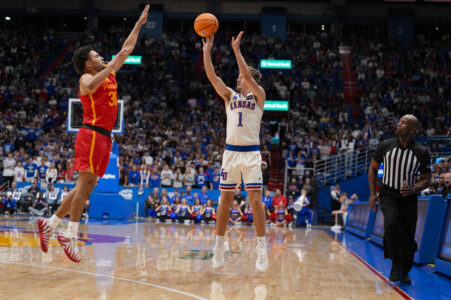
The KU freshmen who surrendered their jersey numbers to Council and White
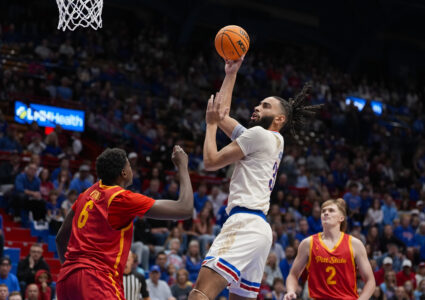
Reeves makes early impression at Late Night
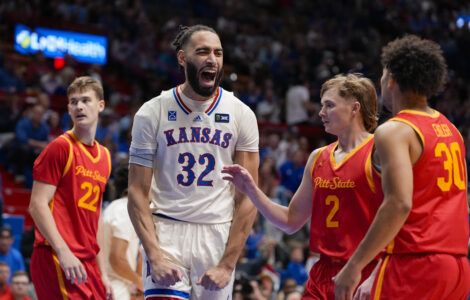
Photo Gallery: Kansas handles Pitt State with an 80-62 exhibition win