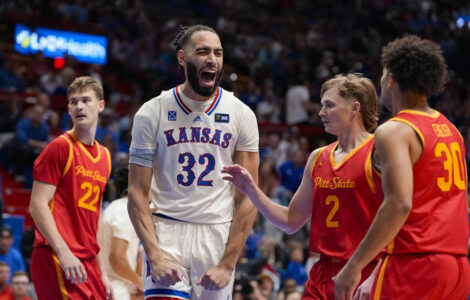
White obtains injunction to become eligible; will he play for Kansas?
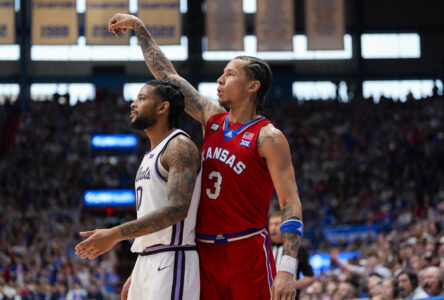
Kansas guard Tre White (3) watches a three from the corner over Kansas State guard David Castillo (10) during the first half, Saturday, March 7, 2026, at Allen Fieldhouse. Photo by Nick Krug
Updated 4:19 p.m. Wednesday, Sept. 23, 2026:
Recent Kansas forward Tre White on Wednesday morning received an injunction against the NCAA in Monroe County, Indiana, court, that will make him immediately eligible to play college basketball.
“We’re very happy for Tre with today’s result,” KU coach Bill Self said in a statement. “He’s had a great summer in the gym and we’re excited to talk to him and his family about his next steps.”
White and his 96 fellow plaintiffs are generally members of the high school class of 2022 who competed in four straight seasons in their respective sports. They are suing on the basis that they should receive the fifth year of eligibility that other NCAA athletes will have at their disposal going forward.
In issuing her order on the motion for a preliminary injunction, Judge Kara E. Krothe asserted that both the NCAA’s new and old manuals should allow a fifth year of eligibility for these plaintiffs. She also emphasized that many of them have had to compete against fifth- and sixth-year athletes as a result of COVID and Pavia waivers and redshirts, and in some cases against former professionals, over the course of their careers.
The injunction allows the plaintiffs to become eligible until the lawsuit goes to trial. It is not yet clear when that might be; it is also believed that the NCAA could appeal the injunction ruling and seek to halt the plaintiffs’ eligibility as it has in many other states.
In the meantime, under the terms of the injunction, the NCAA cannot restrict the plaintiffs from participating on the basis of any actions they may have taken after the 2025-26 season, “such as signing a professional contract, agent contract, or playing in a professional sporting event, so long as they terminate any such contract and repay any money they have received prior to playing in a collegiate game.”
White’s side would likely argue anyway that playing in the NBA Summer League — as he did for the Miami Heat — does not constitute professional participation, but this provision protects him regardless.
The NCAA also cannot enforce penalties against schools who choose to roster these athletes. Where exactly they will play is still in question. For one thing, the order requires that the NCAA give these athletes one week to enter the transfer portal.
According to Krothe’s order, the plaintiffs submitted an Exhibit 17 “that lists the names of each Plaintiff, which school they could play for and information regarding their eligibility.” That exhibit is not yet part of the online court record. But the order says that 84 of the plaintiffs said they were enrolled at specific schools where they would choose to play, and 13 “needed their eligibility confirmed before a school would confirm a scholarship and roster spot for them, with eight (8) of those listing specific schools under consideration.”
The deadline to petition for late enrollment at KU was Monday. A KU spokesperson told the Journal-World on Wednesday that an Anthony “Tre” White who was enrolled last year is no longer enrolled this fall. It’s not yet clear how White — or any other athlete — might bypass the roadblock of that enrollment deadline. Some players could choose to join teams at the semester break.
Asked whether White might play at KU or elsewhere, Brian Jungreis of White’s agency, Seros Partners, said via text message that he did not have “any news on that front.”
Last season, White, who had previously played at USC, Louisville and Illinois, averaged 13.5 points and 6.7 rebounds for the Jayhawks in the most statistically productive season of his career.
The injunction also made several other players of note eligible, including former KU guard Jayden Dawson, who has said he might play at Iowa or Nebraska, and Miami forward Malik Reneau and Central Connecticut State defensive tackle Clifton Thompson, who have apparently received interest from the KU basketball and football teams, respectively.
KU Men's Basketball
KU men’s basketball ranked No. 17 in AP preseason poll
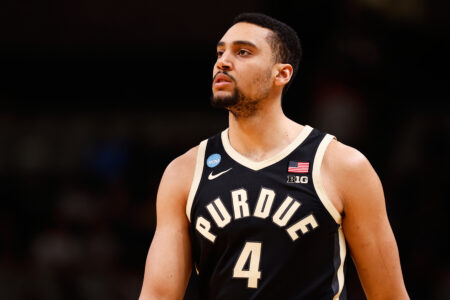
KU men’s basketball adds former Purdue forward Kaufman-Renn for upcoming season
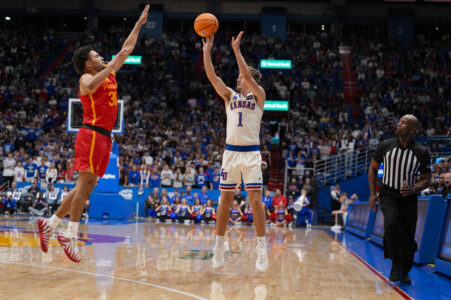
The KU freshmen who surrendered their jersey numbers to Council and White
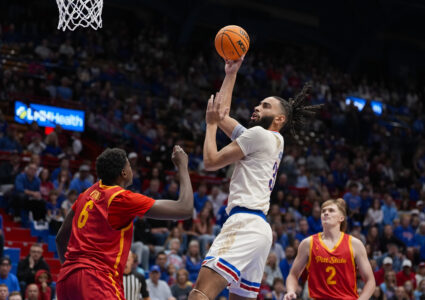
Reeves makes early impression at Late Night
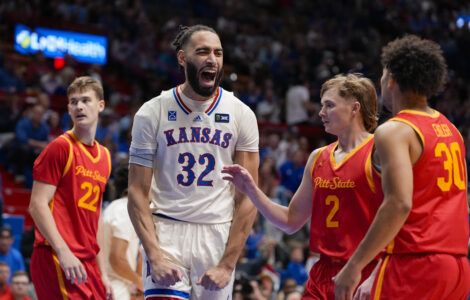
Photo Gallery: Kansas handles Pitt State with an 80-62 exhibition win