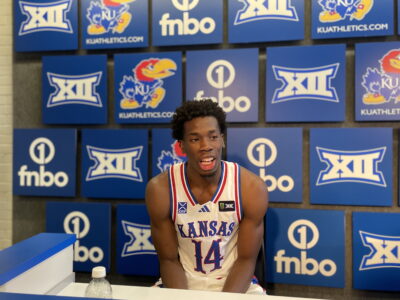
Council receives injunction against NCAA in New York court
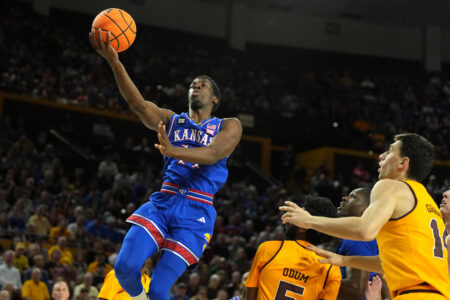
photo by: AP Photo/Rick Scuteri
Kansas guard Melvin Council Jr. drives past Arizona State forward Andrija Grbovic (14) during the first half of an NCAA college basketball game, Tuesday, March 3, 2026, in Tempe, Ariz.
Updated 12:34 p.m. Tuesday, Sept. 29, 2026:
Recent Kansas guard Melvin Council Jr. received a preliminary injunction against the NCAA in Monroe County, New York, court, which will allow him to become eligible for the 2026-27 basketball season.
Judge Daniel J. Doyle issued his decision on Tuesday morning, and the terms of the injunction also prevent the NCAA from retroactively penalizing Council or any institution that may choose to put him on its roster.
“Like we were with Tre (White), we’re happy for Melvin and today’s outcome,” KU coach Bill Self said in a statement. “We’ll continue to learn more about his immediate next steps and be in touch with him and his family.”
It is not yet clear how long this injunction may last. In concluding his judgment, Doyle instructed Council’s lawyers to draft a proposed order “and circulate it to opposing counsel prior to submission to the court by Oct. 27. If an agreement cannot be reached by the parties, each party must submit argument in favor of a requested undertaking with the proposed order.” The NCAA may also have the option to appeal the ruling, as it is attempting to in the case of White.
It also remains to be seen whether Council will return to KU. He was recently listed in the student directory, as the Journal-World reported, prior to the deadline to petition for late enrollment. The university has not responded to multiple queries about whether Council is in fact enrolled.
Council did enter the portal after the 2025-26 season when it appeared he had no remaining eligibility, and one of his lawyers’ stated reasons for moving his case from Douglas County to New York in the first place was to broaden the scope of his case beyond KU and the Big 12 Conference — there was some concern as to whether KU would put him on its roster in light of the Big 12’s rule change prohibiting professional players.
That concern seems less relevant now that KU has added White — who like Council played in the NBA Summer League — to its roster and also given that Doyle did not sympathize with the NCAA’s efforts to show that Council was a professional athlete. He instead sided with Council’s contention that NCAA bylaws do not prohibit Summer League participation.
In his decision, Doyle takes particular issue with the NCAA’s handling of Council’s NCAA waiver requests. To review, the substance of Council’s legal case is that he believes his time spent at a junior college should not count against his four years of NCAA eligibility, and contends that he was forced to attend a JUCO out of high school because he was facing pending criminal charges from which he was later exonerated.
Doyle found no evidence that the NCAA “reviewed, considered, or even passingly contemplated” Council’s waiver requests in the context of these circumstances and its Bylaw 12.6.1.7.1.3, which reads, “The Committee on Student-Athlete Reinstatement reserves the right to review requests that do not meet the more-than-one-year criteria of this waiver for circumstances of extraordinary or extreme hardship.”
“Could the NCAA have invoked their Bylaws to grant Council an additional year of eligibility in light of the circumstances outside his control emanating from the subsequently vacated guilty plea?” Doyle wrote. “Absolutely, yes.”
Council’s attorneys Trevor A. Prince Jr., Patrick A. Afriyie, Mark J. Oberstaedt and Stephen A. Pina of Archer & Greiner issued the following statement to the Journal-World: “We appreciate the Court’s careful consideration and thorough analysis. We are proud to represent Melvin and are deeply gratified that this ruling will allow him to compete at the highest level of NCAA basketball during the 2026-27 season.”
If KU does choose to bring Council back, it would seemingly fill the Jayhawks’ final available roster spot. Council, who after his time at Monroe College played at Wagner and St. Bonaventure, averaged 12.7 points, 5.1 assists and 5.0 rebounds for the Jayhawks during the 2025-26 season.
KU Men's Basketball
Reeves makes early impression at Late Night
Photo Gallery: Kansas handles Pitt State with an 80-62 exhibition win
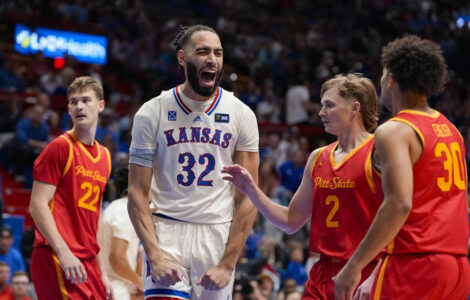
Jayhawks top Pitt State 80-62 in Late Night exhibition
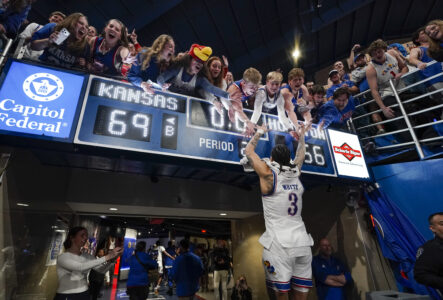
Indiana court keeps injunction in place, maintaining eligibility for several KU athletes
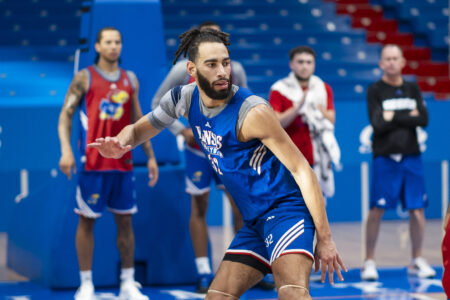
Reeves ready to go after lengthy recovery from shoulder injury