KU is getting paid for the Union Jack Classic — will it also get attention?
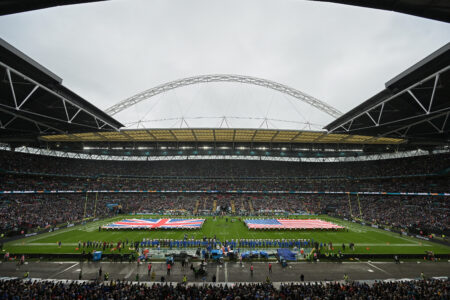
photo by: AP Photo/Anthony Upton, File
FILE - A general view of the flags of Britain and the United States on the field of Wembley stadium before an NFL football game between the Los Angeles Rams and the Jacksonville Jaguars in London, Sunday, Oct. 19, 2025.
Browsing a list of recent and upcoming international college football games reveals a clear pattern: They almost all take place before the season begins in earnest.
North Carolina and TCU will face off in Ireland and N.C. State and Virginia in Brazil as part of this year’s Week 0, a chunk of games that takes place a week prior to the season proper.
Iowa State and Kansas State started their seasons early last year in Ireland, as did Florida State and Georgia Tech the year before, Navy and Notre Dame the year before that and Nebraska and Northwestern the year before that. Go back further and find Stanford and Rice in Australia in 2017. At the FBS level, international games have exclusively taken place either in Week 0 or in the postseason (the Bahamas Bowl) for the last decade.
The first-ever FBS football game in the United Kingdom will not follow that same path. When Kansas meets Arizona State at London’s Wembley Stadium, it will do so on Sept. 19, several weeks into the football season. Both schools had to move previously scheduled nonconference dates to accommodate this time slot that no one has sought out in recent memory.
Now they and the Big 12 have to figure out how to ensure it gets the same outsized spotlight as any other international game.
“That is the challenge, certainly,” Big 12 football czar Scott Draper said in March. “If you look at the Week 3 slate of games, not just in our league but in others around the country, that’s a pretty heavy week of football games. So how do we find the oxygen (for) that game?”
Draper said at the time that the conference was drawing close to determining the right TV partner for the game. Asked if it would get a standalone broadcast window — like what the NFL provides for its international games — he said that was “part of the discussion for sure,” but noted that ESPN and Fox have their weekly pregame shows (“College GameDay” and “Big Noon Kickoff,” respectively) that would coincide with a potential kickoff prior to 11 a.m. Central time.
The salient question is why the Union Jack Classic is taking place in this heretofore unused time slot. Part of it had to do with the availability of historic Wembley Stadium, as KU athletic director Travis Goff recently confirmed to the Journal-World, working around the European soccer schedule and finding a window in which the facility could be locked down days in advance to prepare for staging an American football game.
(A look at the Wembley calendar reveals another possible conflict: the All Elite Wrestling event All In on Aug. 30, an event that was announced for London two years in advance with the date set in stone last July. That lines up nicely with England’s August Bank Holiday long weekend — and also conflicts with college football’s Week 0.)
In any case, Goff also provided another reason.
“The other thing that our partners have leaned into heavily is, hey, late-August London, from a locals perspective, is still a lot lighter than as you get into the fall,” he said. “It’s still a little heavier on the tourism side. A lot of the locals, a lot of the people that the partners want to engage in the game, are not there because you got, maybe you got heat, but also you’ve got a little bit heavier tourist vibe.
“So they believe wholeheartedly that the best time to present American football on that stage is as you get deeper into September.”
The issue then becomes trying to distinguish it from everything else that is going on, a topic KU has “spent a bunch of time on,” because when it committed to the Union Jack Classic it could not be totally confident in “unique windows, network opportunities, threefold the eyeballs,” as Goff put it.
At this point it must be noted that KU is not just working for the exposure, as the unpaid-labor trope goes. The athletic department is getting $2.7 million from the Union Jack Classic for its participation, as the Journal-World reported. But Goff also said as early as the announcement of the game that the “global stage” of the game provided its own value for the university beyond football and athletics.
“We’ve looked at studies around, assessments around, applications and enrollment and all those things,” he said recently. “We are really hopeful that we’ll be able to talk about a parallel between this game and some outcomes and impact for broader KU.”
To maximize that value it has to get seen.
“You work with your partners, in our case obviously Big 12, obviously Union Jack Classic and obviously Arizona State, and then you really start to push on what are some other avenues that can be created?” Goff said.
Goff teased a yet-unannounced “additional really interesting avenue that will attract a lot of eyeballs, a lot of attention, regardless of actual timeslot of game and regardless, frankly — even if there may be a relationship — regardless of which network picks the game.”
“Nothing’s said and done,” he added, “but we’re hopeful that we’ll be able to, in reasonable order, talk about how that’s going to (significantly) move the needle for the University of Kansas.”
According to data compiled by Sports Media Watch, KU garnered 1.83 million viewers last season when it rekindled its rivalry with Missouri and 1.12 million viewers when it played Utah on the morning of Black Friday. Midseason conference matchups like UCF (583,000) and Arizona (480,000) drew far less attention.
The ISU-KSU game in Ireland, which was not even the most watched Aer Lingus Classic, got 4.47 million.
KU Football
Todd hopes his interception will be first of many
KU coaches appreciate shoutout from Indiana’s Cignetti
Leipold updates status of pair of receivers after loss to Utah
What did we learn from KU’s loss to Utah?
Jayhawks’ ‘biggest problem’ put them in early hole in loss to Utah