

Seeking to take on both Republicans and Democrats, pair of smaller Kansas political parties merge
Lawrence resident takes over as executive director of United Kansas party
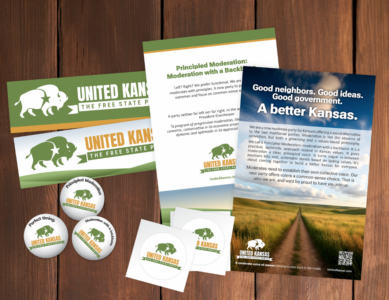
photo by: Submitted
Political material for the United Kansas party is shown.
Two Kansas political parties are merging in an effort to battle the dominance of the Republican and Democratic parties, and a longtime Lawrence resident will serve as the new party’s leader.
The fledgling Free State Party has merged with the more established United Kansas Party, and will begin fielding candidates to take on Republicans and Democrats in elections later this year. Lawrence resident Scott Morgan — who previously worked as a staff member for former U.S. senators Bob Dole and Nancy Landon Kassebaum — will serve as the party’s executive director, the organization announced Tuesday.
“Political parties have realigned throughout American history, and it is really due to happen again,” Morgan said in an interview with the Journal-World.
The party will field candidates under the name United Kansas, and Morgan said it will be seeking to draw support from voters who are dissatisfied with both the Republican and Democratic parties. Morgan — who unsuccessfully sought the Republican nomination for secretary of state against Kris Kobach in 2014 — said he thinks many good people are choosing not to run for office because they don’t want to participate in a primary election system that has become geared towards the extreme views of each party.
“There are a lot of good people out there who haven’t run for office because the primaries are such a hurdle anymore,” Morgan said.
Now, Morgan and other leaders of Kansas United will have to talk those potential candidates into giving a third party a try. Historically, third party candidates have rarely won contested elections, often entering as major underdogs against Republican or Democratic opponents.
Morgan said United Kansas will work to make the case that there are winnable opportunities in the state. He said the party will first focus on the Kansas House, where if five of the chamber’s 88 Republicans were to lose in the coming election, the Republicans would no longer hold a veto-proof majority.
Morgan said part of the challenge with a third party is convincing potential candidates that winning a statehouse seat as a third-party candidate is far different than trying to win a presidential or gubernatorial election, for example. He said winning a Kansas House seat involves interacting with about 12,000 voters, and an expensive race would still be in the $30,000 range. While not easy, the task is far from insurmountable for quality candidates, Morgan said.
“The biggest thing is people believing that it can happen,” Morgan said of third party victories. “People are just so convinced that third parties don’t work, and they just take that as a given.”
What political issues will drive support for the party is less defined currently. Morgan said the party is staking its claim as a party that aims to be more moderate than either the Republican or Democratic Party.
Morgan, though, said United Kansas won’t have a strict party platform that all candidates must follow. Instead, it will have guiding principles such as respect for the rule of law, the idea that every human matters, fiscal responsibility and several other broad topics.
“We recognize that someone from Liberal, Kansas will be a different kind of candidate than someone from Prairie Village, but there will be room for both of them if they believe in our broad principles,” Morgan said.
What that will look like will depend on the issue, but as an example, Morgan said the United Kansas party supports the outcome of the 2022 vote by Kansans who affirmed that access to abortion is a right in the Kansas Constitution.
“But we also recognize there are going to be some differences the later you go into a pregnancy as to what issues you might find appropriate, but you recognize the right of a woman to determine her own health,” Morgan said.
Other issues that United Kansas lists on its website under the “Application of Our Principles” section include:
• Electoral reform, including support for independent redistricting, ranked choice voting, and laws that make the voting process both secure and accessible.
• Environment, including support for candidates who “approach environmental challenges by balancing economic vitality with the need to respond to changing conditions, including a changing climate.”
• Guns, including a belief that the right of “law-abiding Kansans” to own firearms is protected by the Constitution, but also comes with a responsibility. “Many believe that responsible gun ownership and reasonable safeguards can and should exist.”
• Immigration, including support for policies that create a strong border while also providing humane treatment for undocumented people and a clear-path to citizenship for long-time residents.
United Kansas has a short window to find candidates for this year’s election. Since the party does not use a primary election to select candidates, United Kansas must determine its general election candidates by June 1.
In addition to focusing on finding candidates for the Kansas House, the party also will be seeking a candidate for at least one statewide office. Kansas law requires that the party have at least one candidate who receives at least 1% of the total vote in a statewide election. If the party fails to field such a candidate, it could lose its status as a recognized political party in the state.
While this year’s election features the statewide race for governor, there are also statewide races for several other offices, including secretary of state, insurance commissioner, attorney general and treasurer. The party only has to field a statewide candidate for at least one of those positions.
Keeping its status as a recognized political party is critical because gaining that status can be difficult, as Morgan found. Morgan was involved in creating the Free State Party, and was working to get it recognized as a political party in the state. That process involved getting about 30,000 valid signatures to submit to the state, which Morgan said was a very tough task to do on a grassroots budget.
Morgan said he and the other founders of the Free State Party had been aware of United Kansas. As it became clear that the two parties had more commonalities than differences, Morgan said the idea of a merger began to take hold.
“Quite simply, this makes too much sense not to do,” he said.
State Government
2 Douglas County District Court judges up for retention on November ballot
General Election Voter’s Guide
Two state senators vying to be Kansas governor

14 candidates for Kansas House of Representatives will appear across Douglas County ballots in November. See who they are.
Three candidates vying to become state’s chief election officer
There will be a new Secretary of State in Kansas after the incumbent decided not seek re-election to the post that ...
Voters Guide: Meet the candidates vying to become Kansas’ next Attorney General
Current Kansas Attorney General Kris Kobach is facing off against Democrat Chris Mann for the office. Again. The ...