

Proposal to move city, school board elections to even years could cause complications in Douglas County
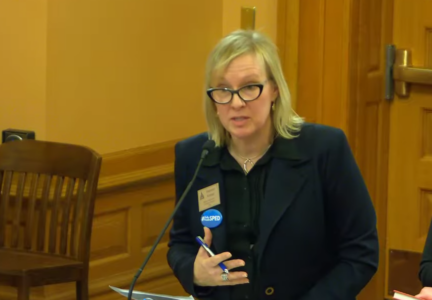
photo by: Screenshot
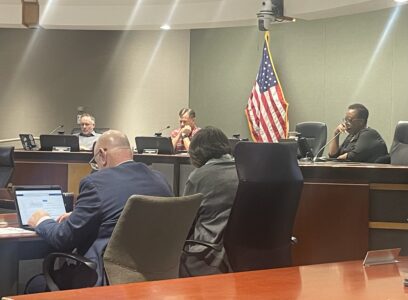
Shannon Kimball testifies at a hearing of the House Elections Committee in Topeka on Tuesday, Jan. 20, 2026.
State legislators are considering a proposal to move city government and school board elections to even-numbered years – and a couple of Douglas County figures are saying that could add some new complications.
The proposal in the Legislature is called House Bill 2452, and it would change the timing of elections such as City Commission and school board races from odd-numbered years to even-numbered ones. Supporters of the bill said at a committee hearing on Tuesday that the idea was to put the races in years where they would have bigger turnout.
But those would also be years that coincide with heated partisan races for things like statewide offices, Congress and the presidency. And that was a problem for Shannon Kimball and the Kansas Association of School Boards.
“Turning them into part of the even-year partisan ballot will make the focus on those national and state races, rather than allowing a focus on the very important issues that apply to our city and school board governments,” Kimball, a government relations specialist for KASB who is also a longtime Lawrence school board member, testified at the hearing.
It would also mean much more complexity, Douglas County Clerk Jamie Shew told the Journal-World.
“The odd-year elections are probably the more complex that we run,” he said, “not because of the turnout but because school district boundaries follow no other boundaries.” He said there are seven school districts in Douglas County, including some that are just “little fingers that come around,” and different styles of ballots have to be printed to account for that.
If you had those races in an even year, he said, “it would make those elections very complex.”
If the bill were to become law, it would go into effect beginning with the 2028 election cycle. It would have provisions to shorten or lengthen the terms of officials in order to line them up with the 2028 election.
It would also be the first time in about 10 years that Kansas has changed its election schedule like this. The last major change was in 2015, and it produced the current system with off-year elections in the fall. Before then, Kansas held off-year elections for city and school board candidates in the spring.
The turnout argument
The argument that moving off-year races to even-numbered years would boost turnout is one that Rep. Steve Huebert, a Wichita-area Republican, has been making for more than a decade.
Huebert was a previous chair of the House Elections Committee, and as early as 2010, he was working to start the conversation about election timing at the Statehouse.
On Tuesday, he told the Elections Committee about two elections he’d been in before. One was in 2000, when he was first elected to the Legislature, and turnout then was around 70%, he said. The other was a local school board race in 1993. He lost that one by seven votes, and the turnout was under 10%.
“There’s a lot of issues that get impacted when you elect people with 10% turnout that impact everybody greatly,” he said.
But when the changes in 2015 passed, Huebert had wanted something more – a shift away from off-year elections entirely.
Jillian Kincaid of the Legislative Research Department told lawmakers that in 2015, the original proposal was to move municipal elections to the fall of even-numbered years, just like HB 2452 is now proposing to do, and to make them partisan, which is not being proposed in HB 2452. But legislators in 2015 had been hearing concerns about extra burdens the bill would cause, so it was amended to move the elections to the fall of odd-numbered years and keep them nonpartisan.
Huebert said that when it passed, the governor at the time, Republican Sam Brownback, congratulated him on the compromise: “Great job; you got half an apple.” Huebert’s response was, “Yeah, we got the half of the apple with the worm in it.”
“Because it’s not going to accomplish its goal” of increasing turnout, he continued. “I agreed to it … I said, ‘Let’s see.’ If it does, great. We’ll celebrate. If it doesn’t, we’ll be back.”
“We’re back,” he said, gesturing to the committee chamber. “And it’s time.”
Bigger ballots and ‘dropoff’
For Douglas County’s part, voter turnout did increase after off-year elections shifted from the spring to the fall. In the general elections in 2011, 2013 and 2015, all spring elections, the county reported turnout of 13.5% in 2011 and 16.6% in 2013 and 2015. Since then, every off-year election has happened in the fall, and all of them have had turnout in excess of 20%. The last two off-year general elections, 2023 and 2025, had 26.1% and 26.7% turnout, respectively.
But Shew told the Journal-World Wednesday afternoon that the election office’s voter outreach efforts played a big role in that. “That had almost a 10% bump in turnout,” he said, and it happened “in 2017 when we started doing informational brochures.”
These numbers still lag behind turnout in even-numbered years with partisan races. Every one of these since 2012 has been over 50%, and some have been much higher. In 2022, Douglas County’s turnout was 57.9%, and in 2024 it was 71.0%, according to the county’s statistics.
Shew said that there would be some major changes with how the county handled its ballots if HB 2452 passed. For one thing, he said, “we would definitely go to a two-page ballot.”
Currently, the county’s even-year elections are printed on one page that’s “filled front to back,” Shew said. It can’t accommodate more without adding an extra page.
For mail ballots, that could mean more headaches, because voters would get two pages and then have to return both pages. A longer ballot would also mean putting local candidates further back, after the national and state races.
“We know that people get tired,” Shew said. There’s “dropoff” of voters’ attention when reading a long ballot, and he wondered, “anything that’s on the second page, is that just kind of going to get lost?”
“And I know the discussion is turnout,” Shew said. “… The city and school candidates are going to be at the back of the ballot. So, does that help them? I don’t know.”
The impact on campaigns
When Kimball testified about the possibility of school board races in even-numbered years getting more politicized, Republican Rep. Pat Proctor, the chair of the House Elections Committee, had a question: whether off-year races were already being politicized by the parties.
He said he’d seen a post from the Kansas Democratic Party celebrating the results of the 2025 elections, and that he heard Republicans at a recent event celebrating their election successes last year, too.
“So, it seems to me like the parties are already involved in these races,” Proctor said. “And the idea that, by pulling them into the even year, suddenly, clutching my pearls, they’re going to become partisan – that may have already happened.”
Kimball responded, “What we do as school board members is supposed to be good for all kids, regardless of politics, right?”
“We want to make sure that we’re doing the right thing for students in our districts,” she continued. “And maintaining that focus on what’s best for kids rather than having those influences at play is the thing that our members (of KASB) have repeatedly raised their voices in support of.”
There’s also the issue of campaigning, Kimball said, and people who run for school boards “are not people who are looking to be politicians in kind of the traditional sense”.
In response to a question from Democratic Rep. Brooklynne Mosley, Kimball said that her own campaign fundraising has varied from a few thousand dollars to as high as $11,000, but that this isn’t typical for a place like Lawrence. “A lot of our school board candidates are not raising and spending quite that much,” she said.
With local, state and national races in the same year, Kimball said, candidates running smaller campaigns would have to compete with the big state and national campaigns for donations and volunteers.
“Getting your message out to the voters that you need to engage in these races is hard enough already,” Kimball said, “especially when you are running for an office where you don’t get paid.”
Mosley and Kimball said the competition from national issues also interferes here, by making it more difficult to capture voters’ attention. The representative asked Kimball about what issues school board candidates deal with, and Kimball listed off things like teacher retention, class sizes and special education funding. If you have both national and local issues and only so much time to engage with voters, Mosley said, those local issues may get lost.
And Kimball said that voter engagement was the key – not just turnout numbers.
“Voter turnout is important,” she said. “But I think voter engagement is the most important issue here, and our local voters are very informed and engaged in our local campaigns.”
City Government
As they approve bikes plan, Lawrence city leaders ask about data collection, Kentucky and Tennessee streets
Lawrence city leaders want to toughen tobacco licensing rules ‘sooner than later’
Algerian government invites Mayor Brad Finkeldei, Lawrence delegation for a visit
Construction on Wakarusa Drive to resume; city manager says KDOT’s secretary has apologized for delay
Evacuation drill planned Tuesday at Lawrence City Hall
