Kansas governor vetoes anti-trans bathroom bill, citing ‘numerous and significant consequences’
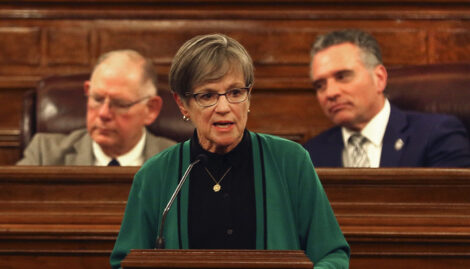
photo by: Thad Allton/Kansas Reflector
Kansas Gov. Laura Kelly is pictured in this file photo.
TOPEKA — Gov. Laura Kelly vetoed a controversial bathroom bill that forces transgender people to use facilities that match their biological sex at birth, saying the poorly drafted legislation would have far-reaching consequences.
The Democratic governor now hands House Substitute for Senate Bill 244 back to a Legislature that has enough Republican votes to put the bill into law.
The bill requires government entities to police bathrooms and other private spaces in their buildings, and levies fines against the governing body if they don’t do so. It also sets up escalating penalties for individuals who use a bathroom that doesn’t match their sex at birth.
In a statement Friday, Kelly cited multiple situations affected by HB 244.
“If your grandfather is in a nursing home in a shared room, as a granddaughter, you would not be able to visit him,” Kelly said. “If your sister is living in a dorm at K-State, as a brother, you would not be able to visit her in her room.”
Kelly said she vetoed the bill because of those “numerous and significant consequences.”
“I believe the Legislature should stay out of the business of telling Kansans how to go to the bathroom and instead stay focused on how to make life more affordable for Kansans,” she said.
Speaker of the House Dan Hawkins, R-Wichita, said he doesn’t understand why the governor would veto a “common sense” bill.
“SB 244 simply recognizes biological reality in state law and ensures that single-sex spaces, such as restrooms and locker rooms in public buildings are designated accordingly. That’s not extreme — it’s basic clarity, truth, and dignity,” he said in a statement. “Kansans expect their laws to reflect reality and protect privacy. Instead of standing with the overwhelming majority of Kansans on this issue, the Governor chose to appease her most radical supporters at the cost of women and girls in our state.”
SB 244 passed the House and Senate with no public input on the bathroom portion of the bill. In a “gut and go” move, the House Judiciary Committee placed House Bill 2426, originally addressing changing gender markers on driver’s licenses and birth certificates, into SB 244.
More than 200 people opposed HB 2426 through written testimony. An amendment proposed by Rep. Bob Lewis, R-Garden City, added a section to the original bill to ban transgender people from using the bathroom of their choice and prohibiting anyone from taking a child older than 10 into a bathroom for the opposite sex.
No public input was allowed on that amendment. The process by which SB 244 came to a vote was as incendiary as the bill itself, as numerous Democratic opponents noted in a six-hour House hearing on the bill.
House Minority Leader Brandon Woodard said SB 244 was a failure of “process and priorities.”
“The bill was rushed through the Legislature without meaningful public input or debate. Beyond its flawed process, the legislation targets a small and vulnerable group of Kansans while creating sweeping and unintended consequences for communities across our state,” he said in a statement.
Like Kelly, Woodard expressed concern for the far-reaching implications of SB 244. It would affect shared hospital, nursing home, rehabilitation and treatment rooms, dorm rooms and sporting events, he said.
“This bill is bad legislation and has bad unintended consequences,” Woodard said.
Harper Seldin, a senior staff attorney at the American Civil Liberties Union, said the Kansas bill stands out as “particularly pernicious” and different from similar legislation that has passed across the country.
“I think this bill is particularly extreme and harmful. It’s unique in that it contains these escalating criminal penalties against individual people, as well as this private right of action,” he said. “I think also the provision regarding municipal liability is particularly harmful, because it puts the price of this kind of discrimination on local taxpayers in a way that feels deeply unjust.”
SB 244 sets an initial penalty if a local government entity doesn’t comply with the bill at $25,000, with penalties escalating to $125,000 after subsequent violations. City and county officials have expressed concern about the bill’s lack of clarity.
Seldin said the language in the bill is confusing for parents, who must decide whether they have to leave their 10-year-old son standing alone outside the restroom if they are using the women’s room.
“This bill is particularly poorly worded and constructed in ways that are going to create confusion and anxiety, and certainly real material harm in the event it’s enforced,” he said.
Seldin said Kansas legislators, no matter their feelings about transgender people, should consider whether the bill should be passed in its current form.
“I think that’s exactly the intent of bills like this, including the poor wording, which is to create the kind of fear and uncertainty that causes trans folks to self police and over comply, even in restrooms where they are perfectly permitted to be,” Seldin said.
Although there has been a “wave” of restroom bans across the country, Seldin said it is a solution in search of a problem.
“Trans people are much more likely to be the victims of violence than than they are to be causing it,” he said. “Public restrooms are not a site of a lot of violence or harm. I think that the assumption of these bills is that trans people are unworthy to be in society, or that there’s something dangerous about us, because we don’t conform to ideas of what men and women are. But there’s no evidence to support that.”
Human Rights Campaign president Kelley Robinson said SB 244’s focus on attacking transgender people is “appalling.”
“SB244 is about invading privacy, forcing people into the wrong bathrooms, stripping transgender Kansans of accurate IDs, and inviting government-sanctioned harassment — all pushed through using cynical procedural tricks to silence public opposition,” Robinson said. “Shameful policies like this are part and parcel of a national right-wing anti-LGBTQ+ campaign, and they don’t make anyone safer.”
Brittany Jones, president of Kansas Family Voice, said the legislation supports the Kansas Women’s Bill of Rights by ensuring women and girls have private, sex-specific spaces.
“Governor Kelly once again refuses to stand up for Kansas women. Most kindergartners know the difference between a boy and a girl and can tell you which restroom each should use, yet the governor of our state cannot seem to recognize the distinction,” she said in a written statement.
— Morgan Chilson reports for Kansas Reflector.
State Government
Kansas governor vetoes anti-trans bathroom bill, citing ‘numerous and significant consequences’
State lawmakers considering bills that would overturn Lawrence housing ordinance related to income

Bill to limit how DEI is taught in universities pulled from hearing schedule, but may still come back
Bill compels teachers, students to undergo annual sexual abuse prevention training
TOPEKA — Erin Merryn wants the Kansas Legislature to require public school teachers and their students in ...
Girod says KU concerned about multiple legislative proposals, including tuition freeze, changes to tenure