Lawrence woman who underwent genital reassignment surgery 13 years ago suing state, which says her driver’s license must say ‘male’
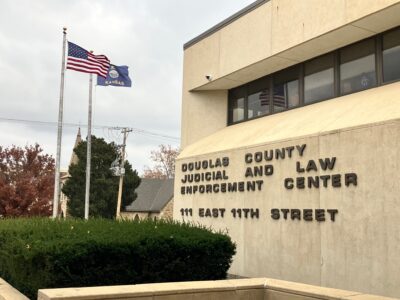
photo by: Kim Callahan/Journal-World
The Douglas County Judicial and Law Enforcement Center is pictured on Nov. 25, 2025.
Updated at 4:55 p.m. Tuesday, April 28
A transgender Lawrence woman on Friday filed a lawsuit against the state of Kansas after it invalidated her driver’s license under a state law known as SB 244.
The woman, Jamie Michelle Miller, born in 1971, underwent irreversible genital reassignment surgery 13 years ago, according to the suit, and has court orders from Douglas County recognizing that her gender is legally female. Miller, who is also an honorably discharged U.S. military veteran, has had a Kansas driver’s license since 2014 listing her as female. She renewed that license in 2017 and again in 2023 to get the “Real ID” star, both times with a female marker.
But on April 10 of this year, she received a letter from the Kansas Department of Revenue informing her that her license had been invalidated under the new state law SB 244. That law purports to invalidate driver’s licenses that do not reflect a person’s biological sex at birth.
Miller sought to appeal the invalidation, but the Department of Revenue never responded to her request nor did it specifically address rights of appeal in its letter invalidating her license, according to the suit. She is thus appealing to the Douglas County District Court for relief.
The suit, filed by Lawrence attorney David Brown, argues that the Department of Revenue has never challenged Miller’s court order declaring her female. It states that the gender marker on her driver’s license has “significant social, legal, and safety implications” for her, and the invalidation of it has caused her isolation from public life and created significant roadblocks to obtaining health care and caring for her disabled daughter.
Among other hardships, she cannot sign any document listing her sex or gender as “male” without committing fraud, the suit says. Additionally, she cannot legally drive without a valid license, impacting her ability to do basic tasks like going grocery shopping.
“She’s in a weird catch-22,” Brown said of the contradictory state rules: the court order declaring her female and the requirements of SB 244 that would have her be male.
“The Legislature is just attacking transgender Kansans,” Brown said of SB 244 and other legislation like SB 63, which blocks gender-affirming care for minors, and SB 180, which banned transgender people from using the bathrooms and other gender-specific areas associated with their gender identity.
Miller’s lawsuit argues that the state law violates her due process rights under the Kansas Constitution, as well as her rights to personal autonomy, privacy, equality under the law and freedom of expression.
The lawsuit requests that the court void SB 244 in its entirety and immediately grant an injunction to prevent enforcement of the law.
State defendants named in the suit include Attorney General Kris Kobach; Director of Vehicles Deann Williams, of the Kansas Department of Revenue; and Secretary of the Department of Revenue Mark Burghart.
SB 244, which took effect in February, has multiple components that target transgender Kansans, including a provision that invalidates driver’s licenses and birth certificates of people who have changed their gender markers. There’s also a “bathroom bill” component of SB 244, which requires public buildings to designate “multiple-occupancy private spaces” as for either male or female users, based on the person’s sex as assigned at birth, and creates financial penalties for noncompliance.
Two transgender men using the pseudonyms Daniel Doe and Matthew Moe filed a lawsuit earlier this year saying SB 244 violates the Kansas Constitution. Douglas County Judge James McCabria last month declined to immediately pause enforcement of the law and scheduled a Sept. 29 hearing to consider an injunction in that case.
State Government
Voters Guide: A look at the candidates seeking to become Kansas Insurance Commissioner
The Kansas Department of Insurance regulates insurance companies that sell policies in Kansas. Voters will decide ...
Voters Guide: A look at the candidates seeking the job of Kansas State Treasurer
In the Nov. 3 election, Republican Kansas Treasurer Steven Johnson faces two challengers for his job as the chief ...
What to know about amendment seeking to restrict noncitizen voting in Kansas
2 Douglas County District Court judges up for retention on November ballot
General Election Voter’s Guide