

State drafting plan to reopen economy once stay-at-home order lifted; governor says more testing, contact tracing required
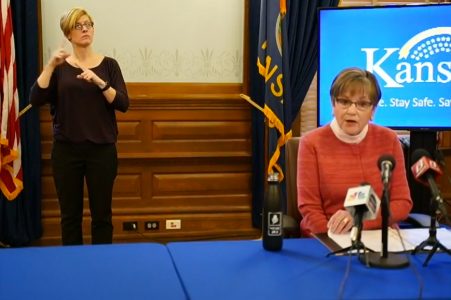
photo by: Screenshot/Kansas Governor's Office
Kansas Gov. Laura Kelly, right, gives a daily briefing on the coronavirus, Friday, April 17, 2020, in Topeka.
Story updated at 6:33 p.m. Friday:
Kansas Gov. Laura Kelly said on Friday that she has begun working with state officials on a plan to gradually reopen the economy once the statewide stay-at-home order is lifted, though moving forward will require robust testing.
Kelly made the announcement at her daily briefing, which she began by saying that on Thursday she spoke with the White House to discuss the new federal guidelines for reopening America. She said she was working with state public health officials, emergency management staff and an assortment of other experts, including those in the business world, to explore how to tailor the guidance to Kansas.
Kelly said she expected to have the guidelines available late next week or the week after.
“We’re going to take our time to make sure that we do it right so that it’s useful to our local units of government, our businesses and other sectors, and doesn’t create confusion but rather creates very clear guidelines for them to act upon,” Kelly said.
Kelly said the plan would most likely begin on a regional basis and noted that after the statewide stay-at-home order was lifted, local communities would be authorized to put their own orders in place. However, she emphasized that the statewide stay-at-home order could be extended beyond May 3 if public heath conditions warrant. She said the state’s ability to test for the virus — and trace the contacts of people who have it — must be much more robust before the state can safely open.
Kansas on Friday confirmed 117 more cases of COVID-19, bringing the state’s total to 1,705. The state also confirmed four more deaths, bringing the statewide total to 84. From Thursday to Friday, the state processed 779 virus test results between the Kansas Department of Health and Environment’s lab and tests processed by private labs.
Kansas Department of Health and Environment Secretary Dr. Lee Norman said during the briefing that additional swabs that are being 3-D printed will soon help the state increase its testing capacity. Norman said Kansas has been behind on testing compared to other states, but he expected testing to increase soon.
“I really think the floodgates will open up and allow much more broad testing within the next week,” Norman said.
Specifically, Norman said the 3-D printing operations were expected to manufacture 1,000 testing swabs a week. The state would like to do another 15,500 tests on people not showing symptoms to determine how prevalent coronavirus infections are in the general population, he said.
Kelly said that the additional swabs would help, but they would not solve the entire problem. She said that the state still needed more test kits — and protective gear for health care workers administering the tests — if it’s going to be able to test on a population basis that will make it safe to reopen the economy. She said she had another call with the White House on Saturday and planned to discuss the need for Kansas to get additional test kits.
As of Friday, Kansas reported testing about 17,000 of its 2.9 million residents, for a rate of 5.8 for every 1,000 residents, according to The COVID Tracking Project, a website managed by journalists and analysts, with The Associated Press among the contributors to the data. That rate is the second-lowest among states, just behind Virginia’s 5.75 per 1,000 residents and a little more than half of the national figure of 10.82 per 1,000 people.
Testing in Kansas generally has been limited to people who are showing symptoms, though it has expanded in a handful of the state’s 105 counties, including the biggest hotspots in the Kansas City area.
Dr. Beth Oller, a family-practice physician in Stockton, said it’s “ridiculous” that in her area of northwest Kansas, testing still isn’t recommended for people who know they’ve had close contact with an infected person but aren’t yet showing symptoms.
“It’s frustrating, but it’s the way it is right now,” she said. “There are still not enough tests.”
As part of the briefing Friday, Kelly also announced a new program that would provide subsidies to child care centers. The Hero Relief Program expands the Department for Children and Families’ child care assistance subsidies for families and provides financial support directly to child care providers. Kelly said parents are pulling their kids out of child care, and the subsidies to the centers will allow them to stay open and offer affordable care to front-line workers who continue to need it.
Clusters, or outbreaks, of the virus have also increased. Norman said the state is currently monitoring 35 clusters, an increase of nine from his last briefing on Wednesday. Thirteen of the clusters are related to long-term care facilities, 13 to private companies, five to religious gatherings, two to group care facilities, one to a hospital, and one at the Lansing Correctional Facility. He said there are now 65 confirmed cases at Lansing, and six of those people have recovered so far. The nine new clusters, Norman said, are related to private companies.
KDHE also announced 16 more COVID-19-related hospitalizations, bringing the state’s total number of people who have been hospitalized with the virus to 375. That figure is out of the 1,377 cases where data is available. The hospitalization percentage has remained about 27% for the past two weeks.
— The Associated Press contributed to this report.
State Government
GOP’s highest profile figures are on rescue mission in once-reliable Kansas

In debate, Marshall says the Ukraine war, not the Iran war, has caused high diesel prices
Candidates lean on their prominent supporters in District 2 race
TOPEKA — Democrat Don Coover and Republican Derek Schmidt stood with partisan allies as their congressional race ...
Funding for new Chiefs stadium moves forward, setting sales tax revenue district
TOPEKA — State officials answered a key question this week underpinning the complex financing of the Kansas City ...
Voters Guide: A look at the candidates seeking to become Kansas Insurance Commissioner
The Kansas Department of Insurance regulates insurance companies that sell policies in Kansas. Voters will decide ...
Voters Guide: A look at the candidates seeking the job of Kansas State Treasurer
In the Nov. 3 election, Republican Kansas Treasurer Steven Johnson faces two challengers for his job as the chief ...