

Orman survives petition challenge, will be on ballot in Kansas governor’s race
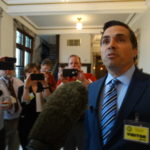
Greg Orman, an independent candidate for governor, speaks with reporters outside a meting of the State Objections Board, where Democrats sought to invalidate thousands of petition signatures he had gathered to qualify for the Nov. 6 general election ballot.
Updated 5:20 p.m. Aug. 23, 2018:
TOPEKA – A three-member state panel on Thursday rejected all but one out of 19 challenges to petitions that independent gubernatorial candidate Greg Orman filed to get on the Nov. 6 general election ballot.
That means, barring any further legal challenges by Democrats who tried to keep him out of the race, Orman’s name will appear on the ballot in November.
“We don’t know yet. We need to assess our options and decide from there,” said Topeka attorney Pedro Irigonegaray, who represented the Democrats’ challenge, after the seven-hour meeting of the State Objections Board.
On Aug. 6, Orman filed more than 10,000 petition signatures to have his name placed on the ballot as an independent candidate for governor. Of those, roughly 7,780 signatures were validated by county election officials as being legitimate signatures of registered Kansas voters.
That was well more than the 5,000 signatures required under Kansas law.
Orman’s candidacy is seen as a potential threat to Democratic nominee Laura Kelly, a state senator from Topeka, because he will likely appeal to many of the independent and moderate Republican voters that Kelly needs to attract. That could, in effect, hand the election to the Republican nominee, Secretary of State Kris Kobach.
“What we’ve seen here today is nothing more than the Democrats trying to deny me access to the ballot because they don’t want to give voters a real choice in November,” Orman said to reporters outside the board’s meeting room.
The challenge had an unusual twist, however, because the secretary of state, or his designee, is a member of the board, along with the attorney general and lieutenant governor, or their designees.
Kobach won the GOP nomination by barely edging out incumbent Gov. Jeff Colyer and Lt. Gov. Tracey Mann in the Aug. 7 primary. Colyer and Mann have since endorsed Kobach.
Kobach had recused himself from the hearing and designated his chief assistant, Eric Rucker, to act in his place.
Will Lawrence, an attorney who is also chief of staff to Senate Minority Leader Anthony Hensley, of Topeka, filed the challenges Monday. He argued that more than 4,000 of those signatures should be invalidated for various technical issues.
Lawrence did not challenge any of the signatures themselves, but instead challenged some of the people who gathered the signatures as well as many of the notary seals attached to them.
The Orman campaign had used volunteers as well as a private company that specializes in gathering signatures to aid in its petition drive.
One of the challenges involved a campaign volunteer whom Lawrence argued was not eligible to gather signatures because he was still on probation for a felony drug conviction in Kansas. The board upheld that challenge, but it only removed a little more than 300 signatures from Orman’s total. Furthermore, it wasn’t known Thursday how many, if any, of those signatures were among those that were counted as validated.
There were also more than a dozen challenges to petition sheets that appeared to be improperly signed by those gathering signatures, or improperly notarized.
But the Objections Board dismissed all of those, saying the technical errors did not outweigh the interests of the voters who had signed the petitions to have Orman’s name placed on the ballot.
The final two objections, though, could have doomed Orman’s campaign because they involved more than 3,500 signatures — enough to drop him below the required 5,000-signature threshold.
One of those involved five out-of-state residents who gathered signatures but, according to Lawrence, listed invalid home addresses on the forms. Among them were addresses that turned out to be a hotel in Sioux Falls, S.D.; a vacation resort in Florida; and a homeless shelter in Minnesota.
Lawrence said he called each of those places, but the people who answered the phone could not confirm that the signature gatherers actually lived there. In the other cases, Lawrence said he conducted property searches and could not match the names of the individuals to the people listed as owning or residing at those addresses.
Assistant Attorney General Athena Andaya, who filled in for Attorney General Derek Schmidt, said there could be any number of explanations for those discrepancies, and she said there was not enough evidence to suggest that fraud had been committed.
But Brant Laue, chief counsel in the governor’s office who sat on the board in place of the lieutenant governor, said he believed the evidence at least warranted further investigation, and he voted against the motion to overrule the objection. That motion passed, 2-1.
The final challenge involved individuals who did not list any home address on the petition forms, something that is clearly required by law.
Again, though, Andaya said that was not enough to negate the fact that county election officials had verified the signatures of voters who had signed Orman’s petitions. Her motion to overrule that objection passed, 3-0.
Orman’s campaign manager, Tim Phillips, said after the hearing that he fully expects Democrats to file further legal action.
“This is a PR campaign, not a legal campaign,” he told reporters after the hearing. “So many of these objections were just designed to throw dirt on the process to make it look like we’d done something wrong. That’s why I called it frivolous in the first place.”
But Democrats now face a tight deadline for any further legal action. That’s because under federal law, ballots must be mailed out to military personnel stationed outside the state at least 45 days before the election.
That would be Friday, Sept. 21, which is about a month away.
State Government
Candidates for ‘The Big First’ Congressional district talk affordability, immigration, Iran in Lawrence forum
US Rep. Sharice Davids introduces healthcare reform package
TOPEKA — U.S. Rep. Sharice Davids introduced healthcare legislation intended to benefit families grappling with ...
Opinion: The Lawrence man seeking to break the power of Republican, Democratic parties this election
State tax receipts top estimate by $147M for quarter
TOPEKA — The state of Kansas collected $147 million more in taxes than anticipated during the first quarter of ...
Rep. Tracey Mann to skip candidate forum in Lawrence; spokesman scarce on details
