

Kobach and Colyer moving forward with general election campaigns, even though primary results may not be known for weeks

photo by: Topeka Capital-Journal via AP
Kansas Republican gubernatorial candidate Kris Kobach and his wife Heather take the stage to thank their supporters and send them home for the night after problems with polls in Johnson County, Kan., delayed the final results until the early morning on Wednesday, Aug. 8, 2018, at the Capitol Plaza Hotel in Topeka, Kan. (Chris Neal/The Topeka Capital-Journal via AP)
TOPEKA — Gov. Jeff Colyer and Kansas Secretary of State Kris Kobach both said Wednesday that they are moving forward with their plans for a general election campaign, even though results of their hotly contested primary race may not be known for weeks.
Kobach emerged from Tuesday’s primary with a razor-thin lead over Colyer of just 191 votes, out of roughly 311,000 Republican ballots cast, for a margin of 0.06 percent.
But those numbers, which were reported immediately after initial vote counting Tuesday night and Wednesday morning, are incomplete because they do not include advance ballots that were mailed back to county election offices but weren’t received before polls closed.
The numbers also do not include thousands of provisional ballots, which are subject to approval or rejection by county boards of canvassers.
Official numbers from each of the 105 counties won’t be known until the end of next week, after each county completes an official canvass of its ballots.
That process involves county commissions sitting as a “board of canvassers” that reviews the totals collected by the county election office and decides which provisional ballots should be added to the totals.
“So the final number will change. It won’t be 191 votes a week from now,” Kobach said during a news conference Wednesday.
“It is certainly possible that the result of the race could change,” he said. “But, that said, it is imperative that the Republican Party not stand still for a week. We must begin running the race that is before us.”
At a separate news conference later in the day, Colyer said he also was proceeding with his plans for a general election campaign, including sending out emails to supporters asking for contributions.
“We were planning on soliciting today for the general election, and we’re continuing our plans,” Colyer said.
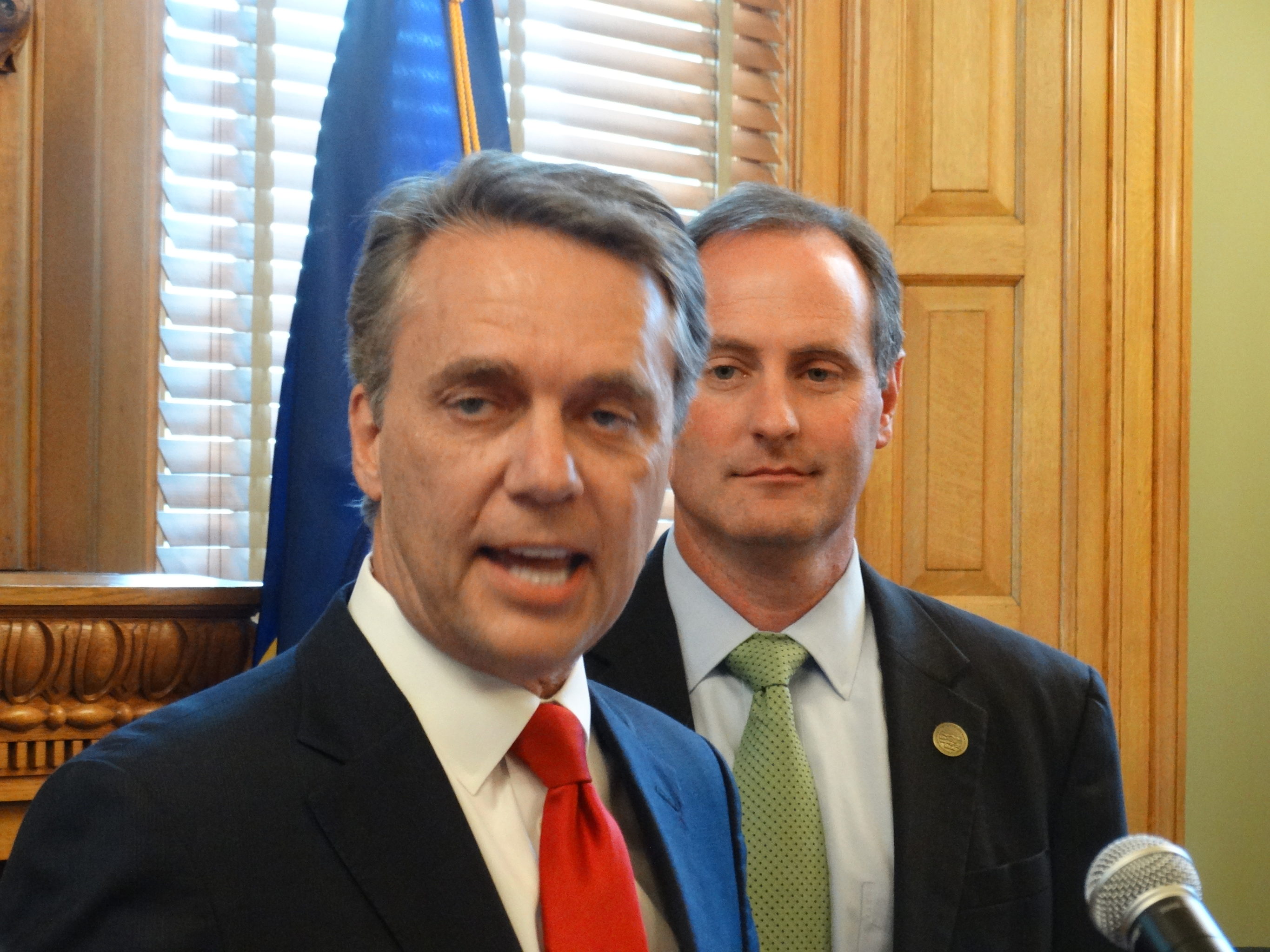
photo by: Peter Hancock
Gov. Jeff Colyer, left, and Lt. Gov. Tracey Mann discuss the historically close Republican primary for governor during a Statehouse news conference Wednesday, Aug. 8, 2018.
Even after the county canvasses are complete, the process may not be over. Under Kansas law, candidates have a right to request a recount in any individual county, or a complete statewide recount, a process that Kobach said could require a “substantial” amount of time.
But the recounts must be completed before the end of the month because, under Kansas law, the State Board of Canvassers must meet no later than Sept. 1 to certify the final results of the primaries.
And that creates an interesting situation for this year’s race because the State Board of Canvassers is made up of the governor and secretary of state, both of whom have a vested interest in how the election is decided, along with the state attorney general.
Brian McClendon, the Democratic candidate for secretary of state, who ran unopposed in Tuesday’s primary, said he believes Kobach, as the state’s current chief election officer, should recuse himself from taking any part in a recount process, and that both Kobach and Colyer should recuse themselves from the State Board of Canvassers.
“In this particular case, I would argue yes. They are not qualified to certify for this (election) because they have too much of a stake in the result,” McClendon said during an interview Wednesday.
In the general election, McClendon will face Scott Schwab, the current House speaker pro tem, who won the Republican nomination for secretary of state.
Both Kobach and Colyer dismissed such suggestions.
Kobach noted that recounts are handled entirely at the county level, and the only involvement his office has in them is to receive the certified results from each county. The State Board of Canvassers, meanwhile, serves mainly a ceremonial role and does not get directly involved in disputed elections.
Colyer, meanwhile, said he believes it’s premature even to talk about recusals or recounts.
“At this point, we’re just trying to get the first count,” he said. “Let’s get the first data out there. Let’s make sure every legitimate vote is out there.”
Both Kobach and Colyer made conciliatory statements about each other, and about the other five candidates in the race, congratulating the other candidates for their hard-fought campaigns and calling for party unity going into the general election, regardless of which one ends up being the nominee.
Democrats, meanwhile, staged their own unity rally Wednesday afternoon to showcase their candidates for congressional and statewide offices.
Kansas Democrats are hoping to end a 10-year losing streak during which time they have lost every congressional and statewide office in which they have fielded a candidate.
Sen. Laura Kelly, of Topeka, who won the Democratic primary for governor with 52 percent of the vote, reiterated her statement from the night before that it doesn’t matter to her whether Kobach or Colyer ends up being the nominee.
“It really doesn’t,” she told reporters. “We’re running on issues, not personality. But as I’ve said before, either of the options the Republican Party likely has are not ones that I think are in the best interests of Kansans and don’t represent Kansans particularly well, so I’m prepared to take either one of them on.”
In her victory speech to supporters Tuesday night, Kelly referred to Colyer as former Gov. Sam Brownback’s “right-hand man,” and she called Kobach “Sam Brownback on steroids.”
Amid all the talk of Democratic unity, however, one Democratic candidate for a statewide office was noticeably absent from the stage — Sarah Swain, of Lawrence, the Democratic nominee for attorney general.
Just days after she filed for office June 1, party officials disavowed her because of a poster she had hung in her law office depicting herself as a Wonder Woman-type character with a lasso around the neck of a police officer, a poster that was seen as overtly hostile to law enforcement.
John Gibson, executive director of the Kansas Democratic Party, declined to say whether the party had intentionally not invited her.
“Sarah Swain is running and I think a lot of Democrats will vote for her, but we’ve made our comment about her candidacy,” Gibson said.
State Government
Candidates for ‘The Big First’ Congressional district talk affordability, immigration, Iran in Lawrence forum
US Rep. Sharice Davids introduces healthcare reform package
TOPEKA — U.S. Rep. Sharice Davids introduced healthcare legislation intended to benefit families grappling with ...
Opinion: The Lawrence man seeking to break the power of Republican, Democratic parties this election
State tax receipts top estimate by $147M for quarter
TOPEKA — The state of Kansas collected $147 million more in taxes than anticipated during the first quarter of ...
Rep. Tracey Mann to skip candidate forum in Lawrence; spokesman scarce on details
