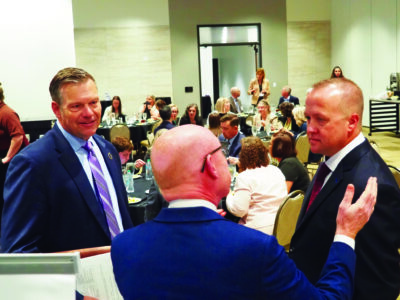
Kansas’ kratom ban begins July 1, and law enforcement and health officials in Lawrence are preparing

photo by: Sylas May/Journal-World
Signs in the windows of several Lawrence smoke shops on 23rd Street advertise kratom on Thursday, June 25, 2026, just under a week before a ban on kratom in Kansas goes into effect.
For years, Douglas County health officials have fought to save people from opioid overdoses and addiction. But all that time, they say, a legal opioid-like substance has been “ubiquitous” in smoke shops all over town.
It’s kratom, and now its days on the shelf in Kansas are numbered.
State legislation banning the sale or possession of kratom and a derivative of it called 7-OH will take effect Wednesday, July 1. And agencies in Douglas County are preparing – both to enforce the ban and to treat people addicted to kratom who may be at risk of painful withdrawals if they suddenly stop taking it.
“Especially with a drug you can pick up at a gas station, people aren’t recognizing the addictive qualities of it,” said Chrissy Mayer, chief community-based services officer at the social service provider DCCCA. “And so we’re kind of in this perfect storm environment right now, where the ban will happen July 1, and then we’re going to move into the Fourth of July holiday weekend, so there’s just a lot of things that could be really problematic, especially for emergency departments.”
Kratom comes from a plant that’s native to southeast Asia, and it can be sold as a tablet, capsule, extract or powder. According to the Drug Enforcement Administration, it can cause increased alertness at low doses and sedative effects at higher doses. Some people have severe symptoms from it, such as seizures, hallucinations or liver toxicity, and people can become addicted to it or even overdose on it.
And, while kratom isn’t a federally controlled substance yet, Kansas decided to ban it with House Bill 2365. In April, Gov. Laura Kelly signed the bill, which designates kratom and products derived from it, including 7-OH, as Schedule I under the state’s controlled substances law. Schedule I substances are those that the state deems to have high potential for abuse and no currently accepted medical use, and it includes a number of other illegal drugs, such as heroin, psilocybin and marijuana.
“The U.S. Food and Drug Administration is in the process of determining whether kratom is a safe and effective means of treating certain medical conditions,” Kelly said in a news release announcing the bill signing. “Until such a time as quality scientific reviews determine positive impacts and minimal health risks, it is wise to safeguard the health of Kansans.”
Statewide statistics do suggest that kratom sent more than 150 Kansans to the hospital last year.
A chart of kratom-related emergency department visits in Kansas is included in a fact sheet from the Overdose Response Strategy program, which is a collaboration between the Centers for Disease Control and Prevention and the High Intensity Drug Trafficking Areas Program. The chart shows 164 kratom-related visits in Kansas in 2025, up from around 50 in 2024 and even fewer in the years before that.
In the documentation of the 2025 visits, the fact sheet says, 53% mentioned withdrawal symptoms, and 7% mentioned an overdose.
“You can see the significant increase that emergency departments are experiencing,” Mayer told the Journal-World.
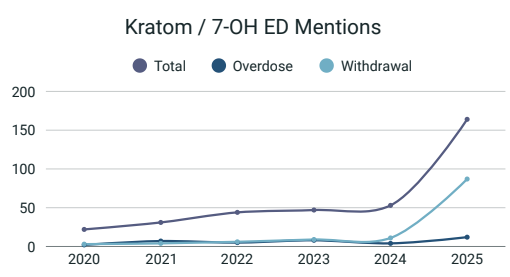
photo by: Overdose Response Strategy
This chart shows the rise in kratom-related emergency department visits in Kansas.
• • •
Here in Lawrence, health officials have been monitoring the prevalence of kratom sales, and they say the drug is easy to find at certain types of businesses.
Vicki Collie-Akers, director of policy and planning for Lawrence-Douglas County Public Health, said that in January and February of this year, health department staff did a small study of the availability of 7-OH in Lawrence. They went to 19 of the more than 80 businesses that are licensed under the city’s retail tobacco licensing program, she said, and checked to see if 7-OH was sold there.
The substance, she said, was present at 13 of the 19 shops sampled, or 68%.
“Our data suggested it was ubiquitous at vape/smoke shops, while it was sometimes present in gas stations/convenience stores, and not at all present in grocery stores,” Collie-Akers said.
Before July 1, she said, the health department will be reaching out to all of the 87 stores in the tobacco licensing program to explain the ban. They’ll also be offered flyers from DCCCA to inform their customers about what resources are available for quitting kratom-derived products.
Mayer said that effort has already begun and that retailers are getting on board.
“A lot of retailers we’ve reached out to have been receptive about having some treatment information,” she said.
Once the ban begins, Mayer said, health officials will continue checking at retail stores to see whether kratom products are for sale. “If we go in and see a product, we can inform law enforcement, hey, this product is still available on the shelf.”
Law enforcement agencies “have a lot of other things to worry about,” Mayer said, so “I’m hopeful that retailers will monitor themselves and pull the products by July 1.”
“But that’s something we’re going to be assessing,” she added.
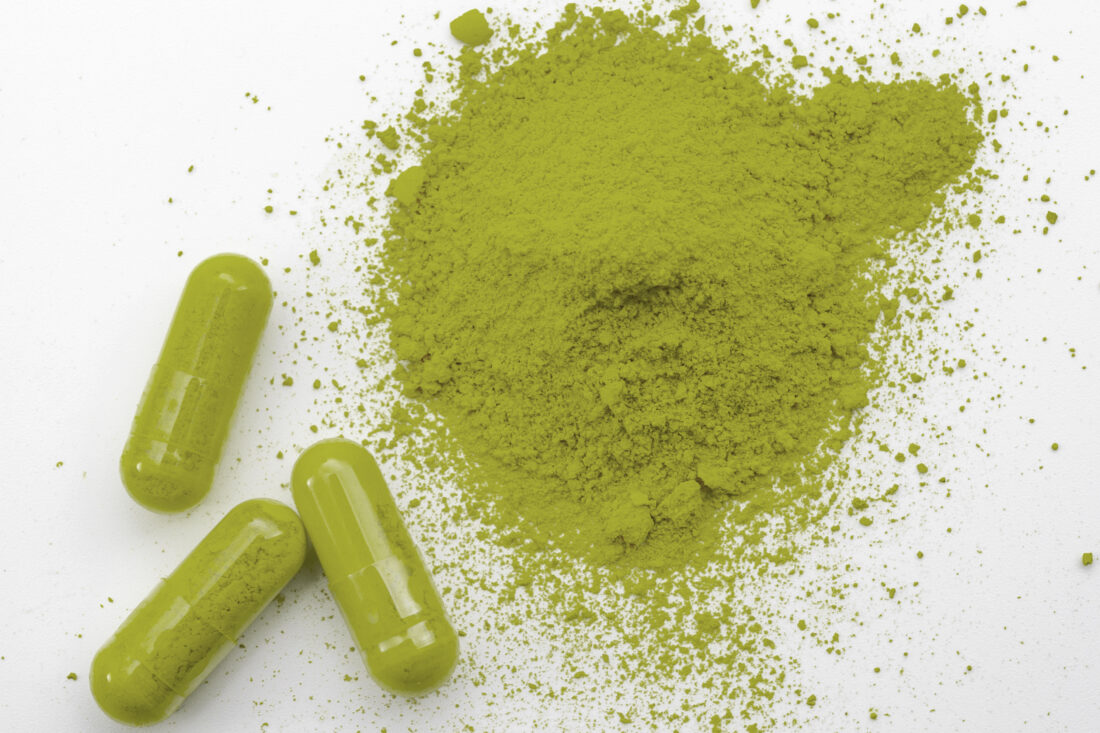
photo by: Adobe Stock
Kratom powder and capsules are shown in this undated photo.
• • •
For individuals who use kratom, the new ban could have legal consequences. And that might be a surprise to some people in Lawrence and Douglas County, based on how the justice systems here have handled another Schedule I drug: marijuana.
In 2019, the City of Lawrence and the Douglas County District Attorney’s Office both decided to begin treating people who possessed small amounts of marijuana more leniently. First, the Lawrence City Commission amended city ordinance to reduce fines for simple marijuana possession to $1 for the first and second convictions in municipal court. And then, under District Attorney Charles Branson, the DA’s Office stopped filing criminal cases for simple marijuana possession in Douglas County District Court. The two DAs who followed Branson, Suzanne Valdez and current DA Dakota Loomis, both kept this policy in place.
But Loomis told the Journal-World that’s not the approach the DA’s Office will take with kratom.
“Our office will review any affidavits submitted to us involving the possession of kratom or 7-OH products on a case-by-case basis and has no plans to make any carve outs or exceptions for these Schedule I substances,” Loomis told the Journal-World.
The Lawrence Police Department, for its part, is still working out the details of how it will enforce the law. Spokeswoman Laura McCabe said Chief Rich Lockhart met with DCCCA and Lawrence-Douglas County Public Health this past week, “and we will continue to partner with them to move toward a reasonable and strategic enforcement plan that has the community’s best interest at heart with education as priority.”
“When new laws are implemented, LKPD often works with community members who may be affected by the change to discover the best way to educate prior to taking enforcement action,” McCabe told the Journal-World. “Our goal is to proactively assist people in not breaking the law so they can avoid legal consequences.”
• • •
Legal issues aren’t the only problems users might face after the ban. There are also the effects on the body when a person suddenly stops using the drug.
“Kratom withdrawal can be really uncomfortable, pretty significantly painful,” Mayer said. Among the symptoms typically reported are sweating, nausea, vomiting, anxiety, muscle aches and trouble sleeping. They usually start within three to 24 hours after the person stops using the drug and can last for days or weeks.
For now, DCCCA is encouraging kratom users to talk to their physicians for help managing those symptoms, she said. Doctors can prescribe medications to reduce withdrawal symptoms and cravings, and can make sure that users get off the drug safely.
The big unknown right now is how many people will be coming to emergency departments and other treatment providers seeking care. Mayer said “we really don’t have a good baseline of what might be happening.”
“It’s just going to depend on, are people stockpiling?” she said. “Are we going to see the need right away after July 1, or is it going to be later on? Are people transitioning to different products? Are they turning to other substances?”
That last part, she said, is why DCCCA is working hard to get more naloxone into the community. Naloxone, commonly known by the brand name Narcan, is a lifesaving drug that can reverse an opioid overdose in progress (and it also works on kratom overdoses because of the similarities with opioids, Mayer said).
Naloxone is available for free at vending machines at several sites around the city, including the Lawrence Community Shelter, Heartland Community Health Center, the Homeless Resource Center and Lawrence Transit’s Central Station.
“A lot of the reason people turn to kratom is the pain management piece,” Mayer said. “And, so, will they turn to opioids or other street-level drugs? That’s why we’re trying to push out naloxone and make sure people are aware of naloxone resources in the county.”
If you need to get off kratom, Mayer said, DCCCA can help.
On Tuesdays, DCCCA has open access for walk-in assessments at its facility at 1739 E. 23rd St. The assessment will determine the level of treatment you need, whether that’s outpatient or a residential program. You can also find information about treatment on DCCCA’s website, dccca.org/kratom, or call the Statewide Substance Use Treatment Referral Line at 866-645-8216.
“What we want the public to know is it can really be dangerous to stop taking a product without the help of a healthcare professional or treatment provider,” Mayer said. “So we want to make sure people have the resources they need to be safe.”
State Government

Opinion: The Lawrence man seeking to break the power of Republican, Democratic parties this election
State tax receipts top estimate by $147M for quarter
TOPEKA — The state of Kansas collected $147 million more in taxes than anticipated during the first quarter of ...
Rep. Tracey Mann to skip candidate forum in Lawrence; spokesman scarce on details

Kobach, Mann debate criminal justice priorities at Tuesday event as they campaign in attorney general race

Kansas must count mail ballots that arrive three days after November election, appeals court rules