A new face in Douglas County DA’s office hopes to play a part in transforming criminal justice

photo by: Contributed
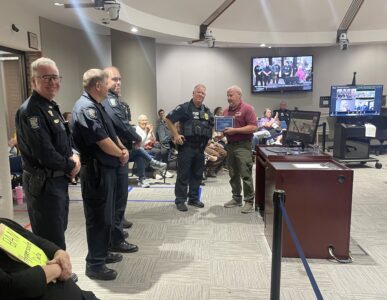
Senior Assistant District Attorney Jim Carpenter
The Douglas County District Attorney’s Office has hired a new prosecutor who will not prosecute.
Jim Carpenter, of Lawrence, joined the DA’s office in March as a senior assistant district attorney. Carpenter has spent most of his career working with families and people with mental health issues, but he had grown restless with the work he was doing in private practice in Wyandotte County.
In Douglas County, Carpenter is participating on behalf of the DA’s office in the specialty courts, which include the Behavioral Health Court, Drug Court and the Restorative Justice Initiative — growing programs that do not involve traditional prosecution.
While he is employed alongside a team of prosecutors and shares their title, Carpenter said his job involved more of an advocacy, rather than adversary, role for criminal offenders in the specialty courts. He has access to everything in a criminal case file, but instead of using those materials to prosecute offenders, he will work with other court advocates to keep people from going to jail. His work will include a kind of firewall within DA Suzanne Valdez’s office.
“We are screened off from what he is doing in the courts,” Valdez said. “Anything he learns as part of the multidisciplinary team in the court, he doesn’t share with us.”
‘Come work with us’
Carpenter wanted to spend his career defending the environment. He got his bachelor’s degree in biology and then a master’s in environmental studies before going to law school at the University of Florida in Gainesville, he said. His wife was working on a PhD in anthropology, and they had two kids in school, so he took the first job he could get, he said; that job didn’t involve the environment, but it taught him some valuable lessons.
“I ended up working for the Florida State Health and Rehabilitative Services. There, I was a staff attorney,” Carpenter said. “I was sworn in on a Wednesday and started work the next Monday, and on Tuesday I had 40 cases by myself in court. That’s how I started.”
Carpenter said his work in Florida representing families taught him to be agile as an attorney because he was representing clients in 14 counties and in front of 40 different judges, and he might be called day or night to meet with a client in jail.
His journey to Kansas came when his wife was offered a position with the University of Kansas. She took the job, and he landed a position with Kansas Legal Services in Wyandotte County in 1993, he said. He was hired to work on domestic violence cases under the then-new Violence Against Women Act.
It was with Kansas Legal Services in 1996 that he first met Valdez, then a new attorney.
“He trained me to be a lawyer,” Valdez said.m”He showed me around the courthouse and introduced me to judges and got me pretty well immersed in the community there, and I never forgot that.”
Carpenter left Kansas Legal Services to start his own law firm in 1998 and spent the next two decades doing divorce work, care-and-treatment cases and advocating for children in guardian ad litem cases.
Valdez never forgot how helpful and knowledgeable Carpenter was, and that’s why she thought to call on him recently, she said.
The two were talking on the phone, just catching up, when Valdez made Carpenter an interesting offer, he said.
“She said ‘come work with us,’ and I said I don’t like criminal law, and she said ‘No, come work with us and do everything but criminal law,” Carpenter said.
Valdez explained the nontraditional programs that Douglas County was building, and her pitch was enough for Carpenter to want to give it a try, he said.
Behavioral Health Court
The Behavioral Health Court, overseen by Douglas County District Judge Sally Pokorny, is meant to give people whose criminal behavior can be linked to a mental health problem a better shot at staying out of prison and out of future trouble.
The court is like an intensive probation program where instead of having a single probation officer to report to, participants have a dozen people from different community services that meet in a large group every week for more than a year.
As with probation, Behavioral Health Court participants are subject to random drug and alcohol screens, plus possible at-home searches. They are required to maintain employment and to give back to the community through volunteer opportunities. Unlike probation, if participants are successful in Behavioral Health Court, their charges are dropped and ultimately expunged.
“They waive their Fourth Amendment (search and seizure) right, but the flip side of that is that none of that can be used against them by the prosecution,” Carpenter said.
Carpenter said that completing the long court program was not easy. The community service team members all have a goal for the participants. Some team members focus on the mental health of the participants while others are concerned with housing or transportation needs to make sure the participants aren’t missing appointments or work, he said.
“I’m in there kind of as the hammer hanging over everyone’s head, you know, saying ‘Oh hey man, that’s enough, maybe they shouldn’t be in here,'” Carpenter said, of circumstances where Behavioral Health Court proves an unsuitable match for a particular person.
His 30 years working with mental health cases, families experiencing domestic abuse and children in the legal system have given him a good idea of what will work and what won’t when trying to stop a particular type of behavior, he said.
The Behavioral Health Court has had 46 people graduate from the program since it started in 2017, Carpenter said.

photo by: Chris Conde/Journal-World
These shadowboxes were created by a graduate of the Behavioral Health Court. The one on the left represents the graduate’s view of the world before going through the program and has a closed bird cage. The other represents how the person felt afterward — with an open cage and flying bird. The graduate wanted to remain anonymous since the criminal charges against the graduate have been dropped and expunged.
Drug Court
The Drug Court has had fewer graduates, with only six people successfully completing the program, but it started only in 2020, Carpenter noted. The court, overseen by Judge Kay Huff, has the same goal of an offender’s charges being dropped, but it comes with a caveat.
“They have to plead guilty at their first hearing in Drug Court and then agree to all of the terms of Drug Court,” Carpenter said.
Offenders struggling with addiction might have a harder time adhering to the rules of the program, and by entering a guilty plea at the start, the consequences for failure are higher than with the behavioral court, as an incentive to people to follow through, Carpenter said.
“I have seen the team bend over backwards to try and help someone get past a crisis. One time Judge Huff was very specific in saying ‘We’re not here to punish people for having a crisis; we’re here to help people get through it,'” Carpenter said.
Behavioral Health Court participants who fail will still face prosecution with a right to trial, while a participant in Drug Court will proceed straight to sentencing, Carpenter said. Some offenders might be better off taking their chances with the traditional court instead of entering such an intensive supervision program, he said.
If offenders complete the Drug Court program, their guilty pleas are withdrawn and their charges are dropped, Carpenter said.
Restorative justice
The restorative justice initiative, which has the goal of using mediation to work out a fitting form of justice, is still in its early stages in Douglas County, Carpenter said.
DA Valdez said that mediation under the restorative justice initiative is different from criminal mediation, which typically results in some form of punishment involving a guilty or no-contest plea followed by sentencing.
The mediation in the restorative justice process, by contrast, may result in the charges against a defendant being dropped altogether, depending on the wishes of the victim in the case, she said.
Carpenter said criminal mediation also doesn’t connect victims with offenders, while a main component of the restorative justice initiative is to give victims a significant voice in what type of remedy suits the crime; it may be that the victim really just wants to confront the defendant and explain how the defendant’s action hurt them and affected their life, he said.
“That’s proving a challenge just figuring out how to protect both the victim and a defendant’s rights,” Carpenter said.
The program hasn’t gotten much traction yet, but Carpenter said he looked forward to seeing it grow as the Lawrence community starts to understand and participate.
More to come
Carpenter said he agreed to join the DA’s team because of the growing emphasis in the culture to keep people out of jail and to put them on a path to success. One obstacle to that goal, he said, is a lack of sober-living and supportive-housing units in the county.
Carpenter, a member of the Lawrence-Douglas County Planning Commission, said he has watched as neighbors fought against sober-housing projects moving into their neighborhoods. One housing project he supported was finally approved despite the neighborhood’s concerns, and years later there haven’t been any complaints, he said.
“It’s all about how you get people talking the same language and moving in the same direction because everybody is coming at it with different points of view,” Carpenter said.
Making sure that people have a safe and sober-living space to support recovery instead of going to jail is vital to the success of people in these programs, Carpenter said.
While Carpenter has plenty on his plate at his new job, he still hopes to see another program get off the ground.
“The newest one we are talking about is Veterans Court. The first thing is to identify how many people with military service are actually in the criminal justice system in Douglas County,” Carpenter said.
The office is working to calculate how many veterans would qualify for a new program and how to get those people to participate. Sometimes, though, veterans who struggle with criminal behavior aren’t always forthcoming with their military history, he said.
“The county has started trying to reduce the jail population, and that continues to be the goal,” Carpenter said.
Specialty courts likely emerged, in part, as a reaction to the mandatory sentencing guidelines created by the Legislature, Carpenter speculated. The guidelines took significant power away from judges to weigh the severity of an individual case and created a system where a criminal charge comes with a blanket punishment instead of a punishment that may better fit the particular crime and circumstances, he said.
“To make the punishment more fitting and more appropriate, it’s justice as opposed to revenge; that’s why I am doing this. That’s the only reason I’d be in this office,” Carpenter said.
Public Safety
In domestic violence case, Lawrence woman is acquitted of 5 of 6 charges; jury finds her guilty of one misdemeanor
Man ordered to stand trial after friend testifies that night of drinking ended with a rape

24-year-old ordered to stand trial in connection with Lawrence mother’s drug death
Former LHS teacher admitted having sex with a sophomore 26 years ago, but a lot turns on whether she was 15 or 16 at the time
23-year-old man charged with second-degree murder in downtown Lawrence homicide