

Kansas justices hear arguments on whether defense attorneys did enough in Eudora day care worker’s murder case
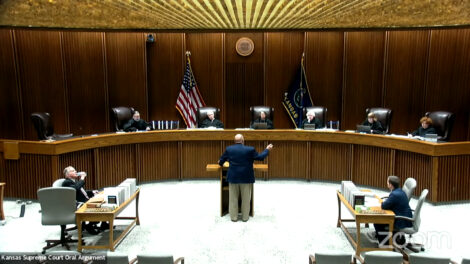
photo by: YouTube
William Skepnek, attorney for Carrody Buchhorn, stands before the Kansas Supreme Court during a review of Buchhorn's case. Buchhorn was convicted in 2018 in the death of 9-month-old Oliver “Ollie” Ortiz. Her conviction was overturned by the Kansas Court of Appeals, and the Douglas County district attorney’s office then asked the Supreme Court to review the appeals court’s decision.
Did the attorneys for a Eudora day care worker do enough to oppose a coroner’s theory of how a baby she was caring for died?
That’s the question Kansas Supreme Court justices grappled with — but did not decide — on Wednesday as they reviewed the case of Carrody Buchhorn, 47, of Eudora.
Buchhorn was convicted in 2018 of second-degree murder in the death of 9-month-old Oliver “Ollie” Ortiz. She was sentenced to more than 10 years in prison, but in August 2021 her conviction was overturned by the Kansas Court of Appeals, which said her counsel was deficient and ordered a new trial. The Douglas County District Attorney’s Office then asked the Supreme Court to review the appeals court’s decision.
Much of Wednesday’s review focused on two expert witnesses who testified at Buchhorn’s trial: then-Douglas County Coroner Erik Mitchell and Seattle-based forensic pathologist Carl Wigren.
At the trial, Mitchell laid out his theory of Oliver’s death: that it was instantaneous and caused by a blow to the head. As the Journal-World previously reported, the coroner testified that Oliver had a fractured skull caused by an incident forceful enough — not a drop, fall or the actions of another child — to render him unresponsive right away and, without intervention, dead within minutes.
Wigren, the defense’s expert witness, had a different theory. In his testimony, he said he believed that the injury that Oliver suffered was an old injury with signs of healing, and that it could not have been caused on the day Oliver died.
The big issue in the case now is whether Buchhorn’s trial attorneys, Paul Morrison and Veronica Dersch, did enough to poke holes in Mitchell’s theory of how Oliver died — particularly in Mitchell’s “electrical interruption theory,” which involves the “depolarization” of neurons and which was used to explain a death from a head injury that did not also dramatically injure the brain.
Attorney William J. Skepnek, who has been representing Buchhorn throughout the appeal process, argued Wednesday that Morrison knew the coroner’s theory was “gobbledygook” and failed to adequately convey that to the jury, leading them to convict Buchhorn.
Deputy Solicitor General Kristafer Ailslieger, who was presenting the case for the Douglas County district attorney, argued that Buchhorn’s trial attorneys met their obligations in offering Wigren’s expert opinion, which presented a reasonable alternative for the jury to consider, even though it did not specifically address the scientific validity of a depolarization theory.
Ailslieger noted that the standard for determining ineffective assistance of counsel, as outlined in the U.S. Supreme Court case Strickland v. Washington, is whether an attorney’s performance fell below an objective standard of reasonableness and whether that performance gave rise to a reasonable probability that if counsel had performed adequately, the result would have been different.
“They just lost the case,” he said of the trial defense attorneys, “and losing does not make you deficient.”
The Kansas Supreme Court will issue its ruling at a later date.
Public Safety
Former LHS teacher admitted having sex with a sophomore 26 years ago, but a lot turns on whether she was 15 or 16 at the time

23-year-old man charged with second-degree murder in downtown Lawrence homicide
Lawrence Police Department receives KDOT’s top traffic safety award for second straight year

Police arrest 23-year-old on suspicion of first-degree murder in downtown Lawrence homicide
At domestic violence trial, Douglas County jurors will decide whether woman was the abuser or the victim